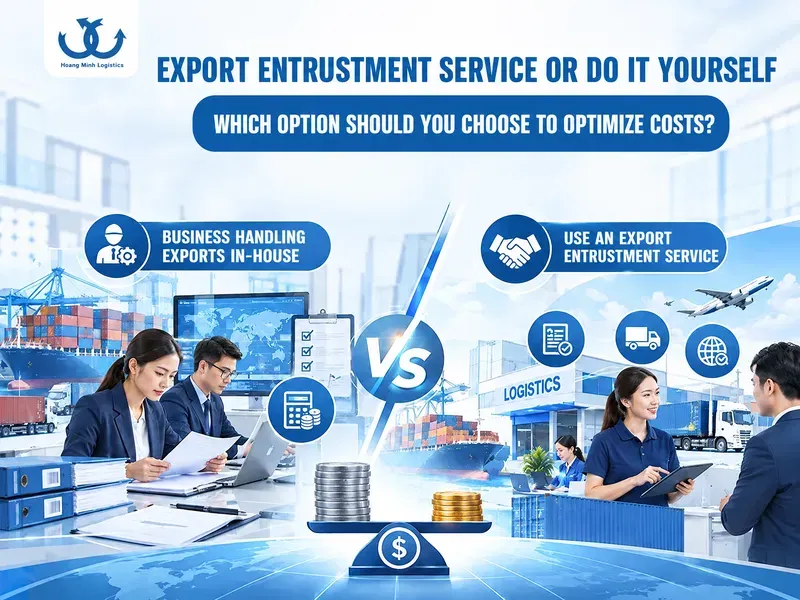
Coffee export entrustment is becoming an increasingly popular choice for Vietnamese businesses seeking to access international markets but lacking sufficient resources to handle the process independently. As an agricultural product with strict requirements on quality, documentation, and logistics, partnering with a professional export entrustment service provider helps businesses minimize risks and optimize operational efficiency.
>>>View more: Agricultural Exports
1. What is coffee export entrustment?
Export entrustment, in general, and coffee export entrustment in particular, is a form of cooperation in which the goods owner (the entrusting party) hires a legally authorized exporter (the entrusted party) to act on its behalf in carrying out export activities.
In simple terms, the business does not directly export the goods but leverages the legal entity, experience, and operational system of the entrusted party to complete the export process legally and efficiently.
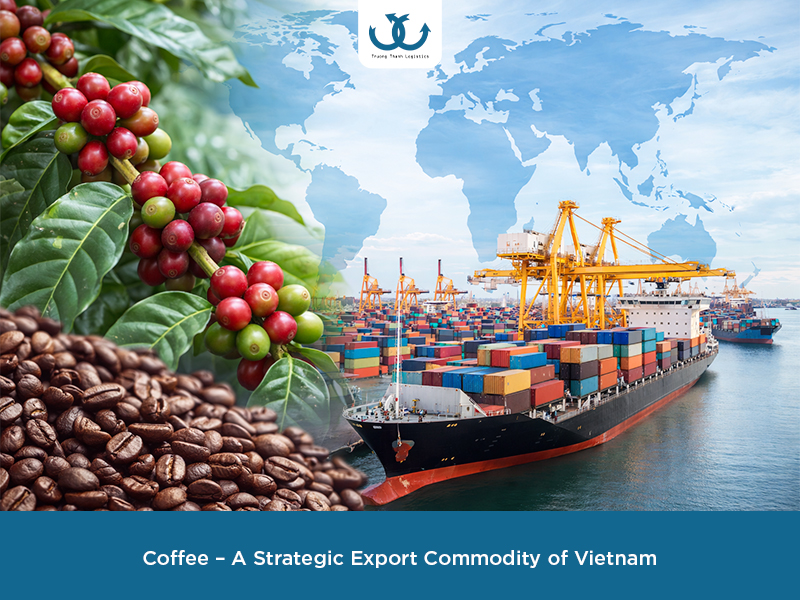
The nature of coffee export entrustment
Essentially, this is a representative commercial service. The entrusted party will:
- Act as the exporter of record on export documents
- Work directly with foreign buyers
- Handle all relevant legal and regulatory procedures
However, ownership of the goods and the resulting profits remain with the entrusting party. The entrusted party only charges a service fee as agreed.
Common forms of coffee export entrustment
Depending on business needs, companies may choose:
Full entrustment:
The entrusted party handles the entire process:
- Sourcing/negotiating with buyers (if required)
- Signing international sales contracts
- Preparing documentation
- Handling customs procedures
- Managing transportation and payment
Partial entrustment:
If the business already has a foreign buyer, it may only outsource:
- Export procedures
- Documentation
- Logistics
Roles of the parties involved
Entrusting party (coffee business):
- Provide export-standard products (green beans, roasted, instant coffee, etc.)
- Ensure quality, packaging, and traceability
- Supply necessary information and coordination
Entrusted party (logistics/import-export company):
- Act as the legal exporter
- Prepare complete documentation
- Work with customs authorities and carriers
- Receive and process international payments
Differences from direct exporting
| Criteria | Export Entrustment | Direct Export |
| Export legal entity | Not required | Required |
| Experience | Not mandatory | Requires specialized team |
| Legal risk | Lower | Fully borne by the business |
| Operational cost | Lower initially | Higher (self-managed) |
When should businesses choose export entrustment?
Businesses should consider this model when:
- They lack export licenses or experience
- They want to test new markets with lower costs
- They do not yet have an in-house export department
- They need to save time and reduce risks
2. Procedures for coffee export entrustment
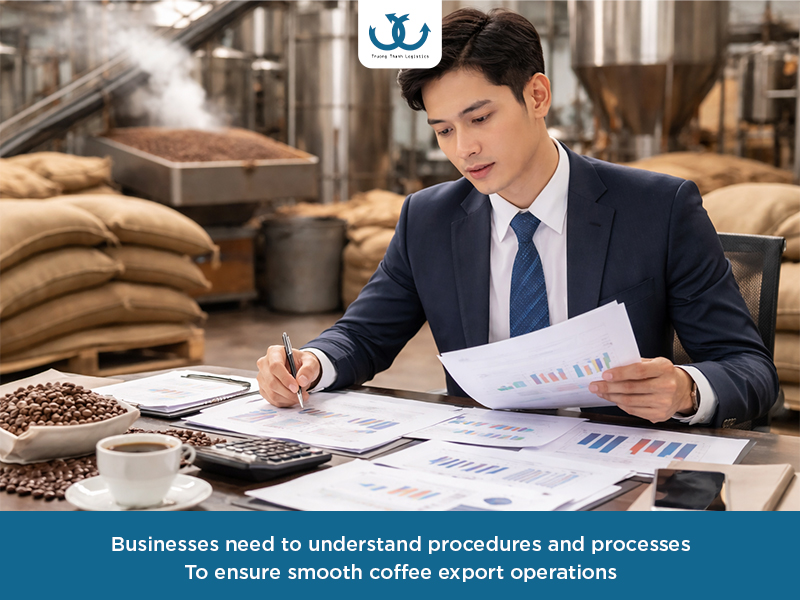
To ensure a smooth export process and minimize risks, businesses must understand the required procedures, from legal documentation to goods preparation.
2.1. Signing the export entrustment contract
This contract is the most critical legal basis, clearly defining the rights and obligations of both parties.
Key contents include:
- Legal information of both parties
- Product description (Robusta, Arabica, roasted, instant, etc.), specifications, and quality standards
- Quantity and unit price (if applicable)
- Entrustment fee (percentage or fixed amount)
- Delivery terms (FOB, CIF, etc.)
- Payment methods (T/T, L/C, etc.)
- Responsibilities at each stage (documentation, transportation, risk allocation)
- Timeline and penalty clauses
Note: The contract must clearly define liability in case of issues (returned goods, delays, document errors, etc.).
2.2. Preparing legal documentation
Even though the business does not export directly, it must provide documents to prove the legality of the goods:
- Business registration certificate
- Tax identification number
- Domestic sales contracts (if applicable)
- Documents proving origin of coffee (farm, supplier, etc.)
Proper documentation helps:
- Avoid suspicion regarding product origin
- Facilitate obtaining required certifications
2.3. Preparing export-standard goods
This is a critical step, especially for agricultural products like coffee.
Businesses must ensure:
- Moisture content meets standards (usually ≤ 12.5%)
- No impurities or mold contamination
- Proper classification (green beans, roasted, instant)
- Correct packaging (jute bags, PP bags, containers)
Some markets may also require:
- Food safety certification
- Organic certification
- Sustainability certifications (Rainforest Alliance, Fairtrade, etc.)
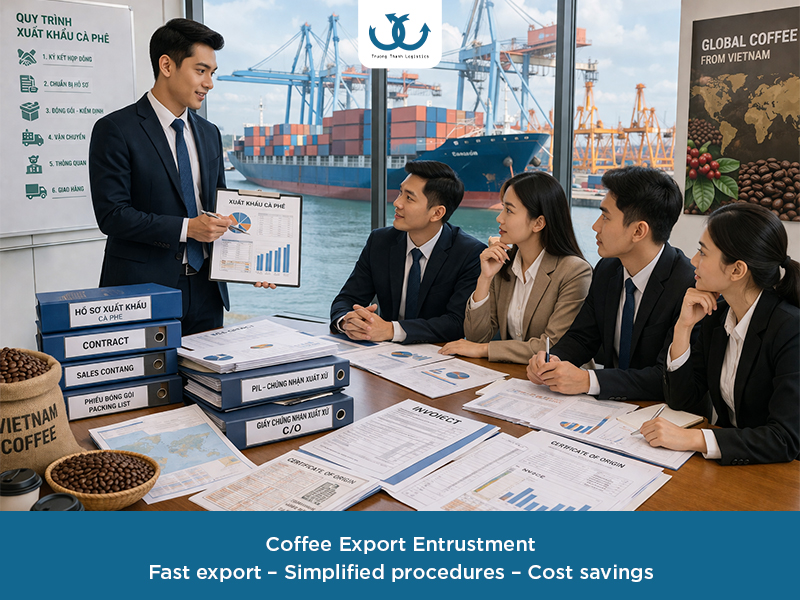
2.4. Preparing export documentation
Documentation is the backbone of the export process. Even minor errors can cause delays or rejection.
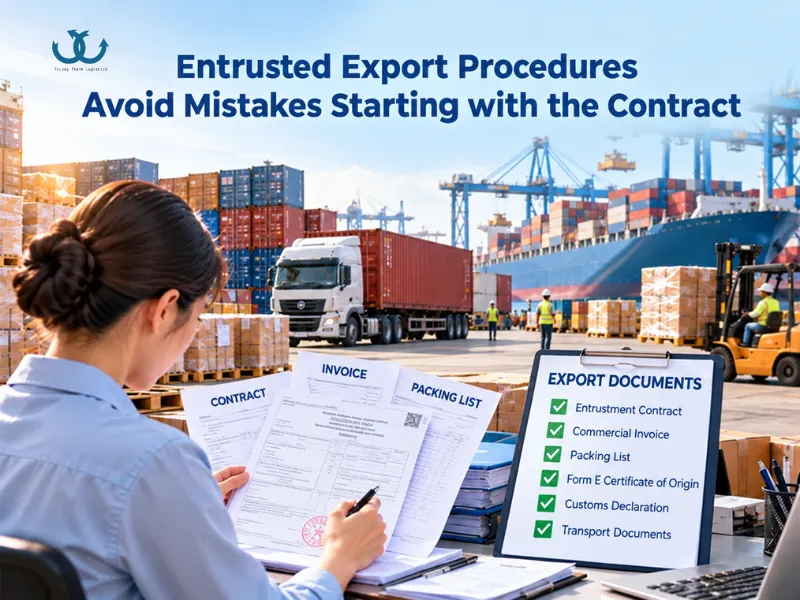
Key documents include:
- Commercial Invoice
- Packing List
- Bill of Lading
- Certificate of Origin (C/O)
- Phytosanitary Certificate
Depending on the market:
- Certificate of Quality
- Fumigation Certificate may also be required
Note: All document details must be fully consistent (product name, quantity, weight, dates, etc.).
2.5. Customs declaration and export clearance
The entrusted party will:
- Submit electronic customs declarations
- Provide all required documentation
- Handle inspections (if any)
- Complete customs clearance
This step requires:
- Strong knowledge of customs regulations
- Quick handling of unexpected issues
Accurate documentation significantly shortens clearance time.
2.6. International transportation
After clearance:
- Goods are containerized
- Transported to port
- Shipped via the selected route (typically sea transport)
The entrusted party will:
- Book shipping space
- Monitor shipment schedules
- Track cargo status
2.7. Payment and settlement
This final step directly impacts cash flow.
Typical process:
- The foreign buyer pays the entrusted party
- The entrusted party reconciles accounts
- Service fees and related costs are deducted
- Remaining funds are transferred to the business
Businesses should clarify:
- Payment timeline
- Exchange rate applied
- Deducted fees
3. Coffee export entrustment process
The export entrustment process is not just a sequence of technical steps but a coordinated system involving the business, the entrusted party, foreign partners, carriers, and customs authorities.
Typical steps include:
- Consultation & requirement assessment
- Signing entrustment contract
- Signing international sales contract
- Document preparation
- Customs clearance & shipping
- Payment & settlement
4. Key considerations in coffee export entrustment
While entrustment simplifies operations, risks can still arise if not properly managed.
Businesses should pay attention to:
- Choosing a reputable and experienced partner
- Strict quality control (moisture, impurities, compliance)
- Transparent cost structure
- Clear understanding of Incoterms (FOB, CIF, etc.)
- Avoiding documentation errors
5. Comprehensive coffee export entrustment solution from Truong Thanh Logistics
In today’s highly competitive export market, choosing an entrustment partner is not just about handling procedures—it requires a strategic partner.
Truong Thanh Logistics provides end-to-end coffee export entrustment solutions, enabling businesses to manage the entire process efficiently.
5.1. Tailored export strategy consulting
- Product analysis (green, roasted, instant coffee)
- Market orientation (EU, US, Middle East, Asia)
- Cost-optimized Incoterms selection
- Logistics planning based on volume and timeline
5.2. Legal representation & full export handling
- Preparation of international contracts
- Customs declaration
- Coordination with authorities
- Issue resolution
5.3. Documentation standardization
- Invoice & Packing List preparation
- Proper C/O issuance
- Phytosanitary support
- Accuracy and consistency assurance
5.4. Optimized logistics solutions
- Route optimization (cost vs. time)
- Stable shipping bookings
- Proper container handling for coffee
- Continuous shipment tracking
5.5. Financial transparency
- Detailed cost breakdown
- No hidden fees
- Clear reconciliation process
- Fast fund transfer
5.6. Quality and compliance support
- Market-specific quality standards consulting
- Moisture and packaging guidance
- Risk alerts (food safety, quarantine)
5.7. Long-term partnership approach
- Performance tracking per shipment
- Process improvement consulting
- Market expansion support
- Continuous regulatory updates
Truong Thanh Logistics not only helps businesses “export successfully” but also builds sustainable export capabilities.
Coffee export entrustment is an effective solution that enables businesses to quickly access international markets, reduce risks, and optimize resources. In an increasingly competitive global environment, choosing the right entrustment partner is the key to enhancing export capacity and achieving sustainable growth.
Trường Thành Logistics – Professional & Dedicated
Hotline: +84 915 36 38 39
Head Office: 5th Floor, Tower A, Song Da Building, Pham Hung Street, Tu Liem Ward, Hanoi, Vietnam.
Email: sale@truongthanhjsc.com
info@truongthanhlogistics.com
Website: https://truongthanhlogistics.com
HAI PHONG BRANCH
Address: Room C103, TTC Building, 630 Le Thanh Tong Street, Hai An Ward, Hai Phong City, Vietnam.
DA NANG BRANCH
Address: 126 Chau Thi Vinh Te Street, Ngu Hanh Son Ward, Da Nang City, Vietnam.
HO CHI MINH CITY BRANCH
Address: Room 41, 4th Floor, Casanova Building, 85 Nguyen Son Street, Phu Thanh Ward, Ho Chi Minh City, Vietnam