International shipping by sea, air, or road? Compare by cargo type, budget, and timeframe to choose the right method for your shipment.
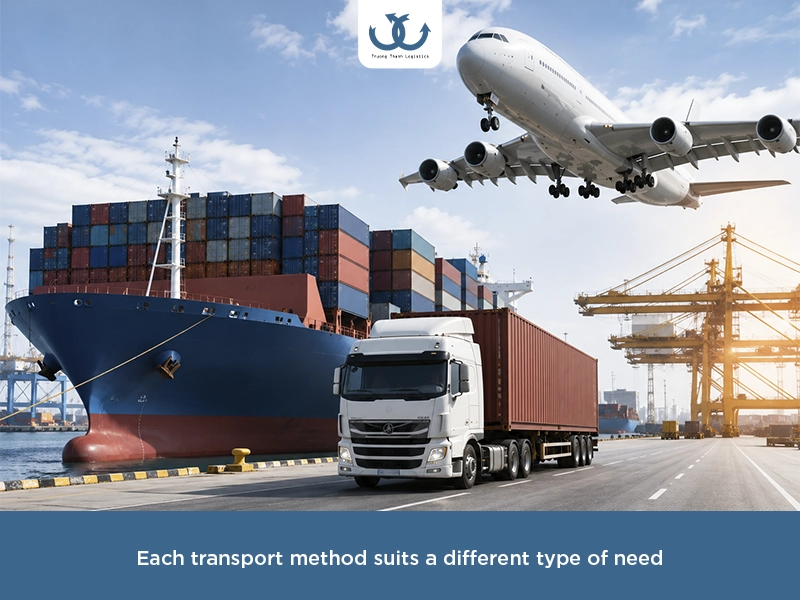
There’s no single answer to “which method should I use to ship internationally” that works for every shipment – it depends on three factors: the type of goods, your budget and your required timeframe.
Rather than simply listing the transport options available, this article from Truong Thanh Logistics helps you weigh these three factors directly to choose the right method for your specific shipment.
1. Three factors that determine which method to choose
- Type of goods: Bulky, heavy cargo with a lower value per unit (machinery, raw materials, furniture) is better suited to sea freight. Small, high-value cargo, or shipments that need to arrive urgently (electronic components, seasonal fashion goods, samples) are better suited to air freight.
- Budget: Sea freight typically costs significantly less per unit of cargo than air freight, especially for large shipments.
- Required timeframe: Air freight is measured in days, while sea freight takes anywhere from a week to over a month depending on the route. If your shipment has a tight delivery deadline, the higher cost of air freight may still be worth it compared to the risk of a late delivery.
Other factors to consider beyond the three main ones
- Delivery terms (Incoterms): If the contract is FOB/EXW, the buyer is responsible for choosing the main transport method, so this needs to be discussed with your partner in advance.
- Special characteristics of the goods: Perishable goods (fresh food), dangerous goods, and high-value goods all have their own requirements that affect which method to choose – not simply a matter of cost and time.
- Cargo insurance: Premiums can differ between methods, so factor this into your total cost comparison.
2. Quick comparison of international transport methods
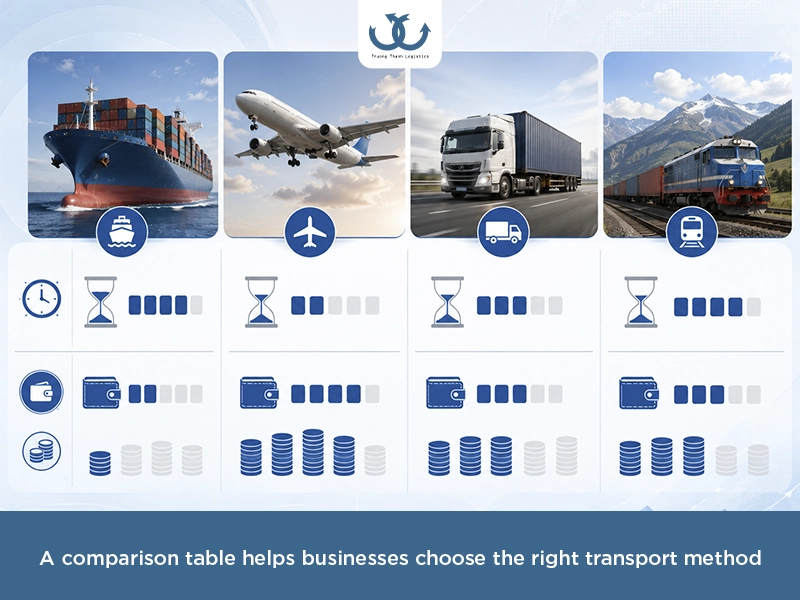
| Method | Best suited for | Typical transit time | Cost per unit | Limitations |
| Sea | Bulky, heavy cargo, not urgent | 1 – 6 weeks depending on route | Low | Long transit time, dependent on sailing schedules |
| Air | Small, high-value cargo needing urgent delivery | 1 – 5 days | High | Size/weight limits; not suited to bulky cargo |
| Road | Shipments to bordering countries (China, Laos, Cambodia) | A few days | Medium | Limited geographic range |
| Rail | Bulky cargo on routes with international rail links | Between sea and road | Medium | Depends on infrastructure; connecting routes still limited |
(The table above is for general reference – actual time and cost depend on the specific route, carrier, and time of year.)
3. A few real – world scenarios to consider
- Importing large industrial machinery/equipment: almost always sea freight, since air freight is both expensive and constrained by size/weight limits that are hard to meet.
- Exporting samples or urgent replacement parts: choose air freight despite the higher cost, since time is the deciding factor in this situation.
- Shipping moderate volumes to China, Laos, or Cambodia: road transport is often a good balance of cost and time, since you’re not waiting on a sailing or flight schedule.
- A shipment that needs to be both fast and cost-effective: consider splitting it – the urgent portion by air, the rest by sea – depending on how time-sensitive each part actually is.
4. Frequently asked questions about international shipping
Can multiple transport methods be combined for the same shipment?
Ye. This is called multimodal transport, for example combining sea freight with road transport to move goods from the port to the final receiving warehouse. This is a common arrangement, not an exception.
Is air freight always faster than sea freight?
In terms of flight time, yes, but the overall timeframe also depends on the frequency of flights/sailings on the specific route, customs processing time at both ends, and the domestic transport time from the airport/port to the receiving warehouse.
For a small business with a small shipment, which method optimizes cost best?
For a shipment too small to fill a full container, consider LCL (less-than-container load) sea freight to optimize cost, rather than waiting to accumulate enough cargo for a full container.
5. Truong Thanh Logistics – Expert guidance on choosing the right international shipping method
Truong Thanh Logistics offers the full range of international freight transport (sea, air, and road) and provides free advice to help businesses choose the right method based on the type of goods, budget, and timeframe of each specific shipment.
If your business is unsure which international shipping method is best for your next shipment, contact Truongng Thanh Logistics today for expert advice.
Trường Thành Logistics – Professional & Dedicated
Hotline: +84 915 36 38 39
Head Office: 5th Floor, Tower A, Song Da Building, Pham Hung Street, Tu Liem Ward, Hanoi, Vietnam.
Email: sale@truongthanhjsc.com
info@truongthanhlogistics.com
Website: https://truongthanhlogistics.com
HAI PHONG BRANCH
Address: Room C103, TTC Building, 630 Le Thanh Tong Street, Hai An Ward, Hai Phong City, Vietnam.
DA NANG BRANCH
Address: 126 Chau Thi Vinh Te Street, Ngu Hanh Son Ward, Da Nang City, Vietnam.
HO CHI MINH CITY BRANCH
Address: Room 41, 4th Floor, Casanova Building, 85 Nguyen Son Street, Phu Thanh Ward, Ho Chi Minh City, Vietnam
Fanpage: TRƯỜNG THÀNH LOGISTICS
You can also read Import – export procedures: A complete process guide for beginners to understand the full process before and after the transport step.
Note: This article is for general reference. Actual transit times, costs, and routes may vary depending on timing; businesses should contact Truong Thanh Logistics directly for a quote and advice specific to their shipment.