Automotive spare parts export procedures involve several points to consider because this product category covers a wide range of items with different structures, functions, and technical requirements. Some products can be exported as ordinary goods, while others may require additional checks on management policies and import regulations in the destination market. What requirements should businesses start with?
Requirements for Exporting Automotive Spare Parts
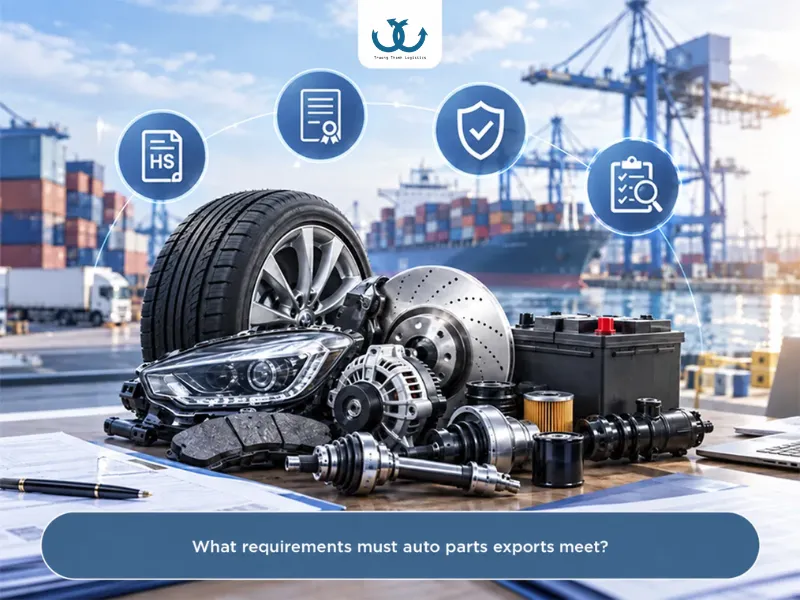
In general, automotive spare parts exported from Vietnam are handled as ordinary goods, except for products subject to export bans, temporary suspension, licensing requirements, or specialized management regulations. Businesses need to correctly determine the HS code, whether the goods are new or used, and their origin, while checking requirements on standards, labeling, technical safety, and environmental regulations in the importing country.
HS Codes for Automotive Spare Parts
Automotive spare parts are not classified under a single chapter. These products are classified based on their structure and function and may fall under Chapters 40, 70, 84, 85, or 87 of Vietnam’s List of Imports and Exports. In addition, engines, pumps, filters, and electrical equipment are often classified under Chapter 84 or 85 according to the Notes to Section XVII.
| HS Group | Reference Description |
| 8708 | Parts and accessories of motor vehicles (brakes, gearboxes, wheels, shock absorbers, airbags) |
| 8707 | Bodies and cabs |
| 4011 | New pneumatic rubber tires |
| 8511 and 8512 | Ignition, starting, lighting, and signaling equipment |
| 8409 and 8483 | Engine parts and transmission shafts |
| 8421 | Oil filters, fuel filters, and air filters |
| 7007 and 7009 | Safety glass and rear-view mirrors |
| 8507 | Batteries |
What Documents Are Required for Automotive Spare Parts Export Procedures?
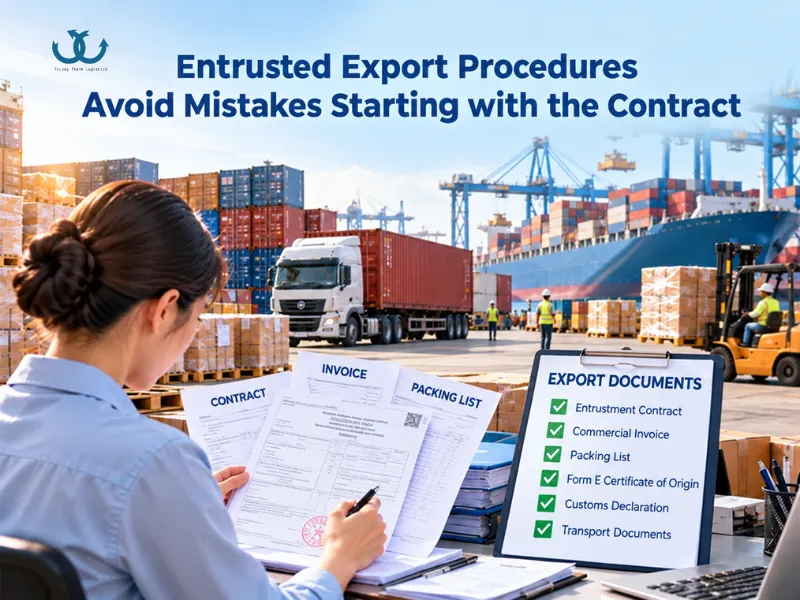
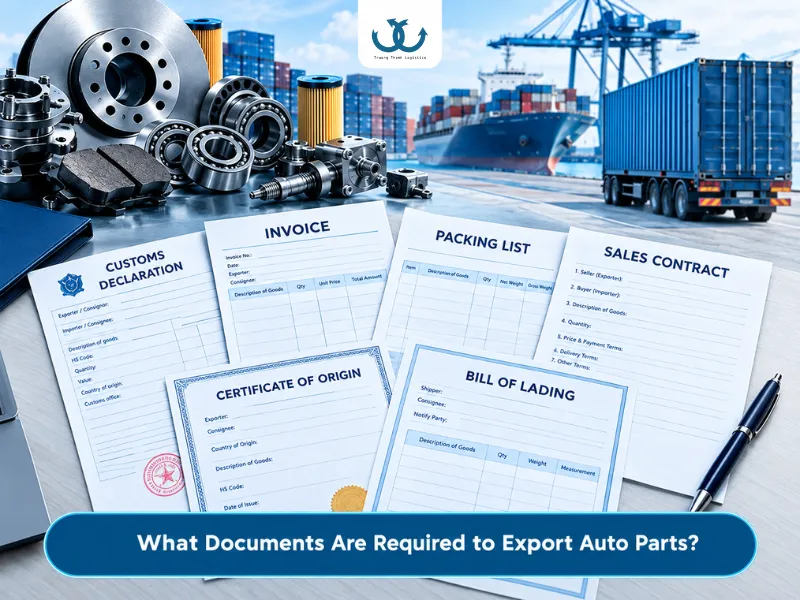
The automotive spare parts export documentation should be prepared based on the characteristics of the shipment, transportation method, and requirements of the destination market. In general, businesses need documents for customs declaration, commercial transactions, and cargo transportation.
Basic Documents
- Export customs declaration: Contains shipment information such as HS code, product description, quantity, value, origin, and other relevant details.
- Commercial Invoice: Shows the value of the goods, unit price, total amount, and delivery terms.
- Packing List: Specifies the number of packages, packing method, weight, dimensions, and distribution of the goods.
- Sales Contract: Sets out the terms and conditions agreed between the exporter and the overseas buyer.
- Bill of Lading (B/L) or Air Waybill: Issued by the carrier to confirm receipt and transportation of the shipment.
Documents Required Depending on the Shipment
- C/O (Certificate of Origin): Certifies the origin of the goods and is often required to obtain preferential tariffs under FTAs or comply with import regulations in the destination country.
- Quality and technical documents: May include CQ/CA, catalogs, technical specifications, or specialized certificates if the goods are subject to specific regulations.
- Insurance documents: Required when the delivery terms or contract require the exporter to purchase insurance for the shipment.
- Fumigation Certificate: May be required when wooden packaging, pallets, or wooden dunnage are used and are subject to treatment requirements in the destination country.
Automotive Spare Parts Export Procedures
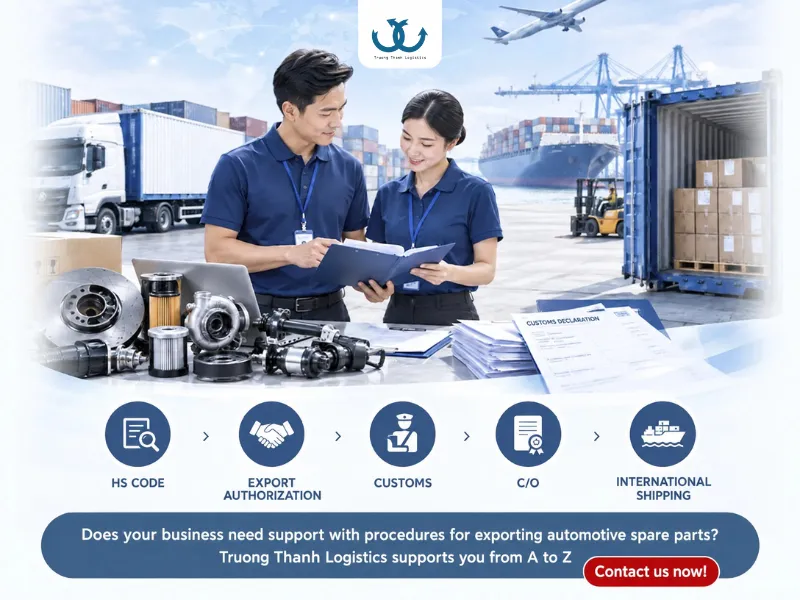
The automotive spare parts export process consists of 5 main steps. Businesses should review shipment information from the beginning to minimize the risk of incorrect HS codes, missing documents, or issues after the goods have been delivered to the port.
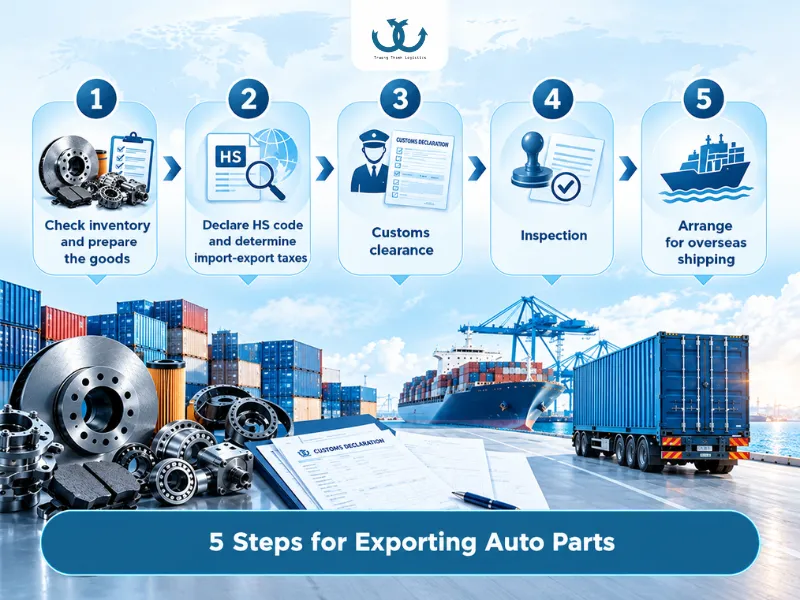
Step 1: Check the Goods and Prepare Documents
First, businesses need to clearly identify the spare part name, part number, product condition, quantity, and manufacturer information. Based on this information, prepare the sales contract, commercial invoice, packing list, bill of lading, and additional documents such as C/O, technical documents, or specialized certificates if required.
Step 2: Determine the HS Code and Export Policy
Businesses should determine the appropriate HS code based on the product’s structure, materials, and function. At the same time, they should check Vietnam’s export regulations and import requirements in the destination country, particularly for used goods or products subject to specific technical, quality, or environmental requirements.
Step 3: Declare and Submit the Customs Declaration
Once the documents are complete, businesses declare shipment information through the electronic customs system, including the HS code, quantity, value, origin, and other relevant details. After submission, the declaration will be assigned to a green, yellow, or red channel, corresponding to different levels of customs inspection.
Step 4: Complete Customs Clearance
Depending on the channel result, businesses must fulfill customs requirements such as presenting or supplementing documents or submitting the goods for physical inspection. Once the documents and goods meet the requirements, businesses complete the relevant tax and fee obligations to obtain customs clearance.
Step 5: Ship the Goods Overseas
After customs clearance, businesses coordinate with shipping lines, airlines, or logistics providers to move the goods into the customs supervision area and complete the Export Procedures for Goods. Finally, the business provides the necessary documents to the carrier and overseas partner to complete the international delivery process.
0% VAT and Invoicing for Exported Automotive Spare Parts
Exported automotive spare parts may be subject to 0% VAT if the conditions under Article 18 of Decree No. 181/2025/ND-CP are satisfied.
Businesses need to have a contract, non-cash payment documents, and a completed customs declaration. All relevant records, invoices, and supporting documents should be retained to demonstrate eligibility for the 0% VAT rate and to declare or claim input VAT refunds where applicable.
Truong Thanh Logistics Provides Comprehensive Automotive Spare Parts Export Services
For businesses that are not yet able to directly act as exporters or do not have dedicated export personnel, Trường Thành Logistics provides comprehensive support for each shipment, from checking applicable policies to customs clearance and international transportation.
- HS code consultation: Review spare part information, determine the appropriate HS code, and check export policies.
- Export Entrustment Services: Handle export procedures on a shipment-by-shipment basis for businesses that cannot directly act as the exporter.
- Customs declaration: Guide document preparation, submit customs declarations, handle channel assignment, and coordinate physical inspection when required.
- C/O support: Advise on the appropriate C/O form and prepare the application documents when required.
- International transportation: Coordinate multimodal transportation to Japan, Singapore, Malaysia, China, the United States, France, and other markets.
- Shipment tracking: Coordinate the process from receiving shipment information and customs clearance to transportation and document handover.
Frequently Asked Questions About Automotive Spare Parts Export Procedures
Do Automotive Spare Parts Require an Export License?
New automotive spare parts (100% new) generally do not require an export license when exported from Vietnam, except for certain special cases involving military-controlled goods or restricted exports.
What Procedures Are Required to Export Automotive Spare Parts to China?
Exporting automotive spare parts from Vietnam to China requires standard commercial export procedures, including preparing the sales contract, completing customs declaration procedures in Vietnam, preparing transportation documents, and coordinating with the importer to complete import customs clearance procedures in China.
Is a C/O Required When Exporting Automotive Spare Parts to Japan?
A C/O (Certificate of Origin) is not generally mandatory when exporting automotive spare parts to Japan, unless the Japanese importer requires it to claim preferential tariff treatment under applicable Free Trade Agreements (FTAs).
What Should Businesses Consider Regarding Labeling and Standards When Exporting Automotive Spare Parts to the US?
When exporting automotive spare parts to the US, labels should generally be in English and include the product name, country of origin, manufacturer, product code, and safety instructions. Businesses should check the requirements of CBP, NHTSA, and applicable FMVSS standards. Parts related to vehicle emissions may also be subject to EPA requirements.
Businesses that properly follow automotive spare parts export procedures can take greater control of document preparation and the process of shipping goods overseas.
If your business does not yet have dedicated export personnel, you can choose Trường Thành Logistics to receive support with document preparation, customs declaration, and international transportation on a shipment-by-shipment basis.
Truong Thanh Logistics – Professional and Dedicated
Hotline: 0915 36 38 39
Head Office: 5th Floor, Tower A, Song Da Building, Pham Hung Street, Tu Liem Ward, Hanoi.
Email: sale@truongthanhjsc.com / info@truongthanhlogistics.com
Website: https://truongthanhlogistics.com/en/
HAI PHONG BRANCH
Address: Room C103, TTC Building, 630 Le Thanh Tong Street, Hai An, Hai Phong
DA NANG BRANCH
Address: 126 Chau Thi Vinh Te Street, Ngu Hanh Son Ward, Da Nang City
HO CHI MINH CITY BRANCH
Address: Room 41, 4th Floor, Casanova Building, 85 Nguyen Son Street, Phu Thanh Ward, Ho Chi Minh City
Fanpage: TRUONG THANH LOGISTICS