Import – export procedures: what steps are involved, from signing the contract to delivery? This overview helps new businesses grasp the whole process and find the right detailed guide for each step.
For businesses new to import-export, the hardest part usually isn’t any single step – it’s not being able to see the big picture: not knowing which stage you’re at, what comes next, or where to look for detailed guidance when a question comes up.
This article from Truong Thanh Logistics acts as an overview map: it walks through each main stage of the import – export process and points you to the right in-depth guide already published on the site for each one.
Import – export procedure workflow
1. Negotiate and sign the foreign trade contract
The first step is agreeing with your partner on the goods, quantity, price, delivery terms under Incoterms (FOB, CIF, EXW…), and payment method. This is the foundational step, since most problems that arise later (who covers transport costs, who handles customs at the destination) usually trace back to a contract that wasn’t clear from the start.
2. Determine the HS code and applicable product policy
The HS code determines the duty rate, the management policy (whether a license or specialized inspection is required), and even which type of C/O can be applied for. This is also the step most prone to error – many tax disputes and shipment delays trace back to an incorrect HS code from the very beginning.
Learn more: 6 Rules of Goods Classification (HS Code Application) – especially important for products with complex construction (components, parts, or products assembled from multiple materials).
3. Prepare the import-export document set
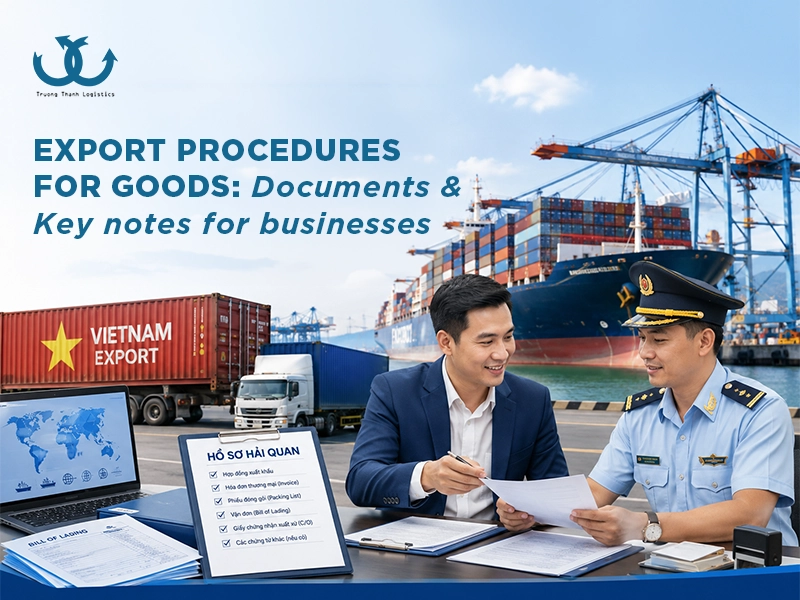
The basic documents most shipments need: sales contract, commercial invoice, packing list, and bill of lading/airway bill.
Some specific goods (timber, food, medical devices, dangerous goods…) require additional specialized documents – if your product falls into one of these categories, look for the dedicated guide for that specific product on the site rather than applying a generic document set.
4. Apply for a Certificate of Origin (C/O) if needed
If your partner wants to claim a preferential import duty under a free trade agreement (FTA), you’ll need to apply for the right type of C/O.
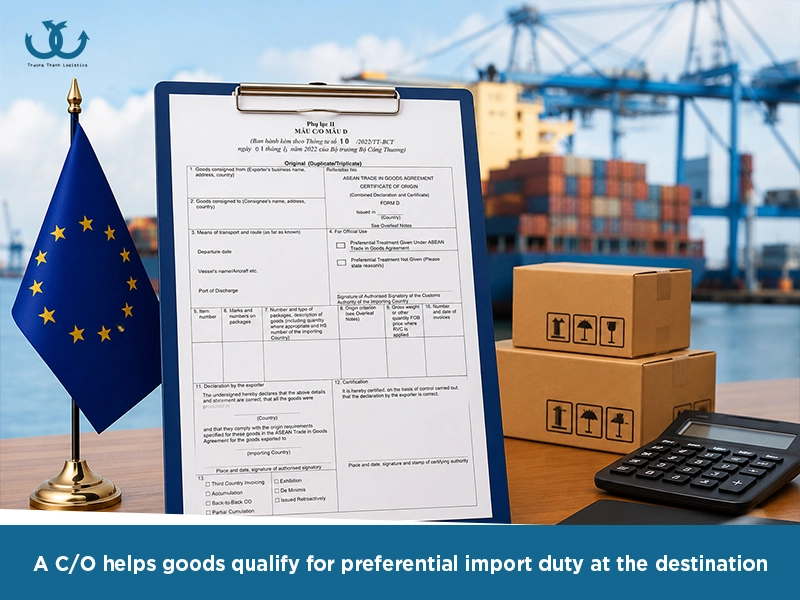
5. Customs declaration
Once you have the complete document set, the next step is filing the electronic customs declaration through the VNACCS system. Depending on the inspection channel result (green, yellow, red), the shipment either clears directly or requires additional documents/goods inspection.
Learn more: Comprehensive customs declaration service – including how to distinguish between customs brokerage and a licensed customs agent.
6. International transport
Alongside or after clearance, you’ll need to choose the right transport mode (sea, air or road) depending on the type of goods, budget, and required timeframe.
Choosing how to handle import – export procedures: In-house, brokerage or entrustment?
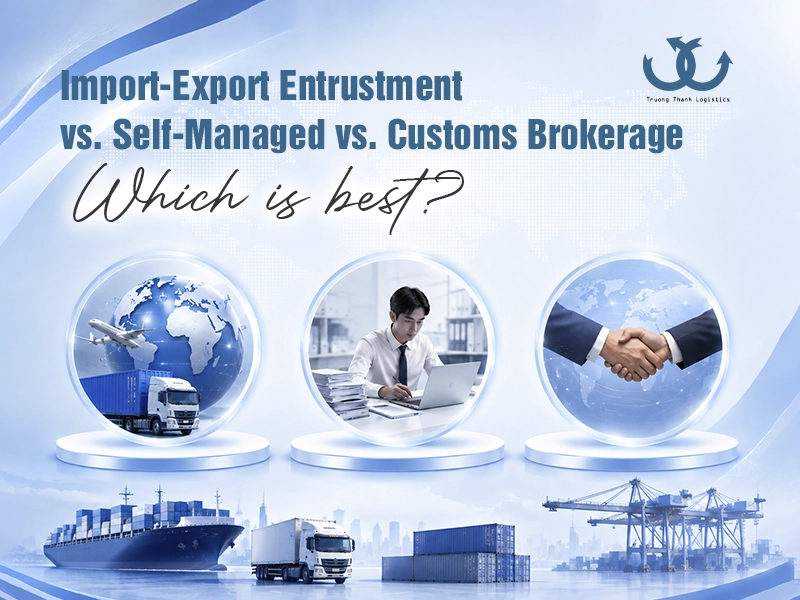
Before diving into the steps above, there’s an important decision to make early: will your business handle everything in-house, hire a customs brokerage, or entrust the entire process to a specialized company? This decision affects who is named on the documents, who bears legal liability, and the overall cost.
Frequently asked questions about import – export procedures
Which step should a new business look into first?
Start by determining the HS code for your product, since it affects nearly every step that follows (duty, management policy, type of C/O). Then decide how you’ll handle the process (in-house/brokerage/entrustment).
Are all 6 steps above required for every shipment?
Not necessarily. Some steps (like applying for a C/O) are only needed if there’s a specific requirement from your partner or you want to claim a preferential duty rate. Identify the actual needs of your shipment to know which steps genuinely apply.
If I have no experience yet, should I handle things myself or find support from the start?
For your first shipment or a new product, it’s worth considering a customs brokerage or import-export entrustment, to have a partner to help navigate situations as they arise, rather than figuring out the entire process on your own.
Truong Thanh Logistics – Supporting your business through the entire import – export procedures
Truong Thanh Logistics supports businesses at every stage of the import – export process – from HS code consulting, document preparation and C/O applications to customs declaration and international transport – whether you handle part of the process yourself or entrust the whole thing to us.
If your business is preparing for its first import – export shipment or wants to review its current process, contact Truong Thanh Logistics Logistics directly:
Trường Thành Logistics – Professional & Dedicated
Hotline: +84 915 36 38 39
Head Office: 5th Floor, Tower A, Song Da Building, Pham Hung Street, Tu Liem Ward, Hanoi, Vietnam.
Email: sale@truongthanhjsc.com
info@truongthanhlogistics.com
Website: https://truongthanhlogistics.com
HAI PHONG BRANCH
Address: Room C103, TTC Building, 630 Le Thanh Tong Street, Hai An Ward, Hai Phong City, Vietnam.
DA NANG BRANCH
Address: 126 Chau Thi Vinh Te Street, Ngu Hanh Son Ward, Da Nang City, Vietnam.
HO CHI MINH CITY BRANCH
Address: Room 41, 4th Floor, Casanova Building, 85 Nguyen Son Street, Phu Thanh Ward, Ho Chi Minh City, Vietnam
Fanpage: TRƯỜNG THÀNH LOGISTICS