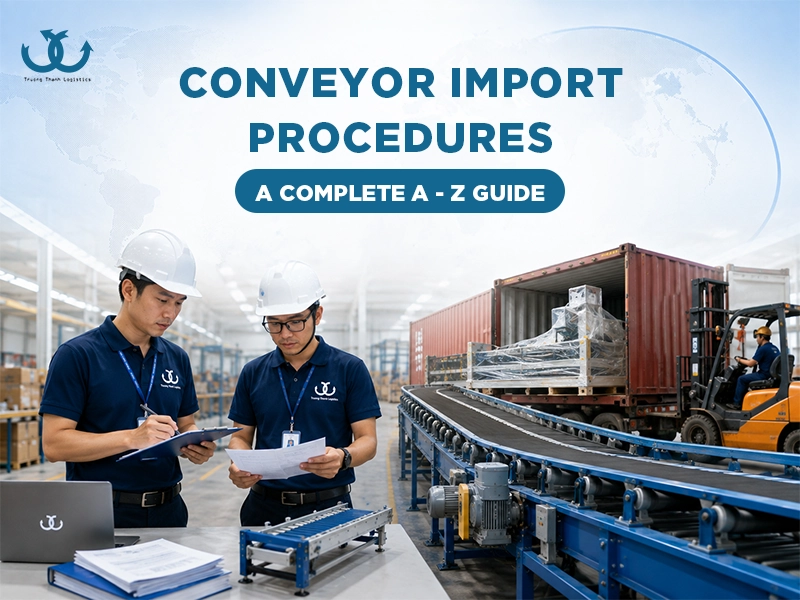
CNC machine import procedures: how to determine the HS code for each machine type, import duty, and key notes for importing used CNC machines.
CNC (Computer Numerical Control) machines are increasingly imported to serve machine shops, wood processing, and metalworking operations in Vietnam – mostly from Japan, Taiwan, South Korea, China, and Germany. What trips up many businesses isn’t customs procedure in general, but two specific issues: determining the correct HS code (since CNC machines come in many types, each with a different code) and knowing whether their used CNC machine is even allowed to be imported. This article from Trường Thành Logistics focuses on resolving exactly those two points.
1. What types of CNC machines are there, and what are their HS codes?
This is the first and most important step, since an incorrect HS code throws off the entire dossier and duty calculation. CNC machines don’t share one common HS code — the code depends on how the machine processes material, not simply on whether it has “CNC” in its name:
- Heading 8456 – machines that process material by non-mechanical methods: laser cutting, water-jet cutting, plasma-arc cutting, ultrasonic, electron-beam… For example, CNC laser cutting machines typically fall under 8456.11, and CNC plasma cutting machines under 8456.40.
- Heading 8457 – machining centers and multi-function CNC combination machines.
- Heading 8458 – CNC metal lathes.
- Heading 8459 – CNC drilling, boring, and milling machines for metal.
- Heading 8460 – CNC grinding and polishing machines for metal.
- Heading 8461 – CNC planing, shaping, broaching, gear-cutting, and gear-finishing machines.
- Heading 8462 – CNC bending, folding, straightening, punching, and stamping machines for metal.
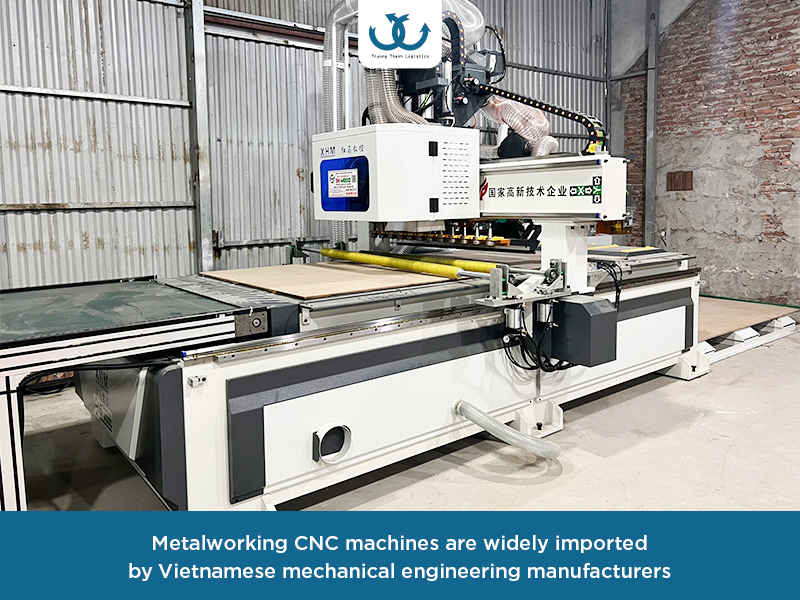
- Heading 8465 – CNC woodworking machines (CNC wood routers, CNC wood drilling machines…).
Given this broad scope, businesses should prepare a catalogue and technical documentation clearly describing the machining principle (mechanical cutting vs. non-mechanical, and whether the material is metal or wood) before looking up the HS code, rather than defaulting to a familiar classification.
If your business specifically needs a CNC wood-processing machine, see the related article CNC Wood Drilling Machine Import Procedures, already published on the site.
2. Import duty and VAT
- Preferential import duty (MFN): depends on the specific HS code; many codes across headings 8456-8465 carry an MFN rate in the range of roughly 0-5%. This is not a single fixed rate for all CNC machines – the exact 8-digit HS code for each machine type needs to be looked up to know the precise rate.
- Special preferential duty under FTAs: with an appropriate C/O (Form E under ACFTA, Form D under ATIGA, Form AK under VKFTA…), many codes can drop to 0%.
- VAT: 10%.
The actual duty rate can change over time; businesses should check the current import-export tariff schedule or ask a customs service provider to confirm the exact rate for the correct HS code before signing a purchase contract.
3. Import policy: new vs. used CNC machines
This is the biggest point of difference and where businesses face the most risk if they overlook it:
Brand-new (100%) CNC machines: not on any prohibited or restricted list, and no import license is required. Most don’t require a separate specialized inspection; however, if the machine has a large motor capacity or falls under an electrical-equipment category listed in the risk-based quality-management categories issued by the relevant regulatory ministry, businesses should still check whether a conformity declaration is required before assuming a full exemption from inspection.
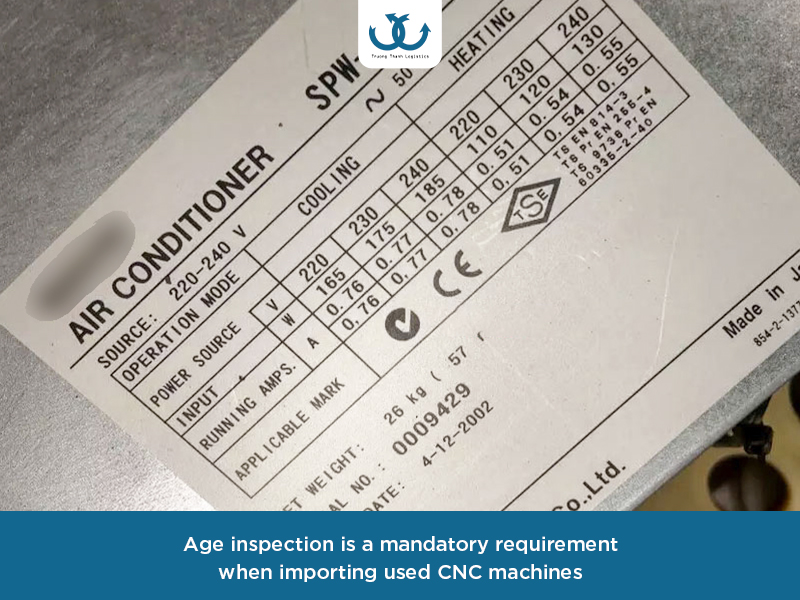
Used CNC machines: must meet the equipment age requirement under Decision 18/2019/QD-TTg – not exceeding 10 years from the year of manufacture. There are some exceptions: if a machine is over 10 years old but its remaining capacity/performance is at least 85% of the original design specification, and its material/energy consumption doesn’t exceed the design specification by more than 15%, a business manufacturing in Vietnam may be considered by the Ministry of Science and Technology for approval to import it to maintain production, following the procedure set out in Decision 18/2019/QD-TTg. In addition, used machines must also meet the relevant national technical regulations (QCVN) on safety, energy efficiency, and environmental protection (where a QCVN applies to that machine type); where no QCVN exists, the machine must conform to the national standard (TCVN) or the standards of the G7 countries/South Korea.
A common risk: a machine without a clear manufacture-date tag or nameplate – or one whose manufacture year cannot be clearly determined – may leave customs without sufficient grounds to confirm the equipment’s age, resulting in a request for additional appraisal or even forced re-export if the age can’t be proven. Businesses should ask the seller to provide complete documentation and a manufacture-year nameplate before signing a contract to purchase a used machine.
If your business wants to understand the general rules for importing machinery and equipment more broadly (not just CNC machines), see two related articles already on the site: Machinery, Production Line, and Equipment Import Procedures and 4 Things You Should Know About Importing Used Machinery.
4. Customs documents required for CNC machine import procedures
- Import customs declaration
- Commercial contract (Sales Contract)
- Commercial invoice
- Packing list
- Bill of lading
- Certificate of origin (C/O) – if claiming preferential duty under an FTA
- Catalogue and technical documentation describing the machine’s operating principle and specifications – to support accurate HS classification
- For used machines specifically: an age-verification appraisal report from a designated inspection body, plus documentation proving the manufacture year (nameplate, technical records from the manufacturer)
5. Points to discuss with your customs service provider
- Declare the machine’s technical details accurately and completely on the customs declaration (machine name, model, specifications, manufacture year, new/used condition) – vague declarations often trigger requests for further explanation from customs, extending clearance time.
- Clearly distinguish the CNC machine from accompanying parts/accessories (tooling, tool holders, separate control units…), since these components may fall under a different HS code (for example, heading 8466 for parts and accessories of machine tools).
- If importing a complete production line with multiple CNC machines, discuss in advance with your customs provider about registering a combined equipment declaration (applicable when the machinery is disassembled across multiple packages/containers) to avoid complications during declaration.
6. Frequently asked questions – CNC machine import procedures
Do CNC wood-processing machines and CNC metal-processing machines share the same HS code? No. CNC wood-processing machines fall under heading 8465, while CNC metal-processing machines fall under different headings depending on the machining method (8456-8462). You can’t use a single code for every type of CNC machine.
Is it absolutely certain that a used CNC machine over 10 years old can’t be imported? Not entirely. In principle, machines over 10 years old aren’t allowed, but there are exceptions if the machine meets the remaining capacity/performance condition (at least 85%) and is approved by the Ministry of Science and Technology under Decision 18/2019/QD-TTg. This is a separate approval procedure, not something automatically granted.
Does a new CNC machine need to be appraised before import? No, a brand-new (100%) CNC machine generally isn’t subject to age appraisal or specialized inspection. Appraisal mainly applies to used machines to determine equipment age.
Does importing a CNC machine from China qualify for a preferential duty rate? Yes, with a Form E C/O under the ASEAN-China Free Trade Agreement (ACFTA), many HS codes within the CNC machine category can qualify for a special preferential import duty rate lower than the standard MFN rate.
7. Truong Thanh Logistics – Comprehensive support for CNC Machine Import Procedures
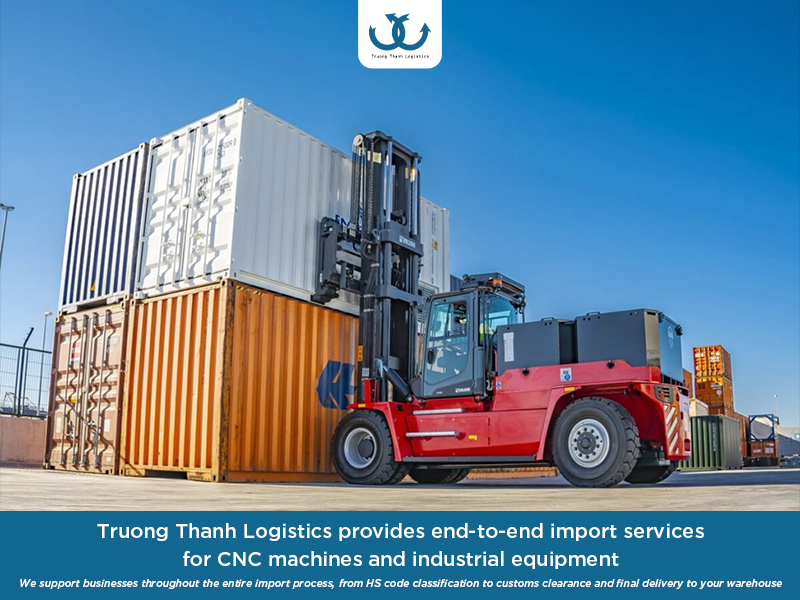
Truong Thanh Logistics helps businesses import CNC machines and industrial equipment with:
- Advice on determining the correct HS code for each type of CNC machine (metal, wood, laser, plasma…)
- Assistance with age appraisal and documentation for used CNC machines
- Customs declaration support and applying for preferential C/Os to optimize import duty
- International sea and road transport from Japan, South Korea, Taiwan, China, and Europe to Vietnam
If your business needs specific advice on CNC machine import procedures for an upcoming shipment, contact Truong Thanh Logistics directly:
Trường Thành Logistics – Professional & Dedicated
Hotline: +84 915 36 38 39
Head Office: 5th Floor, Tower A, Song Da Building, Pham Hung Street, Tu Liem Ward, Hanoi, Vietnam.
Email: sale@truongthanhjsc.com
info@truongthanhlogistics.com
Website: https://truongthanhlogistics.com
HAI PHONG BRANCH
Address: Room C103, TTC Building, 630 Le Thanh Tong Street, Hai An Ward, Hai Phong City, Vietnam.
DA NANG BRANCH
Address: 126 Chau Thi Vinh Te Street, Ngu Hanh Son Ward, Da Nang City, Vietnam.
HO CHI MINH CITY BRANCH
Address: Room 41, 4th Floor, Casanova Building, 85 Nguyen Son Street, Phu Thanh Ward, Ho Chi Minh City, Vietnam
Fanpage: TRƯỜNG THÀNH LOGISTICS