Auto parts import procedures: how to determine the HS code for each part type, import duty, which parts require quality inspection and notes on used parts.
Auto parts are in high demand as an import category in Vietnam, serving the repair, maintenance, and parts-replacement industry, given the country’s still-limited domestic parts manufacturing capacity. What trips up businesses new to this field isn’t customs procedure in general – it’s three specific issues: determining the correct HS code (since a single shipment often contains many different line items), knowing which parts require a quality inspection before they can be sold, and distinguishing new parts from used parts (which are banned from import). This article from Truong Thanh Logistics covers all three.
1. HS codes for auto parts: why isn’t there a single code?
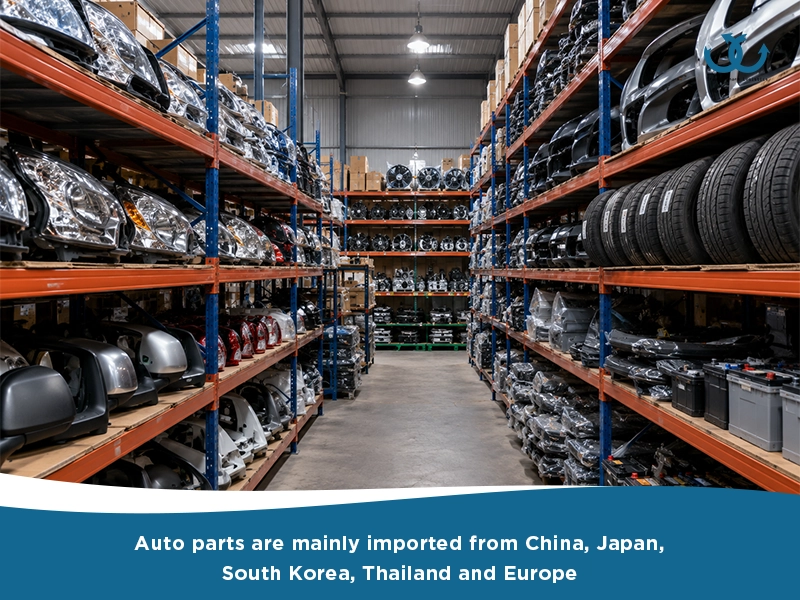
Auto parts cover every component that makes up a complete vehicle – from the engine and chassis to mirrors, lights, tires, and batteries – so there’s no single HS code that applies to “auto parts” as a category. The HS code depends on the actual nature, material, and function of each component, spanning several different chapters of the tariff schedule, for example:
- Chapter 87 (heading 87.08): most parts and accessories used exclusively for motor vehicles – the most common heading, but not the only one that applies.
- Chapter 40: tires (heading 40.11) and other rubber products used in vehicles.
- Chapter 70: safety glass, windshields (heading 70.07).
- Chapter 85: batteries (heading 85.07), electrical lighting/signaling equipment such as headlights, taillights, and wiper motors (heading 85.12).
- Chapter 84: certain mechanical engine and transmission components.
An important classification principle to remember: under the general rules of interpretation (Rules 2(b) and 3(a)), if a component is more specifically described under a particular heading (for example, safety glass under 70.07, or woven carpet used in a vehicle under 57.03), it must be classified there – not automatically placed under heading 87.08 just because it’s fitted in a car. This is the most common classification error when importing auto parts. You can find more on this principle in the article 6 Rules of Goods Classification (HS Code Application) already published on the site – it includes a worked example specifically about auto parts.
Since an auto parts shipment often contains a large number of line items (some orders run into the hundreds), businesses should prepare a catalogue, images, and detailed technical specifications for each item to classify accurately, rather than applying the same code to everything out of habit.
2. Import policy: new parts vs. used parts
- Brand-new (100%) auto parts: not on the prohibited import list, and processed like any ordinary import.
- Used auto parts: this is the point requiring special attention – used parts (such as used engines, chassis, or tires) fall under the current list of prohibited imports under Vietnam’s foreign trade management regulations. Businesses intending to import used parts should confirm carefully with Customs or a service provider before signing a purchase contract, to avoid the risk of the shipment being refused clearance or forced to be re-exported.
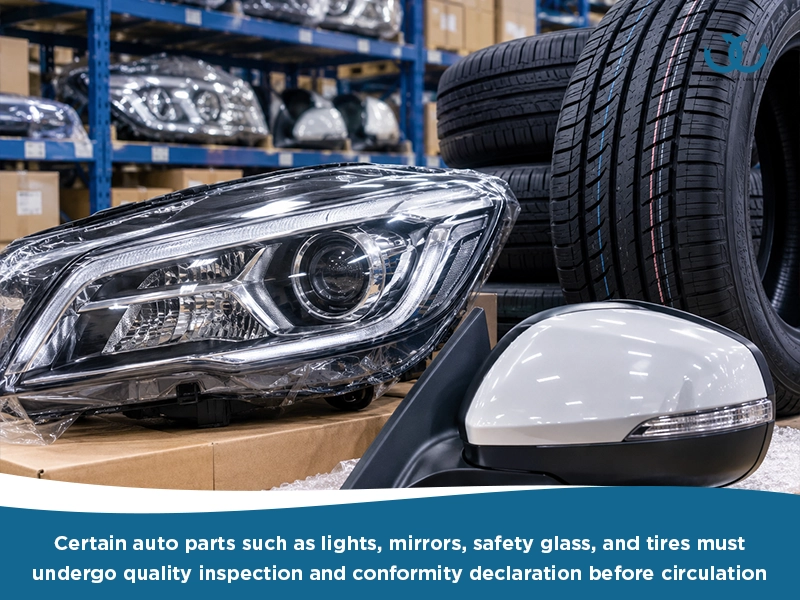
3. Which parts require quality inspection and conformity declaration?
Not every auto part needs a quality inspection on import – only parts that directly affect operating safety fall into this category. Under the Ministry of Transport’s list of products and goods with potential safety risk (currently under Circular 12/2022/TT-BGTVT, as amended by Circular 62/2024/TT-BGTVT effective 15 February 2025), several part categories must undergo quality inspection and conformity declaration before being sold on the market, for example:
- Rear-view mirrors
- Lighting and signal lights (headlights, taillights)
- Safety glass, windshields
- Tires, wheel rims
- Batteries
An important distinction: the conformity declaration for these parts is typically carried out after customs clearance, before the goods are placed on the market – it isn’t a condition for clearance at the border. Businesses can still complete customs procedures normally, then register for quality inspection and conformity declaration before selling. The specific list of parts covered can be updated periodically, so businesses should check the current regulation or contact Truong Thanh Logistics to confirm whether their specific item is subject to inspection.
4. Import duty and VAT
- Preferential import duty (MFN): varies significantly depending on the specific HS code of each part – there’s no single rate for “auto parts” as a category. Businesses need to look up the exact 8-digit HS code to know the applicable rate.
- Special preferential duty under FTAs: with an appropriate C/O (Form E under ACFTA for goods from China, Form D under ATIGA, Form AK under VKFTA…), many codes can qualify for a rate significantly lower than MFN. Note: some specific items may not be eligible for Form E preference even if originating from China, or may carry a separate duty rate under the standard preferential tariff schedule – always check against the exact HS code rather than assuming every item qualifies.
- VAT: 10%.
5. Customs documents required
- Import customs declaration
- Commercial contract (Sales Contract)
- Commercial invoice
- Packing list
- Bill of lading
- Certificate of origin (C/O) – if claiming preferential duty under an FTA
- Catalogue, images, and technical specifications for each line item – to support accurate HS classification, especially important for shipments with many line items
- For parts subject to quality inspection: additional documentation to register for quality inspection and conformity declaration under Ministry of Transport regulations (carried out after clearance)
6. Labeling requirements
Imported auto parts with a foreign-language original label need a supplementary Vietnamese label before entering the market. Under Decree 37/2026/ND-CP (Chapter IV, on product labeling – which replaced the now-expired Decree 43/2017/ND-CP and Decree 111/2021/ND-CP), the supplementary label must show all required information: product name, origin, name and address of the responsible organization, along with other content specific to the part (technical specifications, usage/maintenance instructions where applicable). The supplementary label must be affixed in a clearly visible position without covering the original label’s content, and should ideally be completed before clearance to make customs inspection easier.
(Note: this is a point where many older reference articles still cite the now-expired Decree 43/2017/ND-CP – that document lost effect once Decree 37/2026/ND-CP took effect. Goods correctly labeled under the old regulation before that point may continue to circulate under transitional provisions, but businesses preparing new documentation should apply Decree 37/2026/ND-CP directly.)
7. Points to keep in mind during the process – Auto parts import procedures
- Declare each line item in detail – don’t lump multiple different parts together under a vague single declaration line, as this often triggers a request for further explanation from customs and extends clearance time.
- Be mindful of declared value: auto parts are commonly subject to price risk management, so customs may request a price consultation if the declared value looks unusually low compared to the market – prepare documentation supporting a reasonable price (contract, international payment records).
- Check the origin of the parts carefully before importing to avoid the risk of accidentally importing used, counterfeit, or substandard parts.
8. Frequently asked questions – Auto parts import procedures
Do auto parts require an import license? No, not for brand-new parts. Auto parts in general aren’t on the list of goods requiring an import license; only certain safety-related part categories need a conformity declaration after clearance.
Why do auto parts have so many different HS codes? Because auto parts are a collection of components with very different natures and materials (metal, rubber, glass, electronics…). Under the classification rules, each component is classified under the heading that most specifically describes it, rather than being automatically grouped under the general auto-parts heading 87.08.
Can used auto parts be imported? No. Used auto parts fall under the current list of prohibited imports. Businesses should confirm carefully before signing a purchase contract to avoid the risk of the shipment being refused clearance.
Does the conformity declaration for auto parts delay clearance? Not directly, since this procedure is carried out after the goods have already cleared customs and before they’re placed on the market – it isn’t a mandatory condition for releasing the goods from the port/warehouse.
Does importing auto parts from China qualify for a preferential duty rate? Possibly, with a Form E C/O under ACFTA. However, some specific items may not be eligible for preference or may carry a separate duty rate, so always check against the exact 8-digit HS code rather than assuming.
9. Truong Thanh Logistics – Comprehensive support for importing auto parts import procedures
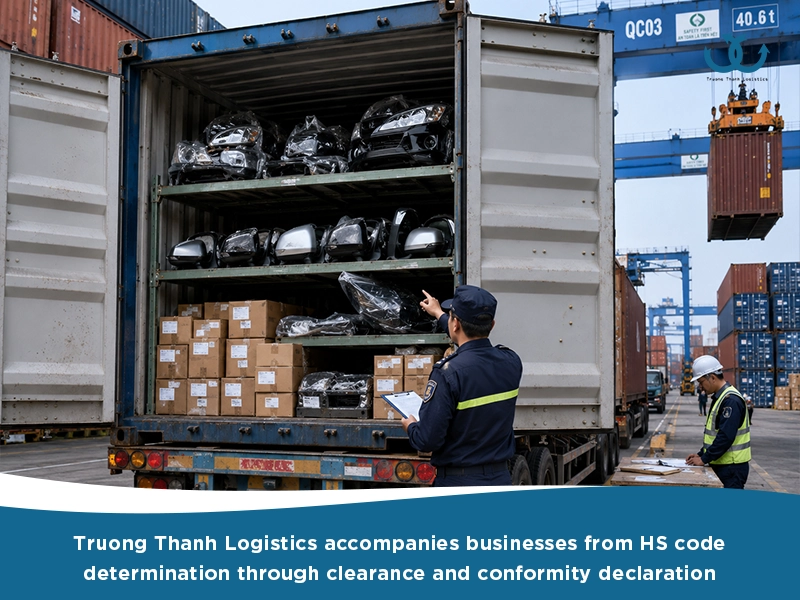
Truong Thanh Logistics helps businesses import auto parts with:
- Consulting on the correct HS code for each component, in line with proper classification principles
- Assistance with quality inspection registration and conformity declaration for parts under Ministry of Transport regulation
- Customs declaration support and applying for preferential C/Os to optimize import duty
- International sea and road transport from China, Japan, South Korea, Thailand, and Europe to Vietnam
If your business needs specific advice on auto parts import procedures for an upcoming shipment, contact Truong Thanh Logistics directly:
Trường Thành Logistics – Professional & Dedicated
Hotline: +84 915 36 38 39
Head Office: 5th Floor, Tower A, Song Da Building, Pham Hung Street, Tu Liem Ward, Hanoi, Vietnam.
Email: sale@truongthanhjsc.com
info@truongthanhlogistics.com
Website: https://truongthanhlogistics.com
HAI PHONG BRANCH
Address: Room C103, TTC Building, 630 Le Thanh Tong Street, Hai An Ward, Hai Phong City, Vietnam.
DA NANG BRANCH
Address: 126 Chau Thi Vinh Te Street, Ngu Hanh Son Ward, Da Nang City, Vietnam.
HO CHI MINH CITY BRANCH
Address: Room 41, 4th Floor, Casanova Building, 85 Nguyen Son Street, Phu Thanh Ward, Ho Chi Minh City, Vietnam
Fanpage: TRƯỜNG THÀNH LOGISTICS