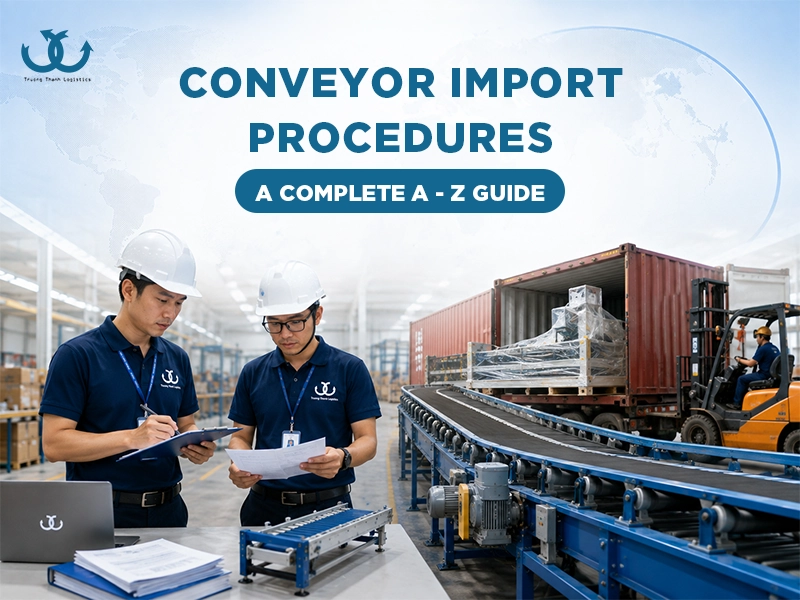
Conveyor belt import procedures: how to determine the HS code by material, import duty, VAT, customs documents, and special notes for passenger conveyors.
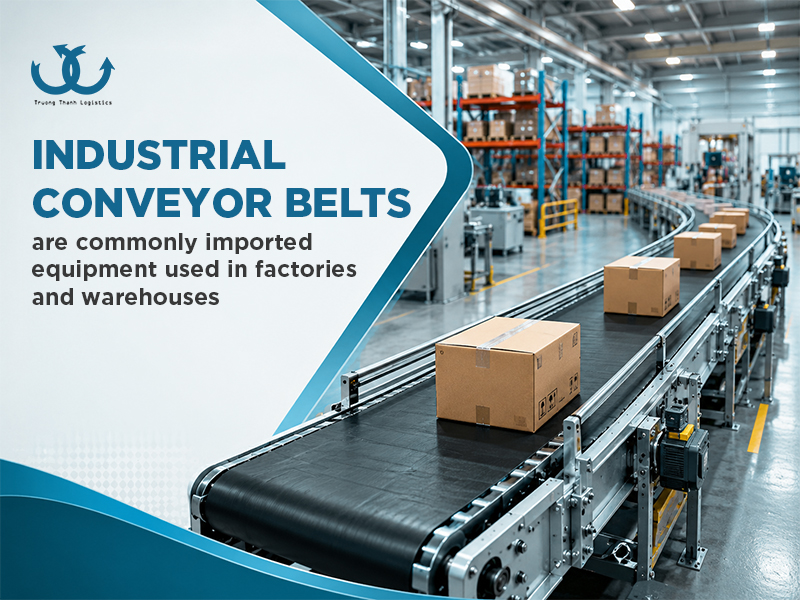
Conveyor belts are commonly imported equipment for factories, warehouses, and production lines in Vietnam, mainly sourced from China, South Korea, Japan, Italy, and Germany. In general, importing this equipment isn’t complicated — ordinary industrial conveyor belts aren’t on any prohibited or restricted list and don’t require a license. However, determining the correct HS code by material and recognizing the one case that requires a safety inspection (passenger conveyors) is where many businesses trip up. This guide from Truong Thanh Logistics walks through the full process.
In this article, “băng tải” (conveyor belt) and “băng chuyền” (conveyor) — two common terms used interchangeably in practice – mainly refer to the conveyor belt itself, imported separately by material. If you’re importing a complete conveyor system (including frame, motor, rollers, belt, control cabinet, etc.), it’s typically classified under a different HS code, usually under Chapter 84 (machinery), depending on the system’s construction and function. Businesses should determine whether they’re importing the belt alone or a full system before looking up the HS code. In practice, “băng tải” and “băng chuyền” are used interchangeably, but HS classification is always based on the actual construction and import condition of the goods, not the terminology used.
1. HS code by material
- Vulcanized rubber conveyor belts: fall under heading 4010 in Chapter 40 (Rubber and articles thereof), broken down by reinforcement:
- 11: reinforced with metal
- 12: reinforced with textile material
- Subheadings 4010.31–4010.34: V-belts, categorized by whether they have V-shaped ribs and by outer circumference
- Plastic conveyor belts: may fall under Chapter 39 or a different heading depending on construction and function (PVC, PU, or modular belts are classified quite differently, and some still fall under heading 4010 if they include a rubber layer). There is no single fixed code for “plastic conveyor belts” — classification must be based on the catalogue and actual material composition.
- Textile-material conveyor belts: may fall under heading 59.10 (transmission or conveyor belts of textile material) if they meet that heading’s description under the HS nomenclature; classification still depends on actual construction.
- Importing a complete conveyor system: usually falls under Chapter 84, not the code for the belt alone.
Quick reference table:
| Type of import | Reference HS heading |
| Vulcanized rubber conveyor belt | 4010 |
| Plastic conveyor belt | Depends on construction (Chapter 39, or 4010 if it includes a rubber layer) |
| Textile-material conveyor belt | Depends on construction (may fall under heading 59.10) |
| Complete conveyor/conveying system | Usually falls under Chapter 84 |
(The table above is for general reference only and does not replace an official HS determination based on the catalogue and actual construction of each shipment.)
Because import duty depends directly on the HS code, businesses should prepare catalogues and technical documents clearly describing the material and construction of the belt to look up the code accurately, rather than defaulting to a code used for a similar product imported before. If uncertain, a business can request an advance HS classification ruling from Customs before importing, instead of self-classifying and risking a later reassessment or a customs-ordered classification review after clearance.
2. Import duty and VAT
- Preferential import duty (MFN): depends on the specific HS code within heading 4010 and the applicable tariff schedule — not every code in the heading carries the same rate. At the time of writing, many common rubber conveyor belt HS codes carry a rate of 5% without a preferential C/O, but businesses need to check the exact 8-digit HS code for their specific shipment to know the applicable rate.
- Special preferential duty under FTAs: with a Form E C/O (ASEAN–China) or Form D (ASEAN), the rate may drop to 0% depending on the applicable tariff schedule at the time of import. Businesses should ask the seller for the right C/O from the outset to optimize costs.
- VAT: 10% — conveyor belts don’t qualify for any current VAT reduction policy.
The applicable duty rate can vary over time and by exact HS code; businesses should check the current import-export tariff schedule or ask a customs service provider to confirm.
3. Import policy: When is a quality/safety inspection required?
This is an important point many businesses overlook — and it’s crucial to distinguish two different concepts: quality inspection/specialized management upon import (handled by the specialized regulatory agency, usually tied to clearance) and occupational safety technical inspection (managed by the labor sector, carried out before the equipment is put into use – not a condition for customs clearance).
- Ordinary industrial conveyor belts (used to move materials or goods in production, processing, warehousing, logistics, etc.) generally don’t fall under the medium/high-risk categories in the current classification system, so no import license is required. A belt used purely to convey goods generally doesn’t require separate quality conformity declaration – however, if importing a complete assembly that includes a motor, electrical cabinet, or falls under a machinery category subject to specialized quality-control requirements, businesses should check carefully before importing.
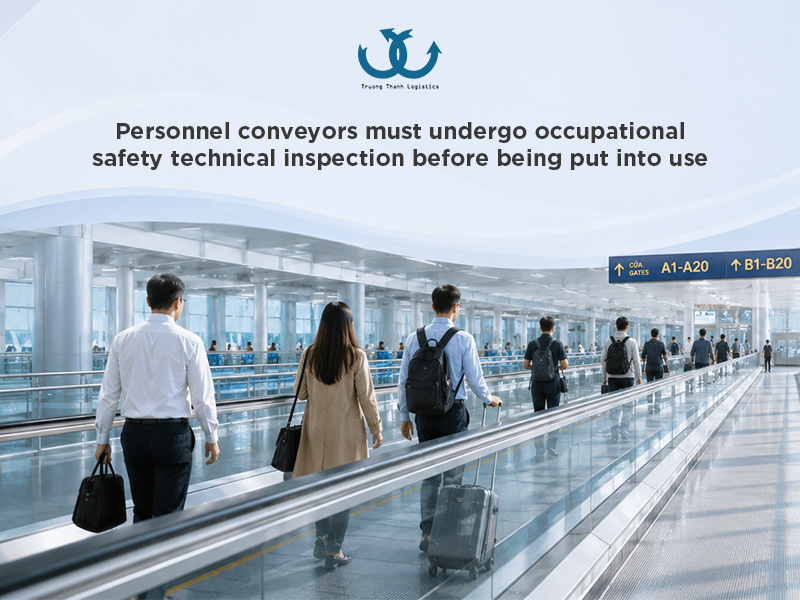
- Conveyors used to carry people (such as passenger conveyors/moving walkways at airports or train stations) are the exception – these fall under the list of machinery and equipment with strict occupational safety requirements (currently under Circular 36/2019/TT-BLĐTBXH) and must undergo a technical safety inspection before use, following the current procedure issued by the Ministry of Labor. Note: the specific inspection procedure for this category was previously set out in Circular 07/2014/TT-BLĐTBXH (which expired on 1 June 2017) and moved to Circular 54/2016/TT-BLĐTBXH; however, the occupational-safety-inspection framework has since been revised further, so businesses should confirm the current governing document with a licensed inspection body or check Vietnam’s National Legal Document Database rather than relying solely on a specific circular number cited in this article. The key point to remember is: the actual intended use of the equipment (carrying goods vs. carrying people) is what determines whether an inspection is required – the exact document number in force may change over time.
4. Customs documents required
- Import customs declaration
- Commercial contract (Sales Contract)
- Commercial invoice
- Packing list
- Bill of lading
- Certificate of origin (C/O) — not mandatory, but needed to claim preferential duty
- Catalogue and technical documents — to support accurate HS classification
Note for conveyors used to carry people: the occupational safety technical inspection (following the current procedure) is a separate process, not part of the customs documentation above. The business still clears the shipment normally with the documents listed above, then completes the safety-inspection registration before installing and operating the equipment.
5. Labeling requirements – Conveyor belt import procedures
Under Decree 37/2026/ND-CP (Chapter IV, on product labeling – which replaced Decree 43/2017/ND-CP and Decree 111/2021/ND-CP, both now expired), imported conveyor belts with a foreign-language original label must carry a supplementary Vietnamese label before entering the market, showing all required information: product name, origin, name and address of the responsible organization, and other content specific to the product type (for machinery and mechanical equipment such as conveyor belts: technical specifications, safety warning information, and usage/maintenance instructions). This step is easy to overlook but is commonly checked once goods are in circulation after clearance.
(Note: goods labeled correctly under the now-expired Decree 43/2017/ND-CP before Decree 37/2026/ND-CP took effect may continue to be circulated and used under the transitional provisions in Article 98 – pre-printed labels/packaging under the old format may continue to be used for up to 2 years from the effective date of Decree 37/2026.)
6. Frequently asked questions – Conveyor belt import procedures
Does an imported conveyor belt require a license? No, not for an ordinary industrial conveyor belt used to move goods. This item isn’t on the prohibited/restricted list or subject to specialized management, so it’s processed like any ordinary import.
How do I know if my conveyor belt falls under HS 4010 or another code? It depends on the main material: vulcanized rubber generally falls under heading 4010; plastic, textile, or complete systems may fall under different codes depending on construction (see the reference table in Section 1). Having a clear catalogue/technical document is essential to avoid misclassification, which can lead to underpaid duty or a post-clearance reassessment.
Does importing a conveyor belt from China qualify for a preferential duty rate? Yes, with a Form E C/O under the ASEAN–China Free Trade Agreement (ACFTA), the import duty can be significantly lower than the standard MFN rate.
7. Truong Thanh Logistics – Comprehensive support for conveyor belt import procedures
Truong Thanh Logistics helps businesses import conveyor belts and industrial equipment with:
- Advice on determining the correct HS code based on the actual material and construction of the conveyor belt
- Assistance with customs declaration and applying for preferential C/Os (Form E, Form D…) to optimize import duty
- Advice on cases requiring safety inspection (passenger conveyors) and the related procedures
- International sea and road transport from China, South Korea, Japan, and Europe to Vietnam
If your business needs specific advice for an upcoming conveyor belt shipment, contact Truong Thanh Logistics directly about conveyor belt import procedures:
Trường Thành Logistics – Professional & Dedicated
Hotline: +84 915 36 38 39
Head Office: 5th Floor, Tower A, Song Da Building, Pham Hung Street, Tu Liem Ward, Hanoi, Vietnam.
Email: sale@truongthanhjsc.com
info@truongthanhlogistics.com
Website: https://truongthanhlogistics.com
HAI PHONG BRANCH
Address: Room C103, TTC Building, 630 Le Thanh Tong Street, Hai An Ward, Hai Phong City, Vietnam.
DA NANG BRANCH
Address: 126 Chau Thi Vinh Te Street, Ngu Hanh Son Ward, Da Nang City, Vietnam.
HO CHI MINH CITY BRANCH
Address: Room 41, 4th Floor, Casanova Building, 85 Nguyen Son Street, Phu Thanh Ward, Ho Chi Minh City, Vietnam
Fanpage: TRƯỜNG THÀNH LOGISTICS
Note: This article is for general reference, compiled based on legal regulations and tariff schedules in force at the time of publication. HS codes, duty rates, and management policies may change over time; businesses should contact Truong Thanh Logistics or the Customs Authority directly for the most accurate, up-to-date information for their specific shipment.