Bolt import procedures: how to determine the HS code by type, and how import duty varies significantly by country of origin and applicable trade agreement.
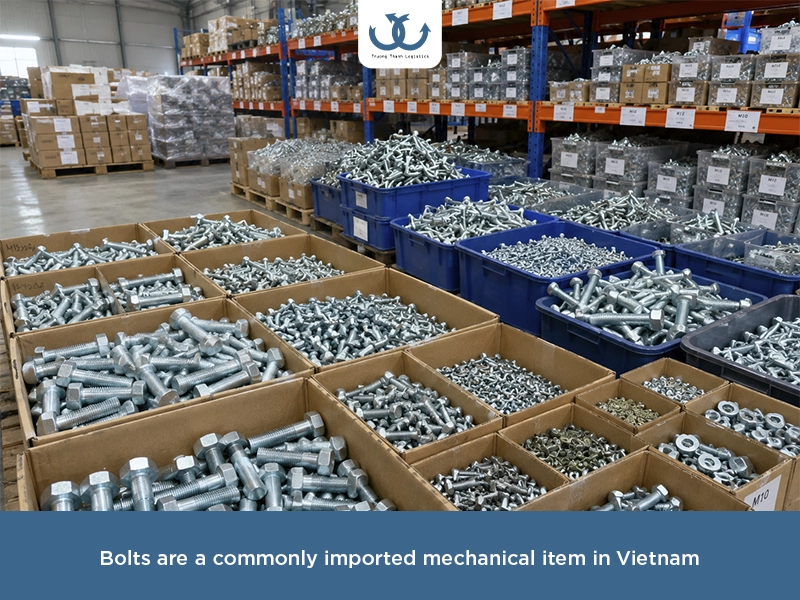
Bolts are a widely imported mechanical item in Vietnam, serving construction, machining, and automotive/motorcycle assembly. Customs procedure for importing bolts isn’t complicated.
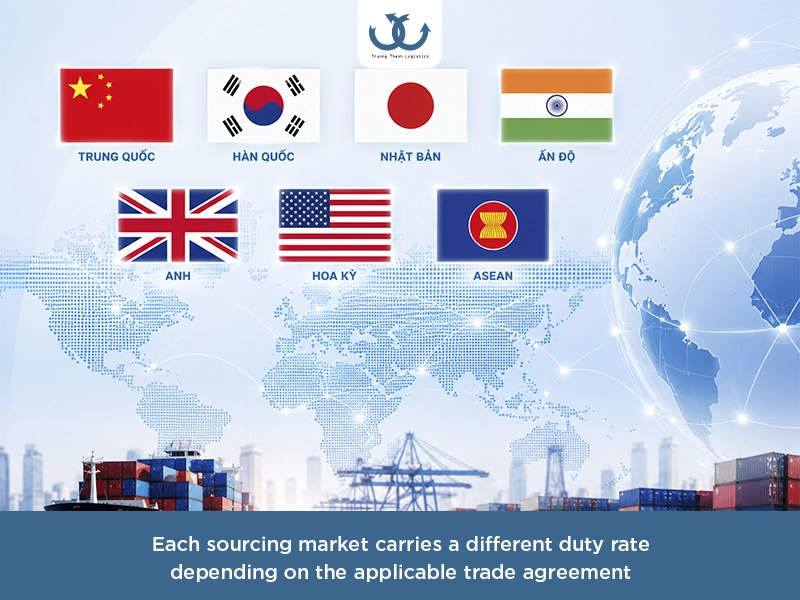
But there’s one point that surprises many businesses: the same type of bolt, imported from two different countries, can carry two very different duty rates, because each country has its own free trade agreement (FTA) with Vietnam. This article from Trường Thành Logistics explains how to determine the HS code and provides a quick duty comparison across common sourcing markets.
1. HS code for bolts and related products
Bolts and related iron/steel products (screws, nuts, washers) all fall under heading 73.18 in Chapter 73 (articles of iron or steel), broken down as follows:
- 7318.11: Coach screws
- 7318.15: Threaded bolts, subdivided by diameter (e.g., 7318.15.10 for external diameter 16mm or less, 7318.15.90 for other types)
- 7318.16: Nuts
- 7318.21/7318.22: Washers (including spring lock washers)
If the bolt is made from a different material (copper, aluminum, plastic), the HS code falls under a different chapter entirely – similar to nuts. Businesses should prepare a catalogue and technical specifications (material, diameter, strength grade) to determine the correct 8-digit code before declaring.
2. How does bolt import duty vary by country?
This is the most important point of this article: bolt import duty depends heavily on the country of origin, since each country has its own free trade agreement with Vietnam. The table below illustrates this variation (rates are for reference – always check the exact 8-digit HS code and current regulations at the time of import):
| Origin | Reference import duty | Applicable agreement |
| China | 5% or 12% | ACFTA or RCEP (depending on which C/O is chosen) |
| India | 18.5% | AIFTA |
| United States | 12% | Standard preferential (MFN) duty – no bilateral FTA yet |
| ASEAN | 0% or 8% | ATIGA or RCEP |
| South Korea | 0%, 5%, or 8% | VKFTA, AKFTA, or RCEP |
| Japan | 0% or 8.3% | AJCEP/VJEPA or RCEP |
| United Kingdom | 3.6% | UKVFTA |
(The table above is for general reference only – the actual rate depends on the exact 8-digit HS code, and businesses need the correctly-formatted C/O to claim the corresponding preferential rate. When a shipment qualifies under more than one FTA at once – as is often the case with South Korea or China – businesses should compare and choose whichever C/O gives the best rate.)
This is also why businesses importing bolts should discuss the possibility of obtaining a C/O with their supplier right from the contract negotiation stage, rather than focusing only on the FOB price.
3. VAT – Bolt import procedures
VAT on imported bolts is 10%, regardless of origin.
4. Do imported bolts require mandatory quality inspection?
Currently, there’s no general regulation requiring every bolt shipment to undergo state quality inspection on import — ordinary bolts are processed like any other mechanical import.
However, there’s one case worth noting separately: high-strength bolts used in structural steel for construction projects (bridges, factory buildings, load-bearing structures). This isn’t a mandatory quality inspection under general law, but it’s typically a contractual requirement from the project owner or supervising consultant.
This usually requires the bolts to have quality certificates (original CQ/CO from the manufacturer) and meet specific technical standards (Vietnamese standards or equivalent international standards such as ASTM, DIN, JIS) matching the project’s design requirements. Businesses importing high-strength bolts for a construction project should confirm the exact technical standard required by their partner before ordering, to avoid importing bolts that don’t meet the required strength grade or design standard.
5. Customs documents required – Bolt import procedures
- Import customs declaration
- Commercial contract (Sales Contract)
- Commercial invoice
- Packing list
- Bill of lading
- Certificate of origin (C/O) – important for claiming the correct preferential rate shown in Section 2
- Catalogue and technical specifications – to support accurate HS classification
- For high-strength construction bolts: additional quality certificates (CQ) and raw-material origin certificates if required by the project owner
6. Frequently asked questions – Bolt import procedures
Why does importing the same bolt from China sometimes get quoted at 5% duty and sometimes at 12%?
Because China and Vietnam are both party to two agreements that can apply to bolts: ACFTA (usually the lower rate) and RCEP. The rate depends on which C/O form the business applies for – it’s worth comparing and choosing whichever form gives the best rate for the specific shipment.
Is a C/O mandatory for importing bolts?
Not mandatory for clearance, but without a C/O, the business will be charged the standard preferential (MFN) duty rate — usually significantly higher than the FTA-preferential rate.
Do bolts used in construction projects need a special import license?
No special import license from a state authority, but they need to meet the technical requirements/quality certificates required under the contract with the project owner or design consultant.
How do I find the exact 8-digit HS code for the bolts I’m importing?
It depends on the material, whether it’s threaded, the diameter, and the specific strength grade. Prepare complete technical catalogues and consult an experienced customs service provider to avoid misclassification.
7. Truong Thanh Logistics – Comprehensive support for bolt import procedures
Trruong Thanh Thanh Logistics helps businesses bolt import procedures and other mechanical products with:
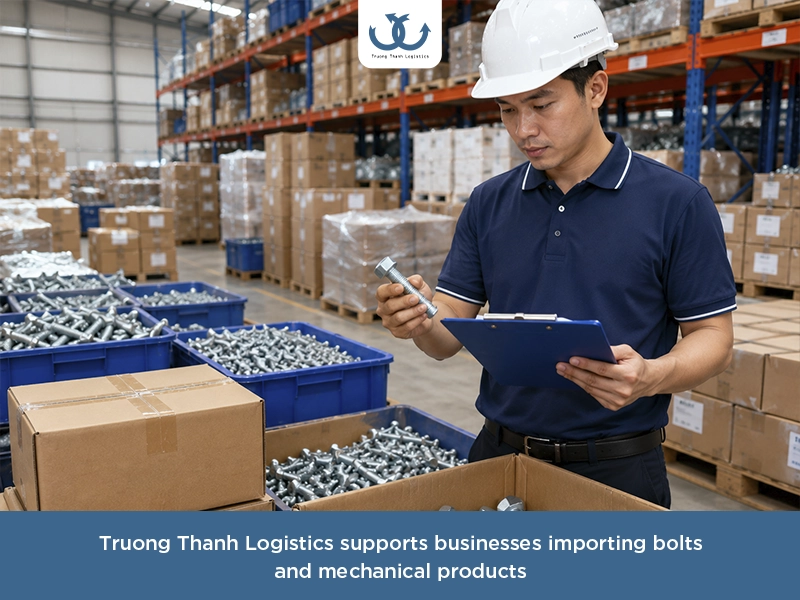
- Advice on determining the correct HS code based on material and construction
- Comparing and advising on the most favorable C/O for each sourcing market
- Customs declaration support with fast, efficient processing
- International sea and road transport from China, South Korea, Japan, ASEAN, and other markets
If your business needs specific advice on bolt import procedures for an upcoming shipment, contact Truong Thanh Logistics directly:
Trường Thành Logistics – Professional & Dedicated
Hotline: +84 915 36 38 39
Head Office: 5th Floor, Tower A, Song Da Building, Pham Hung Street, Tu Liem Ward, Hanoi, Vietnam.
Email: sale@truongthanhjsc.com
info@truongthanhlogistics.com
Website: https://truongthanhlogistics.com
HAI PHONG BRANCH
Address: Room C103, TTC Building, 630 Le Thanh Tong Street, Hai An Ward, Hai Phong City, Vietnam.
DA NANG BRANCH
Address: 126 Chau Thi Vinh Te Street, Ngu Hanh Son Ward, Da Nang City, Vietnam.
HO CHI MINH CITY BRANCH
Address: Room 41, 4th Floor, Casanova Building, 85 Nguyen Son Street, Phu Thanh Ward, Ho Chi Minh City, Vietnam
Fanpage: TRƯỜNG THÀNH LOGISTICS
You can also read nut export procedures if your business both imports raw material and exports similar finished mechanical products.
References:
- Vietnam’s Import – Export Tariff Schedule – Chapter 73
- Free trade agreements: ACFTA, RCEP, AIFTA, ATIGA, VKFTA, AKFTA, AJCEP, VJEPA, UKVFTA
Note: This article is for general reference, compiled based on the tariff schedule and trade agreements in force at the time of publication. Specific duty rates by HS code and agreement may change over time; businesses should contact Truong Thanh Logistics or the Customs Authority directly for the most accurate, up-to-date information for their specific shipment.