Conveyor import procedures: HS code 8428 for complete conveyor systems, procedures for registering synchronized goods when importing disassembled systems and regulations applicable to used conveyors.
In this article, “conveyor” refers to a complete conveyor system consisting of the frame, motor, rollers or conveyor belt, and control cabinet. This is different from a separate conveyor belt (only the belt/drive component), which Truong Thanh Logistics covers in a separate article: Conveyor belt import procedures.
If you are importing only a separate conveyor belt for replacement purposes, you should refer to that article. If you are importing a complete conveyor system for new installation, this article will be more relevant.
1. HS codes for complete conveyor systems
A complete conveyor system, including the motor, frame, and transmission components, falls under HS heading 84.28 – “Other lifting, handling, loading or unloading machinery” in Chapter 84. This heading also covers equipment such as elevators, escalators and cableway containers.
More specifically:
- 8428.33: Belt conveyors with motors, commonly used in industrial production.
- 8428.39: Other conveyors that are not belt-type conveyors, such as roller conveyors.
- 8428.40: Escalators and passenger conveyors, including those used to transport people at airports and railway stations. This is the category relevant to passenger conveyors, which are subject to occupational safety inspection requirements.
- 8428.90: Other lifting, handling, loading or unloading machinery not specifically classified under the above subheadings.
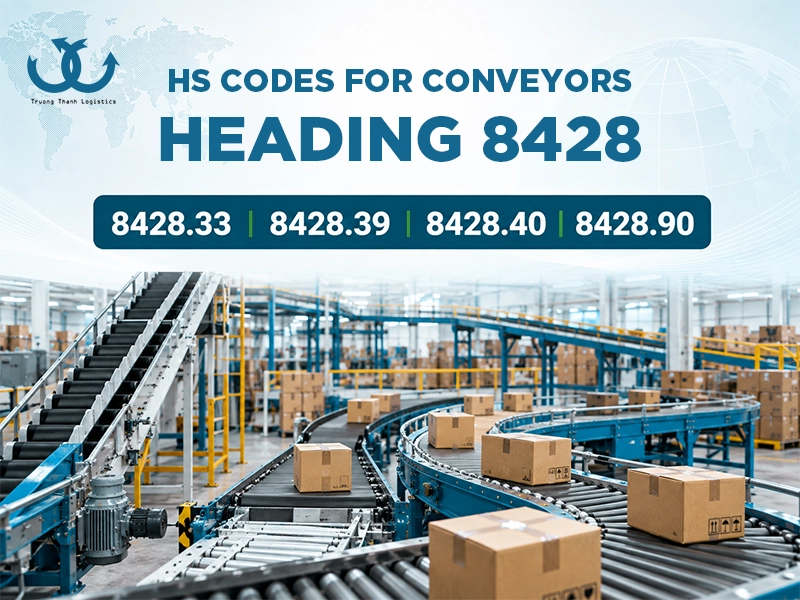
The exact HS code depends on the equipment’s specific structure and function, such as whether it has a motor, whether it is belt-type or roller-type, and whether it is designed to transport goods or people. Therefore, businesses should prepare the product catalogue and system structure diagram before customs declaration.
2. Complete system or disassembled components – Why does the distinction matter?
This is one of the most important points when handling conveyor import procedures, because the import method directly affects customs declaration procedures.
- Synchronized import of a complete system (imported as one unit, in the same shipment and through the same customs checkpoint): the system is classified according to the finished product under HS heading 84.28 and declared as a complete product.
- Disassembled import (shipped in multiple containers and potentially across multiple shipments): under Rule 2(a) of the General Rules for the Interpretation of the Harmonized System, components forming a complete system may still be classified as the finished product, even when unassembled, provided they meet the relevant conditions for assembly using simple tools.
In this case, the importer should register the list of synchronized imported goods with customs before carrying out the import procedures. This allows components such as the frame, motor, conveyor belt, and control cabinet to be handled consistently under the same classification and documentation framework, instead of having individual components assigned separate HS codes that may create difficulties when completing the overall system.
Businesses should determine which import method applies before placing an order and planning transportation, as registering the synchronized list after part of the shipment has already arrived in Vietnam can be considerably more complicated than completing the registration from the beginning.
3. Conveyor import policy: New and used systems
- Brand-new systems: Complete new conveyor systems are generally not on the prohibited or restricted import list and can be imported under standard customs procedures.
- Used systems: Used conveyors are subject to regulations on the age of used machinery under Decision No. 18/2019/QD-TTg, similar to other used industrial machinery and equipment. For details on application requirements and exceptions, including the 85% capacity-related exception, businesses can refer to the CNC machine import procedures article available on the website. The general principles are similar for used conveyor systems.
4. Import duty and VAT – Conveyor import procedures
- Preferential import duty (MFN): The applicable rate depends on the specific 8-digit HS code within heading 84.28.
- Special preferential import duty under FTAs: If the shipment is accompanied by a valid Certificate of Origin (C/O), many HS codes may qualify for significantly lower preferential rates.
- VAT: 10%.
5. Passenger conveyors: Special safety inspection requirements
If a business imports a passenger conveyor (HS code 8428.40), commonly used at airports, railway stations, and similar facilities, special attention should be paid to this type of equipment.
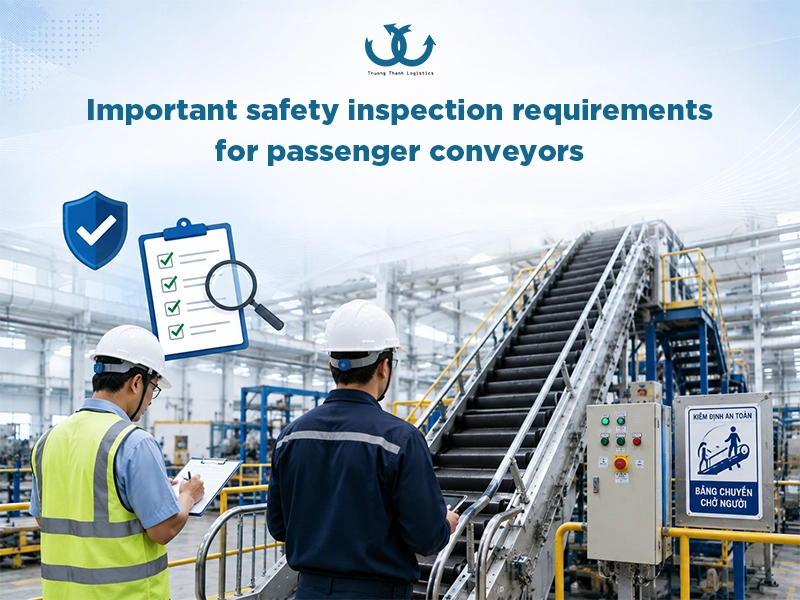
The equipment must undergo occupational safety technical inspection before being put into operation, unlike conventional conveyors used solely for transporting goods.
The safety inspection is carried out after customs clearance. It is generally not a prerequisite for the importer to take the goods out of the port or warehouse.
Therefore, businesses should clearly determine from the beginning whether the conveyor is intended for passenger transportation or goods transportation, so that all relevant customs procedures and safety requirements can be properly prepared.
6. Required customs documents
The following documents may be required for conveyor imports:
- Import customs declaration (or a set of declarations if the system is imported in disassembled components across multiple shipments, together with the registered synchronized goods list)
- Commercial Contract / Sales Contract
- Commercial Invoice
- Packing List – with detailed information for each package when importing disassembled components
- Bill of Lading
- Certificate of Origin (C/O) – if preferential import duty is claimed
- Product catalogue and system structure diagram – to support HS classification and synchronized goods registration
- For used systems: equipment age inspection documents and documents proving the year of manufacture
7. Frequently asked questions – Conveyor import procedures
Are conveyors and conveyor belts the same thing?
In practice, the two terms are sometimes used interchangeably. However, for customs purposes, they should be clearly distinguished.
A separate conveyor belt made of rubber, plastic, or textile materials may fall under different chapters or headings, such as Chapters 39, 40, or heading 59.10. A complete conveyor system with a motor, on the other hand, generally falls under HS heading 84.28.
Therefore, the HS code and import procedures can be completely different.
Is importing a conveyor system in multiple containers more complicated?
It can be more complicated from a procedural perspective because the importer may need to register a synchronized goods list with customs before importation.
This helps ensure that all components are handled consistently according to the applicable classification rules for unassembled or disassembled machinery.
Does a passenger conveyor at an airport have different import procedures from a conventional goods conveyor?
The basic customs procedures are generally similar. However, passenger conveyors may require an additional occupational safety technical inspection after customs clearance and before being put into operation.
This requirement does not generally apply to conventional conveyors used for transporting goods.
Are there age restrictions on imported used conveyors?
Yes. Used conveyors are subject to the general regulations governing the age of used machinery and equipment, including the principle that used equipment generally must not exceed 10 years of age, unless an applicable exception is approved by the competent authority.
8. Truong Thanh Logistics – Full-service support for conveyor import procedures
Truong Thanh Logistics provides comprehensive support for businesses importing conveyor systems, including:
- Consulting on the correct HS code based on the system’s structure and function, including belt conveyors, roller conveyors, passenger conveyors, and goods conveyors
- Supporting the registration of synchronized goods lists when importing disassembled systems across multiple shipments
- Supporting equipment age inspection for used conveyor systems
- Customs declaration and support with preferential C/O documentation to optimize import duties
- International transportation by road, sea, rail, and air
If your business needs specific advice on conveyor import procedures for an upcoming shipment, contact Truong Thanh Logistics directly.
Trường Thành Logistics – Professional and Dedicated
Hotline: +84 915 36 38 39
Head Office: 5th Floor, Tower A, Song Da Building, Pham Hung Street, Tu Liem Ward, Hanoi, Vietnam.
Email: sale@truongthanhjsc.com
info@truongthanhlogistics.com
Website: https://truongthanhlogistics.com
HAI PHONG BRANCH
Address: Room C103, TTC Building, 630 Le Thanh Tong Street, Hai An Ward, Hai Phong City, Vietnam.
DA NANG BRANCH
Address: 126 Chau Thi Vinh Te Street, Ngu Hanh Son Ward, Da Nang City, Vietnam.
HO CHI MINH CITY BRANCH
Address: Room 41, 4th Floor, Casanova Building, 85 Nguyen Son Street, Phu Thanh Ward, Ho Chi Minh City, Vietnam
Fanpage: TRƯỜNG THÀNH LOGISTICS