Garment export procedures don’t stop at customs clearance – the US, EU, Japan, and Korea each impose their own labeling and chemical-safety standards. Read on for details.
Many garment exporters complete Vietnam’s customs procedures correctly, hold a valid C/O, and clear customs smoothly – yet the shipment still gets held or returned once it reaches the destination port. The most common reason isn’t domestic declaration at all: it’s failing to meet the destination market’s technical requirements – the wrong labeling language, missing fiber-content information, or fabric with chemical residue above the allowed limit. This article focuses on exactly that overlooked piece: the specific requirements in Vietnam’s key garment export markets – the US, the EU, Japan, and South Korea.
Quick reference by market:
| Market | Label language | Main chemical/safety regulation | Key point |
| US | English | Flammability (16 CFR 1610; sleepwear also: 1615/1616), FTC Care Labeling Rule | Country of Origin Marking (CBP) |
| EU | Language of the country of sale | REACH (mandatory), OEKO-TEX (usually buyer-required) | Regulation (EU) No 1007/2011 on fiber labeling |
| Japan | Japanese | Depends on product type | Household Goods Quality Labeling Act; importers may affix labels themselves |
| South Korea | Korean | KC Certification (for some children’s products) | Labeling per KATS regulations |
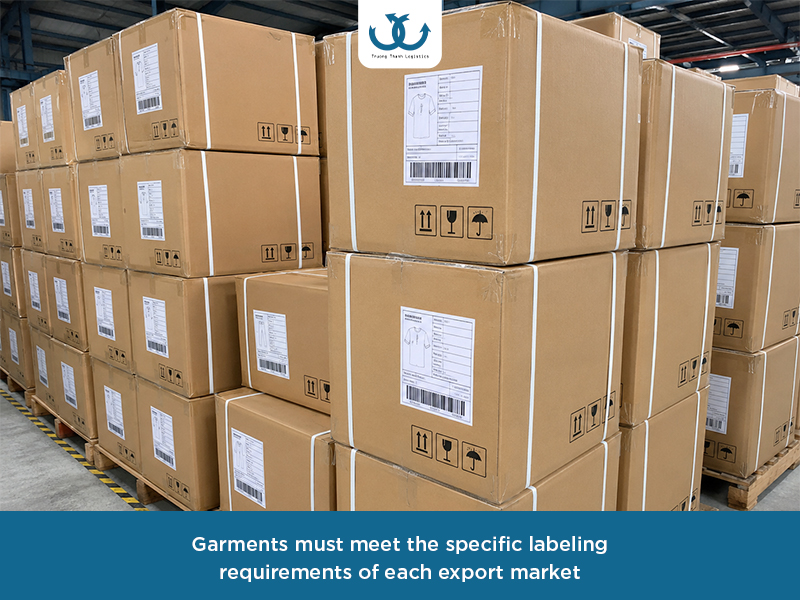
1. Why isn’t domestic clearance enough on its own?
Vietnam Customs only checks the validity of the paperwork, the HS code, and domestic export policy. Whether the shipment is accepted by customs or the importer at the destination depends on an entirely different set of rules – usually set by the destination country’s market regulator, consumer protection agency, or the buyer itself. For garments, these typically cover:
- Required labeling language and content
- Fiber composition and residual chemical limits
- Safety certification for specific product groups (children’s wear, skin-contact items)
2. Requirements in the US market
- Fiber content labeling: under the Textile Fiber Products Identification Act (TFPIA), the label must accurately list the percentage of each fiber making up the product.
- Care instructions (Care Labeling Rule): under the US Federal Trade Commission’s (FTC) 16 CFR Part 423, garments must carry clear washing, ironing, and drying instructions, usually shown with standard international symbols plus text.
- Flammability standards: under 16 CFR Part 1610, enforced by the US Consumer Product Safety Commission (CPSC), garment fabrics generally must meet a minimum flammability threshold. Children’s sleepwear is subject to the additional, significantly stricter standards 16 CFR Part 1615 and 1616 – so a single flammability requirement cannot be assumed to cover all children’s products.
- Country of origin marking: the label must clearly indicate the country of origin (e.g., “Made in Vietnam,” “Product of Vietnam”), in compliance with US Customs and Border Protection’s (CBP) Country of Origin Marking requirements – the law doesn’t mandate one fixed phrase, as long as the origin is clearly stated.
3. Requirements in the EU market
- REACH: a mandatory EU chemical-safety regulation applying to all textile products entering the EU regardless of origin. REACH controls numerous chemical groups such as azo dyes, phthalates, heavy metals, and other high-risk substances (not a single blanket limit for all textile products, but specific limits per substance group listed under the regulation). Beyond the legal requirement of REACH, many buyers also maintain their own Restricted Substances List/Manufacturing Restricted Substances List (RSL/MRSL) with stricter thresholds than the law itself — businesses should ask their partner whether a separate RSL/MRSL applies. Meeting REACH requirements requires coordination among the chemical supplier, the dyeing/weaving mill, the garment manufacturer, and the EU importer — with the EU importer bearing final legal responsibility once the product enters the market.
- EU textile labeling regulation (Regulation (EU) No 1007/2011): requires fiber composition to be labeled in the language of the country where the product is sold, using the correct fiber names from the regulation’s approved list.
- OEKO-TEX Standard 100: a voluntary certification (not a legal requirement), but many major EU buyers and retailers add OEKO-TEX to their mandatory supplier requirements (as part of their Restricted Substances List), especially for children’s wear and skin-contact items.
4. Requirements in the Japanese market
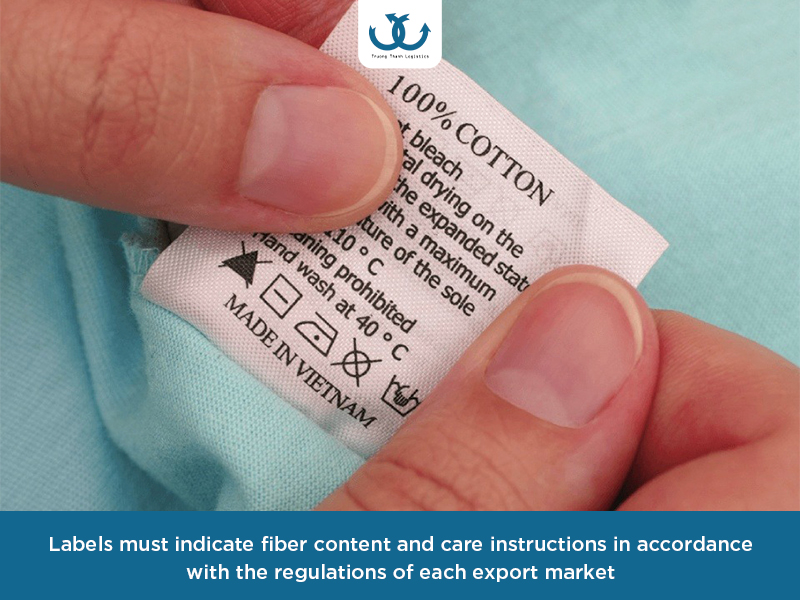
- Label language: goods sold in Japan must carry the required information in Japanese. In practice, this doesn’t necessarily have to be done by the exporter – many Japanese importers affix the Japanese label themselves after receiving the goods, or request the exporter prepare it in advance depending on the agreement.
- JIS L0001 standard: governs care-instruction symbols on garment labels in Japan.
- Required content: fiber composition ratio, washing/care instructions, manufacturer/importer name and address, product code.
- Label placement: usually required to be sewn permanently into the garment (collar, inner seam) rather than only on a removable hang tag.
5. Requirements in the South Korean market
- Label language: must be in Korean.
- Required content: origin, manufacturer/importer name, fiber composition, care instructions, size. (A factory code is not a general legal requirement – this is typically a specific request from certain buyers and shouldn’t be assumed to apply to every shipment.)
- Special case: some children’s products fall under the KC (Korea Certification) system, requiring testing and safety assessment before they can be sold.
This article focuses on Vietnam’s four largest garment export markets. For other markets such as Canada, Australia, the UK, or the Middle East, businesses should check each country’s specific requirements or contact Truong Thanh Logistics for tailored advice.
6. Cross-market certifications worth knowing
- OEKO-TEX Standard 100: controls residual chemicals in fabric and textile products, seen by many markets (not just the EU) as a mark of a reliable supplier.
- GOTS (Global Organic Textile Standard): for products made from organic fiber, often required by sustainability-focused brands.
- Social compliance certifications (BSCI, WRAP…): these don’t test product quality but assess factory working conditions – increasingly required by major buyers as a condition for long-term cooperation, even though they aren’t a legal customs requirement.
7. Checklist before shipping a garment export procedures
- Confirm the label language and content match the destination market’s requirements – don’t reuse a single label template across multiple markets.
- Check whether the buyer requires a specific certification (OEKO-TEX, GOTS…) under the contract, and how long it takes to obtain it before shipment.
- For children’s wear or skin-contact items, proactively ask your fabric supplier for chemical test results rather than waiting for the destination country to reject the shipment.
- Key details such as product description, origin, composition (where applicable), and quantity should be consistent between the labels and the export documentation to reduce risk during inspection at the destination.
8. Frequently asked questions – Garment export procedures
Do small businesses that export occasionally need to obtain certifications like OEKO-TEX right away? Not necessarily for every shipment — many certifications are required by specific buyers under contract, not a universal condition for clearance in every market. It’s best to check directly with your importing partner before deciding whether a certification is needed.
Are English-language labels accepted in Japan or South Korea? Generally, no. Both markets require labels in the local language (Japanese/Korean) for mandatory information such as fiber composition and care instructions.
If a shipment has already been exported and a labeling error is found at the destination, what happens? Depending on the country’s regulations, the goods may be held for relabeling, returned, or — in cases involving errors related to origin or C/O documentation – lose eligibility for preferential tariffs. This is why it’s important to check labeling carefully before packing for export, rather than dealing with it after the goods have shipped.
9. Truong Thanh Logistics – Supporting garment export procedures
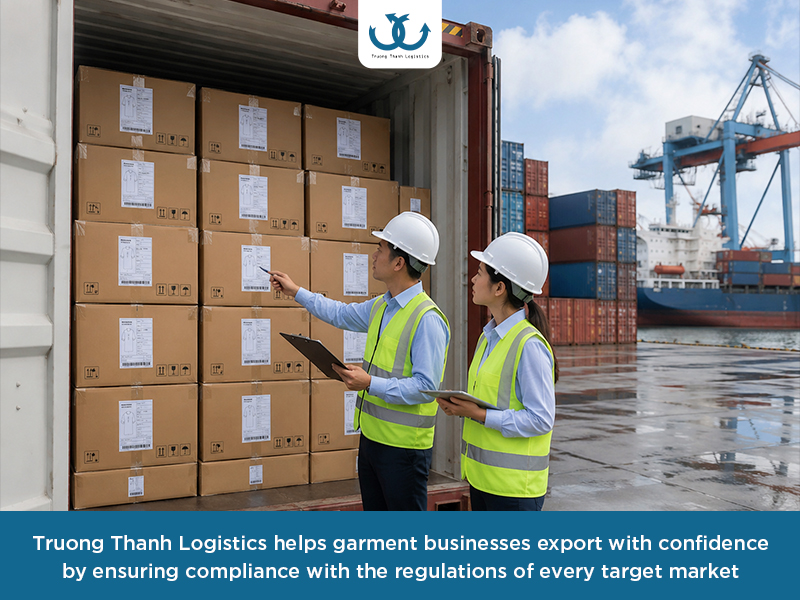
Beyond domestic customs procedures, Truong Thanh Logistics helps garment businesses with:
- Advice on labeling and documentation requirements for specific export markets
- Connecting comprehensive customs declaration services and applying for the right C/O under each trade agreement (Form D, AK, CPTPP, or EUR.1/Statement on Origin under the EVFTA for the EU market, etc.)
- Advice on the right transport mode – sea freight for large-volume orders, air freight for urgent fashion shipments
If your business needs advice specific to your export market, contact Truong Thanh Logistics directly:
Trường Thành Logistics – Professional & Dedicated
Hotline: +84 915 36 38 39
Head Office: 5th Floor, Tower A, Song Da Building, Pham Hung Street, Tu Liem Ward, Hanoi, Vietnam.
Email: sale@truongthanhjsc.com
info@truongthanhlogistics.com
Website: https://truongthanhlogistics.com
HAI PHONG BRANCH
Address: Room C103, TTC Building, 630 Le Thanh Tong Street, Hai An Ward, Hai Phong City, Vietnam.
DA NANG BRANCH
Address: 126 Chau Thi Vinh Te Street, Ngu Hanh Son Ward, Da Nang City, Vietnam.
HO CHI MINH CITY BRANCH
Address: Room 41, 4th Floor, Casanova Building, 85 Nguyen Son Street, Phu Thanh Ward, Ho Chi Minh City, Vietnam
Fanpage: TRƯỜNG THÀNH LOGISTICS
You can also read Textile and Garment Export Procedures: A Detailed Guide and Key Notes for the customs clearance process, HS codes, and C/O documentation in Vietnam.
References
- FTC – Care Labeling Rule (16 CFR Part 423)
- CPSC – Flammable Fabrics Act and related standards (16 CFR Part 1610, 1615, 1616)
- CBP – Country of Origin Marking Requirements
- European Commission – REACH Regulation
- Regulation (EU) No 1007/2011 on textile fibre names and labelling
- Consumer Affairs Agency (Japan) – Household Goods Quality Labeling Act
- Korean Agency for Technology and Standards (KATS)
Note: This article is for general reference, compiled from publicly available regulations for each market at the time of publication. Labeling, chemical, and certification requirements may change over time and vary by buyer, so businesses should confirm directly with their importing partner or the relevant regulatory authority before exporting.