Export procedures for electronic components are attracting significant attention from businesses as global demand for electronic equipment manufacturing continues to grow rapidly. However, electronic components are a category of goods subject to relatively strict management regarding HS codes, export policies, and customs documentation.
Therefore, businesses need to thoroughly understand electronic component export procedures in order to minimize risks arising during customs clearance and international transportation.
What Products Are Classified as Electronic Components?
Electronic components are products used for assembling or manufacturing complete electronic devices. This product category is highly diverse and is commonly classified according to functionality.
Common products include:
- Printed circuit boards (PCBs)
- Electronic chips
- Semiconductor ICs
- Resistors
- Capacitors
- Electronic sensors
- Electronic modules
- Electronic displays
- Electronic cables
- Power supply units
- Microelectronic devices
Each product category has its own HS code and management policy. Therefore, businesses must accurately identify technical specifications before proceeding with export procedures.
Are Electronic Components Prohibited from Export?
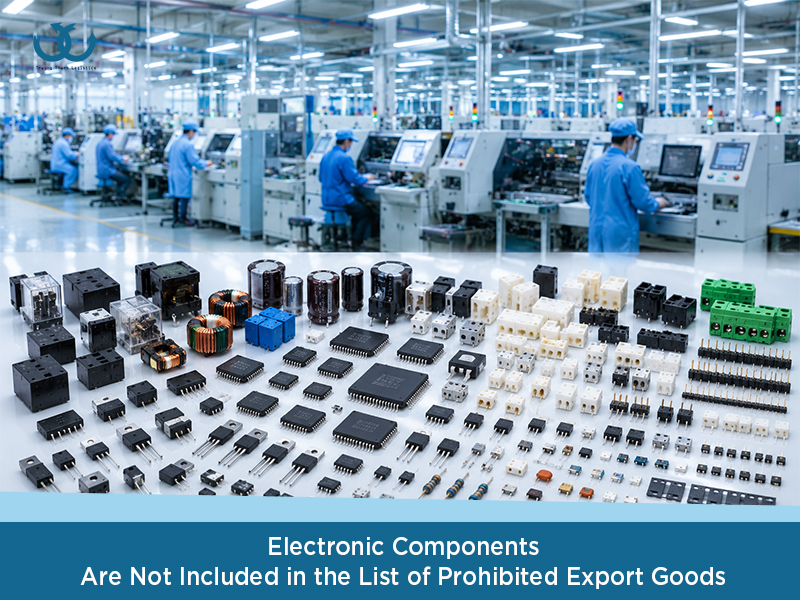
According to current regulations, most electronic components are not included in Vietnam’s list of prohibited export goods. Businesses may conduct export activities normally if they fully comply with relevant regulations.
However, certain specialized products may fall under:
- Specialized management
- Quality inspection
- Technology control
- Dual-use goods regulations
Particularly for high-tech components or products related to security applications, businesses should carefully review export policies before carrying out customs procedures.
Labeling Regulations for Exported Technology Products
Exported goods must strictly comply with labeling regulations. Product labels must clearly display basic information including:
- Product name
- Manufacturer name
- Country of origin (Made in Vietnam)
English is commonly used on export product labels.
Proper labeling helps facilitate customs inspection and clearance procedures.
Guidelines for HS Code Classification of Electronic Components
HS codes are the universal classification language used in international trade. Correct HS code declaration helps determine accurate tax obligations and management policies.
HS Code Categories for Electronic Products
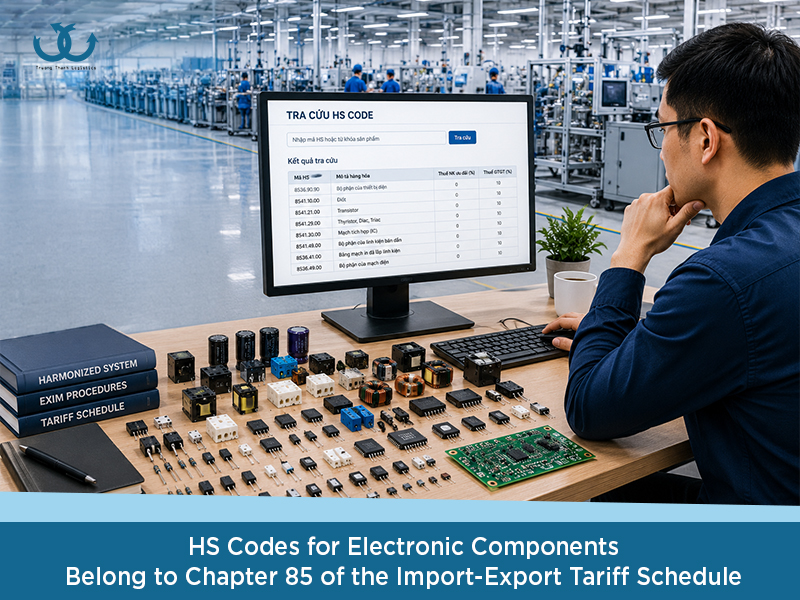
Electronic components are generally classified under Chapter 85 of the import-export tariff schedule. This chapter covers electrical machinery, electrical equipment, and their parts.
- HS Code 8534.00.00: Printed circuits
- HS Code 8541: Diodes, transistors, and similar semiconductor devices
- HS Code 8542: Integrated electronic circuits (Chips/ICs)
Due to the highly technical and diverse nature of electronic components, businesses must rely on technical documents such as datasheets for accurate HS classification.
Consulting specialists is strongly recommended to avoid legal and customs-related errors.
Export Tax Policy for Electronic Components
The Vietnamese government has introduced many incentive policies to promote technology exports. Currently, the export duty rate for most electronic components is 0%.
Businesses are also eligible for a 0% Value Added Tax (VAT) rate on exported goods. This provides significant economic advantages and enhances the competitiveness of Vietnamese products in international markets.
Preparing Documentation for Electronic Component Export Procedures
A complete and accurate customs documentation set is the key to fast customs clearance. Businesses should gather all required commercial documents before customs declaration.
What Does an Export Customs Documentation Set Include?
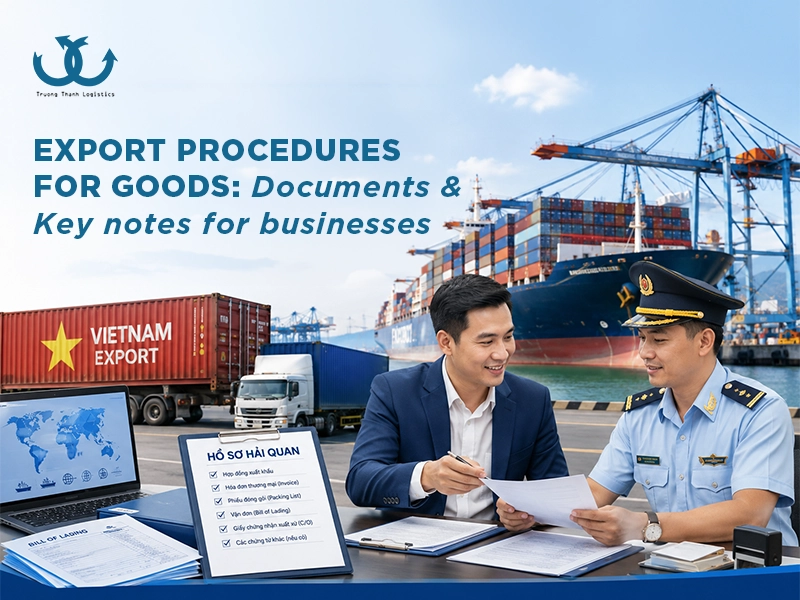
Customs declarants must prepare the following core documents:
- Commercial Invoice
- Detailed Packing List
- Official Sales Contract
- Bill of Lading or Airway Bill (AWB)
- Certificate of Origin (C/O) if requested by the buyer
Importance of the Certificate of Origin (C/O)
A Certificate of Origin serves as proof that the goods are manufactured in Vietnam. This document allows foreign importers to enjoy preferential import duties under free trade agreements.
Vietnam currently participates in many major trade agreements such as EVFTA and RCEP.
Businesses should apply for the appropriate C/O form to help partners optimize import costs.
Detailed Customs Clearance Procedures for Exporting Electronic Components
The customs clearance process is conducted through modern electronic systems. Businesses must strictly follow standardized procedures.
Step 1: Customs Declaration Through the VNACCS/VCIS System
The customs declarant enters all shipment data into the electronic customs software system. All information must be completely accurate and consistent with the original documentation.
The General Department of Customs system will automatically classify the declaration into different inspection channels.
Green Channel
The shipment is immediately cleared through the system.
Yellow Channel
Customs authorities conduct detailed document inspection.
Red Channel
The shipment undergoes physical inspection at the port or customs yard.
Step 2: Complete Customs Clearance Procedures at the Customs Branch
For yellow and red channel declarations, staff must present documentation at the port.
Businesses may need to explain technical specifications if requested by customs officers. Once the inspection is completed successfully, the customs declaration will be approved for clearance.
Step 3: Finalize Customs Procedures and Deliver Goods to the Carrier
Businesses proceed with payment of port handling and cargo handling fees.
The goods are then handed over to the shipping line for sea transportation or to the airline for international air freight transportation.
Important Notes for Packaging and Transporting Electronic Components
Electronic components are high-value products and are highly vulnerable to damage. Transportation therefore requires extremely strict packaging standards.
Use Specialized Anti-Static Packaging
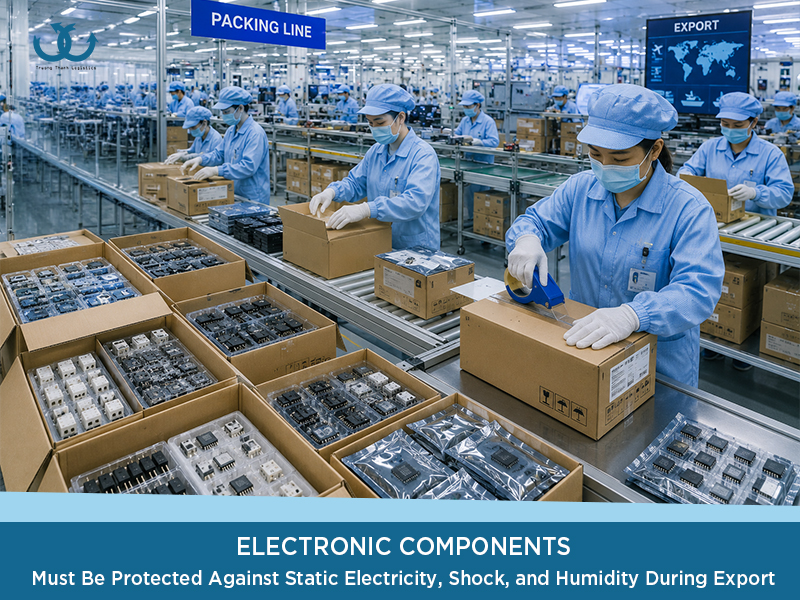
Static electricity can damage internal chips and circuits. Therefore, products should be packed in anti-static bags before being placed into cartons.
Use Adequate Shock-Absorbing Materials
Cartons should be lined with foam pellets or bubble wrap to minimize impact during cargo handling and transportation.
Strictly Control Humidity Levels
Moisture is one of the biggest threats to electronic circuit boards.
Businesses should place industrial desiccant packs inside each carton to reduce humidity during transportation.
Choose the Appropriate Transportation Method
For urgent and high-value shipments, air freight is usually the preferred option.
Sea freight is more suitable for large-volume shipments to optimize logistics costs.
Truong Thanh Logistics – A Trusted Partner for Electronic Component Export Procedures
If your business is facing difficulties with electronic component export procedures, Truong Thanh Logistics is ready to support you. We are proud to be a reputable and long-established logistics brand in Vietnam.
About Truong Thanh Logistics
Truong Thanh Logistics has a team of experts with deep knowledge of high-tech cargo handling. We have many years of practical experience in processing complex electronic shipments.
Our office network is present at all major seaports and airports. We are always ready to handle arising situations quickly and efficiently.
Services Provided by Truong Thanh Logistics
| Service Category | Commitments and Customer Benefits |
| Customs Declaration | Accurate customs processing to minimize the risk of red-channel inspection |
| HS Code Consultation | Free analysis of technical documents and HS code classification |
| International Freight | Competitive sea freight and air freight solutions |
| Certificate of Origin Support | Fast processing of C/O applications for businesses |
The Distinctive Value Truong Thanh Logistics Brings to Businesses
Truong Thanh Logistics does more than simply handling administrative procedures. We provide businesses with comprehensive logistics solutions aimed at optimizing the entire supply chain.
Our professional workflow helps businesses save significant time and warehousing costs. We continuously update ourselves on the latest customs regulations and tariff policy changes.
This allows us to provide practical advice that helps businesses maximize their legal and financial benefits.
At Truong Thanh Logistics, we always treat our customers’ cargo as our own valuable assets.
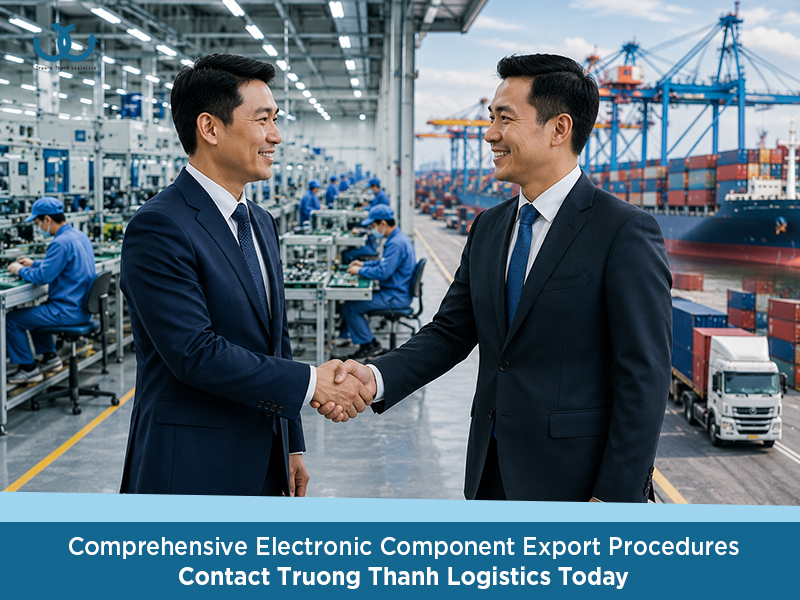
Completing electronic component export procedures requires careful attention to detail and strong technical expertise. Businesses should not underestimate the importance of document preparation, as mistakes may directly affect delivery schedules.
Let Truong Thanh Logistics become your trusted logistics partner.
Trường Thành Logistics – Professional & Dedicated
Hotline: +84 915 36 38 39
Head Office: 5th Floor, Tower A, Song Da Building, Pham Hung Street, Tu Liem Ward, Hanoi, Vietnam.
Email: sale@truongthanhjsc.com
info@truongthanhlogistics.com
Website: https://truongthanhlogistics.com
HAI PHONG BRANCH
Address: Room C103, TTC Building, 630 Le Thanh Tong Street, Hai An Ward, Hai Phong City, Vietnam.
DA NANG BRANCH
Address: 126 Chau Thi Vinh Te Street, Ngu Hanh Son Ward, Da Nang City, Vietnam.
HO CHI MINH CITY BRANCH
Address: Room 41, 4th Floor, Casanova Building, 85 Nguyen Son Street, Phu Thanh Ward, Ho Chi Minh City, Vietnam
Fanpage: TRƯỜNG THÀNH LOGISTICS