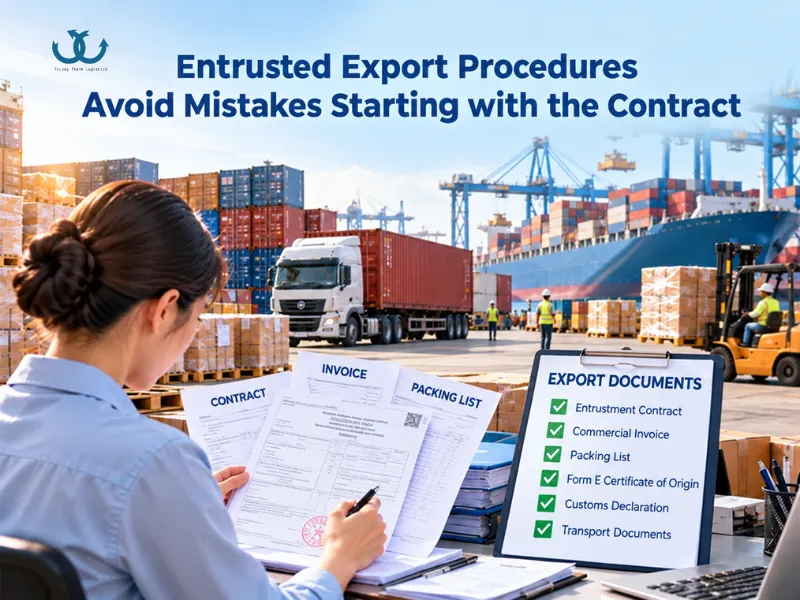
Fresh fruit export is becoming one of the fastest-growing sectors in Vietnam, thanks to its tropical climate, abundant supply, and strong demand from international markets. Fruits such as mango, dragon fruit, durian, and banana have been successfully entering demanding markets like the US, EU, Japan, and South Korea.
However, unlike many other commodities, fresh fruits are highly perishable and require strict control over storage and quality inspection. Therefore, to ensure successful export, businesses must clearly understand legal procedures, export processes, and key technical requirements to guarantee that products meet standards and reach buyers in optimal condition.
1. Overview of Fresh Fruit Export
Fresh fruit export refers to the process of supplying unprocessed or minimally processed fruits to international markets through various trade methods such as direct export, entrusted export, or via intermediaries.
Compared to dried or processed agricultural products, fresh fruits have distinct characteristics:
- Short shelf life
- Highly sensitive to temperature, humidity, and physical impact
- Strict requirements on phytosanitary control and food safety
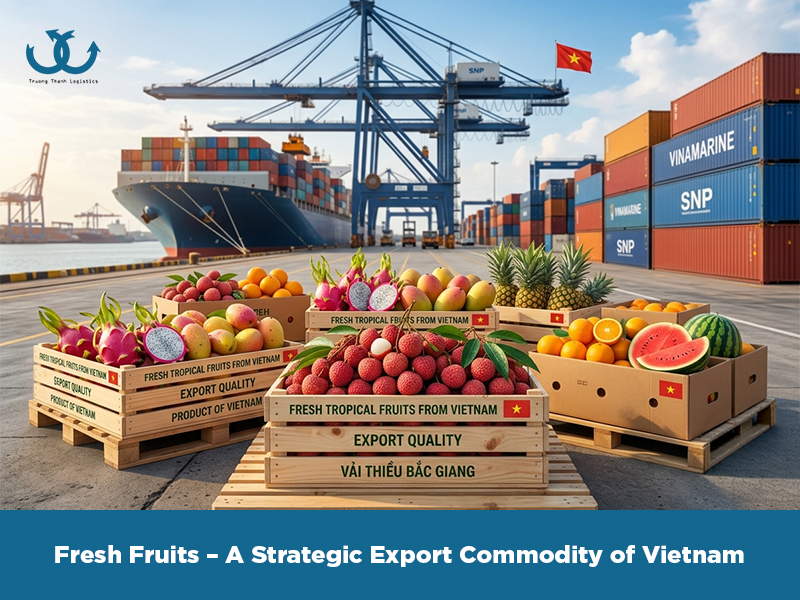
Common Exported Fruits
- Tropical fruits: mango, dragon fruit, banana, durian
- Seasonal fruits: lychee, longan, rambutan
- High-value fruits: pomelo, coconut, jackfruit
Each type of fruit has specific requirements regarding quality standards, packaging, and transportation depending on the importing market.
Key Export Markets
Vietnamese fresh fruits are currently exported to many countries and regions, including:
- China: the largest market, with increasing requirements on traceability and packaging standards
- The US and EU: highly regulated markets with strict phytosanitary requirements, including irradiation or hot water treatment
- Japan and South Korea: prioritize high quality, appearance, and strict food safety standards
- The Middle East and ASEAN: emerging markets with growing demand
Development Trends
The fresh fruit export sector is showing several key trends:
- Increased application of post-harvest preservation technologies to extend shelf life and maintain quality
- Expansion of cold chain logistics to ensure freshness upon delivery
- Shift toward official (formal) export channels with full compliance in quarantine, packaging, and labeling
- Focus on high-value markets rather than volume growth
2. Detailed Procedures for Fresh Fruit Export
Fresh fruit export procedures require strict compliance with regulations on quarantine, food safety, and export documentation. The basic steps include:
Step 1: Verify Export Eligibility
- Confirm whether the fruit is permitted for export to the target market
- Check requirements for:
- Growing Area Code
- Packing House Code
- Ensure the product meets the importing country’s standards
Step 2: Prepare the Goods
- Harvest at the appropriate time to ensure quality
- Conduct preliminary processing, sorting, and treatments (washing, disinfection, irradiation, or heat treatment if required)
- Package according to standards (packaging materials, labeling, traceability)
Step 3: Phytosanitary Inspection
- Register for inspection with the competent authority
- The authority inspects the shipment
- Issue a Phytosanitary Certificate if requirements are met
Step 4: Prepare Export Documentation
Basic document set includes:
- Sales Contract
- Commercial Invoice
- Packing List
- Bill of Lading / Airway Bill
- Certificate of Origin (C/O – if required)
- Phytosanitary Certificate
Additional food safety or quality inspection documents may be required depending on the market.
Step 5: Customs Declaration
- Submit electronic customs declaration
- Provide required documents and wait for clearance classification (green, yellow, red channel)
- Coordinate inspection if required
Step 6: Transportation and Delivery
- Select appropriate transport method:
- Sea freight (reefer container)
- Air freight (for high-value, time-sensitive goods)
- Monitor temperature and storage conditions throughout transit
- Deliver goods according to agreed Incoterms
Important Notes
- Cold chain must be strictly maintained from post-harvest to final delivery
- Errors in inspection or documentation may result in shipment rejection or destruction
- Regulations should be updated regularly as requirements frequently change
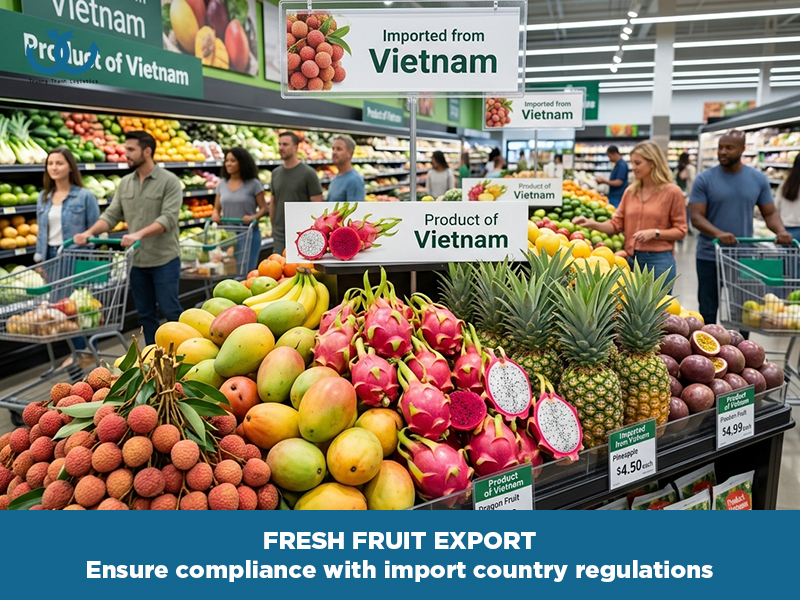
3. Practical Export Process of Fresh Fruits
Fresh fruit export is not just about procedures, but a continuous operational chain from farm to end customer. Any disruption in one stage can affect the entire shipment.
Step 1: Order Confirmation
Confirm product type, quantity, quality standards, packaging specifications, delivery timeline, Incoterms, and payment terms.
Step 2: Raw Material Preparation
Select certified growing areas with valid codes and plan harvesting schedules aligned with shipping timelines.
Step 3: Harvesting and Treatment
Harvest at the correct maturity stage. Perform sorting, remove defective items, and apply required treatments such as irradiation or heat treatment depending on market requirements.
Step 4: Packaging and Storage
Pack according to export standards, label with traceability information, and store in cold facilities before shipment.
Step 5: Transport Booking
Book reefer containers or flights and set appropriate temperature conditions for each type of fruit.
Step 6: Inspection and Customs
Conduct phytosanitary inspection, obtain certificates, and complete customs clearance procedures.
Step 7: Loading and Shipment
Load goods into reefer containers, seal, and transport to port or airport.
Step 8: Monitoring and Delivery
Track shipment progress, monitor temperature conditions, and send documents to the importer.
Step 9: Completion
Confirm delivery, reconcile costs, and proceed with payment.
4. Transportation Methods for Fresh Fruits
Transportation plays a critical role in maintaining product quality, delivery time, and overall cost.
4.1. Sea Freight (Reefer Container)
- Suitable for large shipments
- Lower cost
- Requires strict temperature control
4.2. Air Freight
- Fast transit time
- Suitable for high-value fruits
- Higher cost
4.3. Road Transport
- Suitable for nearby markets
- Flexible with moderate transit time
The choice of transport method depends on the type of fruit and market requirements.
5. Effective Fresh Fruit Export Solutions with Truong Thanh Logistics
Fresh fruit export is not only about transportation but a comprehensive process involving sourcing, quality control, logistics, and compliance. Due to the perishable nature and strict import requirements, businesses need an integrated solution to minimize risks and optimize costs.
Truong Thanh Logistics provides end-to-end solutions to help businesses manage the entire export process efficiently.
Market Consultation and Export Conditions
- Verify export eligibility for each market
- Advise on growing area and packing house codes
- Update phytosanitary and quality standards
Export Procedures and Documentation
- Handle phytosanitary inspection
- Prepare full documentation: Invoice, Packing List, C/O, Bill of Lading
- Execute accurate and fast customs declaration
Optimized Transportation Solutions
- Provide high-quality reefer containers with stable temperature control
- Select suitable transport modes: sea transport, air, or road
- Continuously monitor shipment status
Cost and Time Optimization
- Plan shipments based on vessel/flight schedules
- Optimize routes and transport methods
- Minimize unnecessary costs
Ongoing Support and Issue Handling
- Support throughout the export process
- Provide real-time shipment updates
- Ensure on-time and compliant delivery
Value Delivered by Truong Thanh Logistics
- Clear and efficient export process
- Reduced risks in quality and compliance
- Optimized logistics costs
- Enhanced competitiveness in international markets
With practical experience in logistics and agricultural exports, Truong Thanh Logistics is not only a service provider but also a strategic partner, helping businesses build a professional and sustainable fresh fruit export process.
Trường Thành Logistics – Professional & Dedicated
Hotline: +84 915 36 38 39
Head Office: 5th Floor, Tower A, Song Da Building, Pham Hung Street, Tu Liem Ward, Hanoi, Vietnam.
Email: sale@truongthanhjsc.com
info@truongthanhlogistics.com
Website: https://truongthanhlogistics.com
HAI PHONG BRANCH
Address: Room C103, TTC Building, 630 Le Thanh Tong Street, Hai An Ward, Hai Phong City, Vietnam.
DA NANG BRANCH
Address: 126 Chau Thi Vinh Te Street, Ngu Hanh Son Ward, Da Nang City, Vietnam.
HO CHI MINH CITY BRANCH
Address: Room 41, 4th Floor, Casanova Building, 85 Nguyen Son Street, Phu Thanh Ward, Ho Chi Minh City, Vietnam