Textile export procedures are an important process for Vietnamese businesses. This process includes everything from preparing goods to customs clearance.
The article below provides a comprehensive overview of the implementation steps.
1. Overview of the Textile Industry and Export Demand
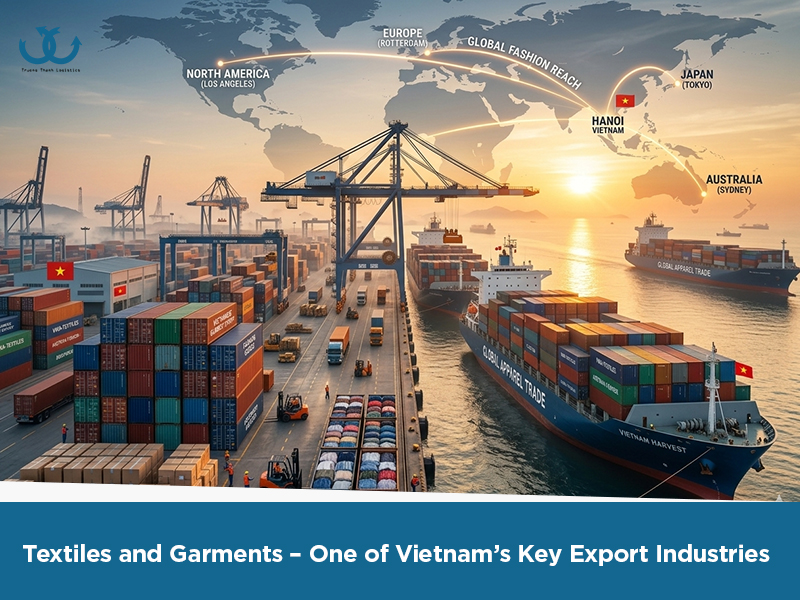
Vietnam’s textile and garment industry is experiencing strong growth. Free Trade Agreements (FTAs) have opened up many major opportunities.
However, technical barriers in importing countries are also very strict. Understanding textile export procedures helps businesses become more confident. Enterprises can avoid risks related to shipment delays.
The Importance of Properly Understanding Procedures
Each country has its own regulations regarding imported textile products. If preparations are not thorough, goods may be held at the port. This can cause significant financial losses for manufacturers. Properly understanding the process helps businesses operate smoothly and professionally.
Key Export Markets
The United States, the EU, Japan, and South Korea are currently the largest markets. Each market requires different types of quality certifications. Businesses need to carefully study the regulations of the importing country before signing contracts.
Truong Thanh Logistics is always ready to support you in understanding this information.
2. Legal Basis and Export Policies for Textile Products
Before getting started, businesses need to clearly understand the relevant government regulations. Textile products are currently not subject to export prohibition or restriction.
Relevant Decrees and Circulars
Businesses should refer to Decree No. 69/2018/ND-CP on foreign trade management. In addition, Circular No. 39/2018/TT-BTC provides detailed guidance on customs procedures. Compliance with legal regulations is a mandatory condition for customs clearance.
Regulations on Textile Product Labeling
Labels are one of the most frequently inspected items at border checkpoints. Labels must clearly state the country of origin as “Made in Vietnam.” Fiber material composition must be accurately listed according to percentage ratios.
Washing and care instructions must also be fully included. Incorrect labeling may result in severe administrative penalties.
3. HS Codes and Export Tariffs for Textile Products
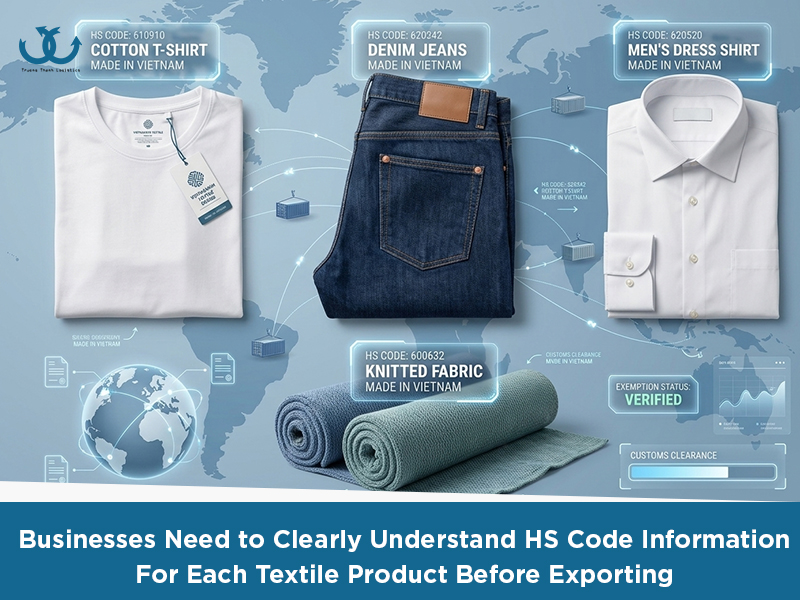
Determining the correct HS code is the most difficult step in textile export procedures. This serves as the basis for tax calculation and the application of product policies.
How to Accurately Look Up HS Codes
Textile products are generally classified under Chapters 61, 62, and 63.
- Chapter 61: Knitted or crocheted apparel.
- Chapter 62: Non-knitted or non-crocheted apparel.
- Chapter 63: Other made-up textile articles such as blankets, bedsheets, and pillows.
Each type of garment has a detailed 8-digit HS code. Applying the wrong HS code may be considered tax fraud.
Export Tax and Value-Added Tax (VAT)
Textile exports currently have an export tax rate of 0%. Businesses are also entitled to a 0% VAT rate for exported goods. This policy aims to encourage production and overseas exports.
However, businesses must provide sufficient non-cash payment documents. Keep all input invoices carefully for future VAT refund procedures.
4. Process for Implementing Textile Export Procedures
Truong Thanh Logistics would like to guide you through a 5-step process for customs clearance.
Step 1: Sign Contracts and Prepare Goods
The sales contract must clearly specify delivery terms (Incoterms). Goods must be manufactured according to the agreed specifications and quality standards.
Quantity inspection and packaging must be carried out carefully. Do not forget to attach compliant labels to each individual product.
Step 2: Apply for a Certificate of Origin (C/O)
The C/O is the key document that allows your partner to receive import tax incentives. Depending on the destination country, different C/O forms will apply.
- Form D: For ASEAN countries.
- Form AK: For the South Korean market.
- CPTPP Form: For member countries of the CPTPP agreement.
C/O application documents should be prepared early to avoid affecting shipping schedules.
Step 3: Submit Customs Declarations Through the Electronic System
Businesses use ECUS/VNACCS software to submit customs declarations electronically. All information regarding product names, HS codes, and customs value must be accurate. After submission, the system will return the declaration channel classification result.
- Green Channel: Goods are cleared, and a barcode can be printed for cargo release.
- Yellow Channel: Customs authorities inspect the paper documentation in detail.
- Red Channel: Physical inspection of goods at the port yard or CFS warehouse.
Step 4: Arrange International Transportation
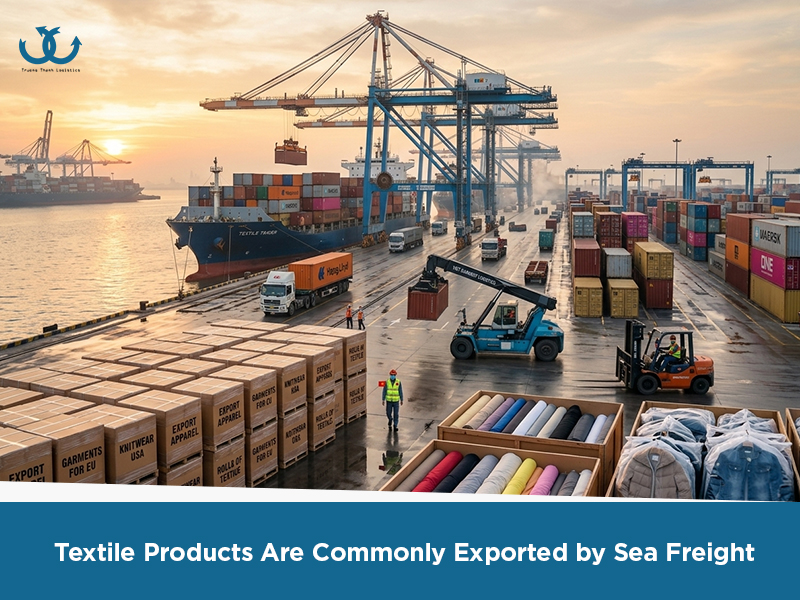
After customs clearance, businesses need to contact a forwarder to book cargo space. Choose a suitable transportation method such as sea transport, road transport, rail transport, or International Freight Transportation.
Sea freight is usually cheaper but takes longer. Air freight is suitable for urgent fashion orders. Truong Thanh Logistics will advise you on the most optimal transportation solution.
Step 5: Complete the Document Set for the Buyer
You need to send the original document set to the customer to ensure a smooth cargo release process. The document set usually includes invoices, packing lists, and bills of lading.
If there are errors in the documents, the customer may not be able to receive the goods. Carefully cross-check all data among the documents.
5. Complete Customs Documentation for Textile Exports
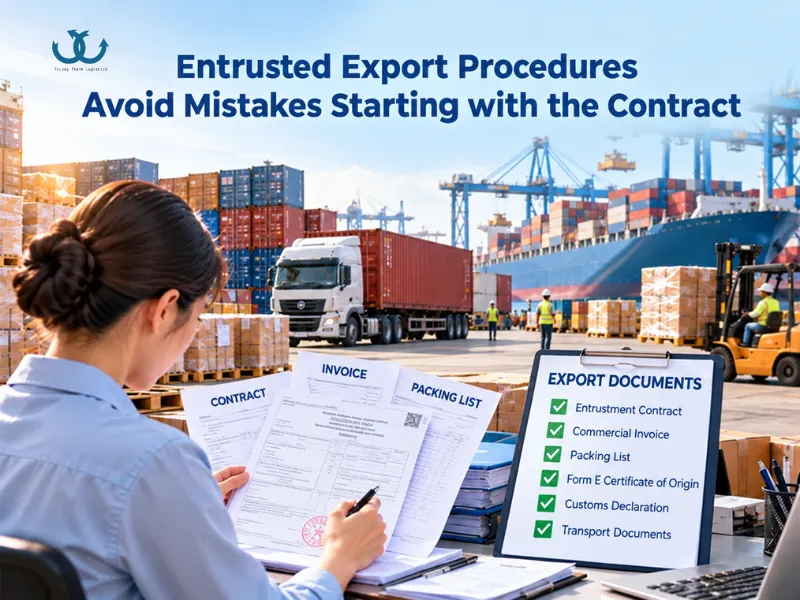
To complete textile export procedures, businesses need to prepare the following documents:
- Commercial Invoice: Clearly stating the payment amount.
- Packing List: Detailed description of cargo packing methods.
- Sales Contract: Legal basis between the two parties.
- Customs Declaration: Confirmation of successful customs submission.
- Bill of Lading: Document confirming ownership of sea cargo.
- Certificate of Origin (C/O): If applicable.
6. Important Notes for Exported Textile Products
Textile products have specific characteristics that businesses need to pay attention to. These details may lead to disputes if not clarified properly.
Phytosanitary Inspection and Quality Control
Some markets require testing for chemical residue levels in fabrics. Businesses must ensure fabrics do not contain prohibited substances harmful to human skin. If exporting natural fibers, products may require phytosanitary inspection.
Request quality certificates from fabric suppliers.
Moisture and Mold Control During Transportation
Garments are highly susceptible to moisture and mold during long sea voyages. Containers must be carefully inspected to prevent leaks or water penetration. Businesses should use desiccant bags inside cartons. Vacuum-sealed plastic packaging is also an effective solution.
7. Common Mistakes in Textile Export Procedures
Many new businesses often make avoidable mistakes. These errors significantly increase storage and port charges.
Incorrect Product Description and Classification
The product description on the customs declaration must match the invoice and labels. Generic descriptions such as “clothing” are often not accepted. Businesses should provide detailed descriptions such as: “Men’s trousers, 100% cotton material.”
Clear descriptions help customs officers verify goods more easily.
Missing Documents in the Customs File
Many businesses forget to apply for a C/O or apply too late. As a result, customers may not receive the expected tax incentives.
Document preparation should be carried out simultaneously with production. Create a checklist to avoid missing any paperwork.
Lack of Understanding of Rules of Origin
To obtain a C/O, goods must meet the required localization ratio. For example, the cutting and sewing processes must be performed in Vietnam. If businesses simply import products and relabel them, they will not qualify for a C/O. Understanding the rules of origin helps maximize the benefits of FTAs.
8. Why Choose Truong Thanh Logistics?
Truong Thanh Logistics is proud to be a reputable company in international freight forwarding. We thoroughly understand every aspect of textile export procedures.
A Team of Highly Experienced Experts
We have a team of staff with in-depth knowledge of HS codes. Truong Thanh Logistics has handled thousands of complex garment shipments. We constantly update the latest changes in customs regulations. The dedication of our team gives customers complete peace of mind in production activities.
Global Multimodal Transportation Solutions
We have an extensive network of agents worldwide. Truong Thanh Logistics provides multimodal transportation services with the most competitive freight rates on the market today. Your goods will be transported quickly and with absolute safety.
Comprehensive Customs Procedure Support
We help you prepare the most accurate export documentation set. Truong Thanh Logistics represents businesses in working with customs authorities and provides customs declaration services. We quickly handle issues arising during the customs clearance process.
Our goal is to ensure your cargo flow never stops.
9. Conclusion
Properly implementing textile export procedures is the key to success. It helps enhance the value of Vietnamese garment brands in the global market. Do not let procedural complications hinder your business growth.
Truong Thanh Logistics is always ready to accompany your global expansion journey. We are committed to providing the highest quality and most reliable logistics services. Contact us today for free consultation.
Trường Thành Logistics – Professional & Dedicated
Hotline: +84 915 36 38 39
Head Office: 5th Floor, Tower A, Song Da Building, Pham Hung Street, Tu Liem Ward, Hanoi, Vietnam.
Email: sale@truongthanhjsc.com
info@truongthanhlogistics.com
Website: https://truongthanhlogistics.com
HAI PHONG BRANCH
Address: Room C103, TTC Building, 630 Le Thanh Tong Street, Hai An Ward, Hai Phong City, Vietnam.
DA NANG BRANCH
Address: 126 Chau Thi Vinh Te Street, Ngu Hanh Son Ward, Da Nang City, Vietnam.
HO CHI MINH CITY BRANCH
Address: Room 41, 4th Floor, Casanova Building, 85 Nguyen Son Street, Phu Thanh Ward, Ho Chi Minh City, Vietnam
Fanpage: TRƯỜNG THÀNH LOGISTICS