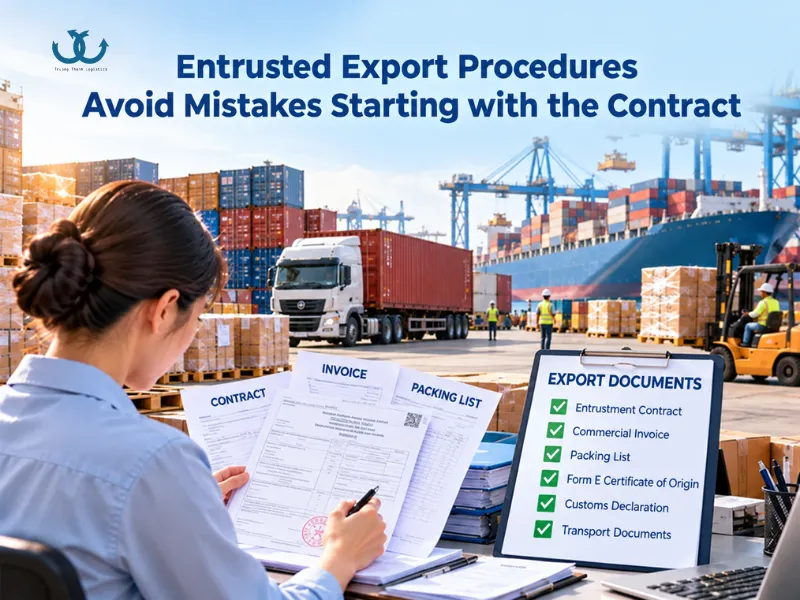
Entrusted import-export services are a solution for businesses and individuals who wish to trade goods with foreign partners but lack experience in handling international trade transactions, documentation, and customs procedures.
How does entrusted import-export work? What costs are involved? What are the responsibilities of each party, and what legal considerations should you be aware of? This article provides a comprehensive A-to-Z guide.
What Is Entrusted Import-Export?
Entrusted import-export is a form of commercial arrangement in which one party authorizes another trader to purchase or sell goods with a foreign partner under an entrustment agreement in exchange for a service fee. The entrusted party conducts the transaction in its own name, in accordance with the agreement between the two parties.
This activity is primarily governed by Articles 155–165 of Vietnam’s 2005 Commercial Law.
An entrusted import-export transaction typically involves three parties:
- Entrusting party: An individual or organization that wishes to export or import goods and provides relevant information and documentation.
- Entrusted party: A trader that meets the business requirements for the relevant goods and carries out foreign trade transactions and other assigned tasks.
- Foreign partner: The supplier of goods in an import transaction or the buyer in an export transaction.
What Is Entrusted Importation?
Entrusted importation is an arrangement in which the entrusted party conducts the transaction to purchase goods from overseas, handles import procedures, makes payments as agreed, and delivers the goods in Vietnam to the entrusting party.
What Is Entrusted Exportation?
Entrusted exportation is an arrangement in which the entrusted party conducts sales transactions with foreign buyers, prepares the necessary documentation, handles export procedures, coordinates transportation, and settles the proceeds with the entrusting party.
When Should Businesses Choose Entrusted Import-Export Services?
Businesses and individuals may consider using entrusted import-export services in the following situations:
- They lack experience in handling international trade transactions and import-export procedures.
- They have not established a dedicated team for documentation, customs clearance, and international payments.
- They need assistance with goods subject to licensing requirements or specialized regulatory controls.
- Their shipment volume is relatively small, making it unnecessary to maintain a separate import-export team.
- They need a service provider to coordinate with overseas suppliers, buyers, and transportation companies.
Legal Requirements for Entrusted Import-Export Activities
Under Article 156 of Vietnam’s 2005 Commercial Law, the party entrusted with purchasing or selling goods must be a trader conducting business in goods that are appropriate to the goods covered by the entrustment arrangement.
In addition to this requirement, both parties should pay attention to the following matters:
- Customs declarant requirements: The entity responsible for submitting customs declarations must meet the requirements stipulated in the Customs Law and its current implementing regulations.
- Goods policies: Goods must not fall within the list of prohibited imports or exports. Goods subject to restrictions or conditions must comply with the relevant regulations.
- Specialized regulatory controls: Certain products, such as cosmetics, food, medical devices, and chemicals, may require licenses, product declarations, registration, or specialized inspections.
- Documentation and taxes: The documentation must accurately reflect the nature of the transaction, customs value, origin, and applicable tax obligations.
Customs procedures should be reviewed against the regulations currently in force, including Decree No. 08/2015/ND-CP and its amendments and supplements, as well as Circular No. 121/2025/TT-BTC, which takes effect on February 1, 2026.
What Are the Steps in the Entrusted Import-Export Process?
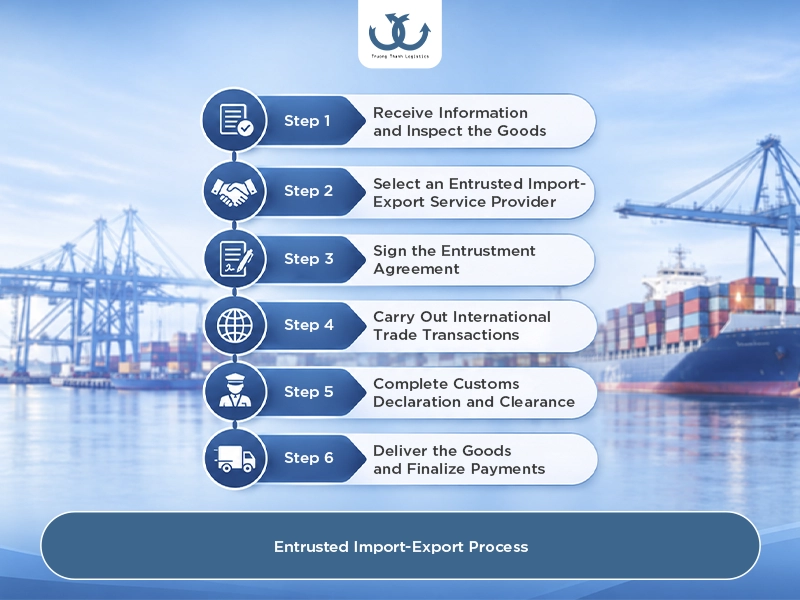
Typically, an entrusted shipment is handled through the following six steps:
Step 1: Receive Information and Inspect the Goods
Identify the product name, quantity, value, origin, and preliminary HS code, then review the applicable regulatory policies. Check whether the goods are prohibited, restricted, subject to licensing requirements, or required to undergo specialized inspection.
Step 2: Select an Entrusted Import-Export Service Provider
Evaluate the provider’s legal status, experience in handling the relevant goods, customs declaration capabilities, and ability to coordinate transportation.
Step 3: Sign the Entrustment Agreement
Agree on the scope of work, service fees, payment methods, tax responsibilities, documentation requirements, and procedures for handling unexpected situations.
Step 4: Carry Out International Trade Transactions
The entrusted party conducts the purchase or sale of goods with the foreign partner under the relevant contract and the lawful instructions of the entrusting party.
Step 5: Complete Customs Declaration and Clearance
Prepare the required documentation, submit customs declarations, pay applicable taxes, and coordinate specialized inspections if necessary. Goods may only be cleared through customs once all regulatory requirements have been met.
Step 6: Deliver the Goods and Finalize Payments
Arrange transportation, hand over the goods, complete the documentation, reconcile outstanding balances, and settle the entrustment service fees and any additional costs.
What Should an Entrusted Import-Export Agreement Include?
Under Article 159 of Vietnam’s 2005 Commercial Law, an agreement for entrusted goods purchase or sale must be made in writing or in another legally equivalent form.
The agreement should clearly specify the following key terms:
- Product name, quantity, quality, value, and delivery terms.
- Scope of work and authority of the entrusted party.
- Entrustment service fees, taxes, transportation costs, and payment methods.
- Responsibilities for providing documents, obtaining licenses, and completing specialized inspections.
- Responsibilities concerning HS codes, customs value, origin, and declaration information.
- Ownership of the goods and the time of handover.
- Procedures for handling situations in which goods are detained, denied customs clearance, or subject to additional tax assessments.
- Performance deadlines and dispute resolution mechanisms.
In particular, under Article 160 of Vietnam’s 2005 Commercial Law, the entrusted party may not re-entrust the transaction to a third party without the entrusting party’s written consent.
Responsibilities of Each Party in an Entrusted Import-Export Transaction
What Are the Responsibilities of the Entrusted Party?
- Carry out the purchase or sale of goods in accordance with the entrustment agreement.
- Handle customs declarations, payments, and transportation within the agreed scope of work.
- Provide information and documentation and hand over the goods as agreed.
- Promptly notify the entrusting party of any issues that may affect the shipment.
- Be responsible for violations arising from its own breaches or faults within the scope of its obligations.
What Are the Responsibilities of the Entrusting Party?
- Provide accurate and complete information about the goods and relevant documentation.
- Transfer payment for the goods, taxes, and other fees as agreed.
- Cooperate in providing explanations and supplementary documents when requested.
- Receive the goods and fulfill payment obligations on time.
- Be responsible for inaccurate information or violations arising from its side, in accordance with applicable laws and the agreement.
Both parties should clearly define their respective responsibilities. The entrusted party does not automatically assume all legal liabilities on behalf of the entrusting party in every situation.
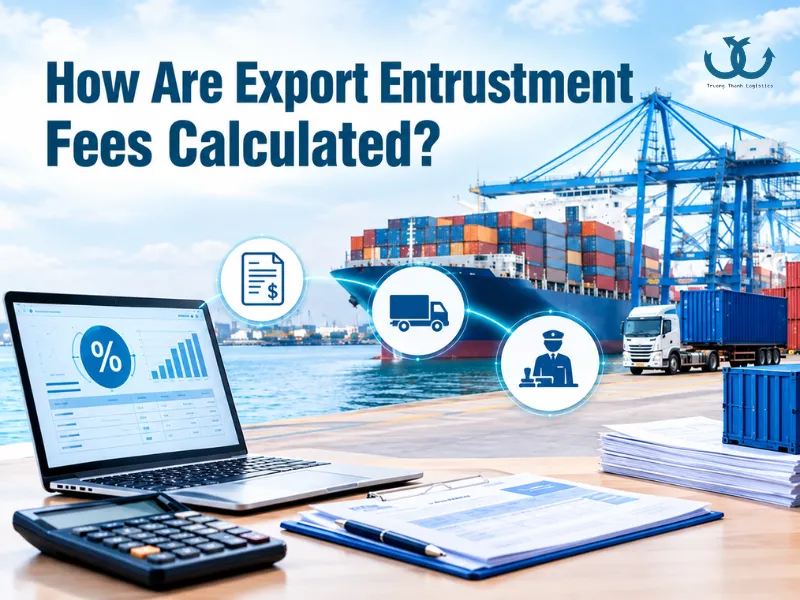
How Are Entrusted Import-Export Service Fees Calculated?
Entrusted import-export service fees are negotiated between the two parties. They are generally calculated as a percentage of the shipment value or as a fixed package fee, depending on the scope of services.
Common cost items include:
| Cost Item | Description |
|---|---|
| Entrustment service fee | Remuneration paid to the entrusted service provider |
| Goods payment | Payment value for goods purchased from the foreign partner |
| Import and export duties | Taxes calculated according to the HS code and applicable tax policies |
| Freight charges | Sea, air, road, or rail transportation costs |
| Port and customs fees | Charges related to the shipment and customs procedures |
| Specialized inspection fees | Testing, quarantine, and licensing fees, if applicable |
| Additional expenses | Cargo insurance, warehousing, storage, and bank charges |
To manage their budgets effectively, businesses should request a detailed quotation that clearly distinguishes between included service fees and excluded expenses.
Why Choose Truong Thanh Logistics for Entrusted Import-Export Services?
If you need a partner with expertise in import-export procedures who can support you from licensing to final delivery, Truong Thanh Logistics is a service provider worth considering:
- More than 10 years of experience in international freight forwarding, supported by an agency network in multiple countries.
- Office network in Hanoi, Hai Phong, Da Nang, and Ho Chi Minh City, providing convenient access to direct support.
- Industry-specific expertise: Cosmetics, dried food, dietary supplements, fashion products, electronic components, and goods requiring licenses, such as alcoholic beverages and medical devices.
- Multimodal transportation: Sea freight, air freight, road freight, and rail freight.
- Integrated services: Customs clearance for goods, import-export licensing services, Certificate of Origin (C/O) application services, cargo insurance, sea freight services, and more.
Frequently Asked Questions About Entrusted Import-Export
Question 1: What is entrusted import-export?
It is an arrangement in which one party authorizes another trader to purchase or sell goods with a foreign partner in the entrusted party’s own name under an agreement, in exchange for a service fee.
Question 2: Whose name appears on the customs declaration in an entrusted import-export transaction?
The customs declarant must be determined based on the nature of the transaction, the entrustment documentation, and current customs regulations. In entrusted transactions, the entrusted party commonly handles customs declarations in the capacity and with the corresponding legal responsibilities applicable to the transaction.
Question 3: How much does entrusted importation cost?
There is no fixed fee applicable to every shipment. Costs depend on the value and category of the goods, the scope of services, the transportation route, and any licensing requirements.
Question 4: Can individuals use entrusted import-export services?
Yes. Article 157 of Vietnam’s 2005 Commercial Law allows the entrusting party to be either a trader or a non-trader. However, the goods must still comply with import regulations, tax requirements, and specialized regulatory controls.
Question 5: Are businesses required to hire an entrusted import-export service provider?
No. Businesses may carry out import-export activities directly if they meet the relevant legal requirements. Entrusted services are an option for businesses that need support with international trade transactions and related procedures.
Question 6: Can the entrusted party re-entrust the transaction to another party?
The entrusted party may not independently re-entrust the transaction to a third party without the entrusting party’s prior written consent, as stipulated in Article 160 of Vietnam’s 2005 Commercial Law.
Question 7: Can prohibited goods be imported or exported through an entrustment arrangement?
No. Using an entrustment arrangement does not change the applicable goods management policies. Prohibited goods remain prohibited from import or export, while goods subject to specific conditions may only be traded when all relevant requirements are met.
Question 8: How long does it take to complete an entrusted shipment?
The processing time depends on the type of goods, transportation route, shipping schedule, documentation status, and specialized inspection requirements. Preparing complete documentation from the beginning helps minimize delays.
Contact Truong Thanh Logistics today for consultation on the most suitable import-export solution for your shipment!
Truong Thanh Logistics – Professional and Dedicated Service
Hotline: 0915 36 38 39
Head Office: 5th Floor, Tower A, Song Da Building, Pham Hung Street, Tu Liem Ward, Hanoi, Vietnam.
Email: sale@truongthanhjsc.com / info@truongthanhlogistics.com
HAI PHONG BRANCH
Address: Room C103, TTC Building, 630 Le Thanh Tong Street, Hai An, Hai Phong, Vietnam.
DA NANG BRANCH
Address: 126 Chau Thi Vinh Te Street, Ngu Hanh Son Ward, Da Nang, Vietnam.
HO CHI MINH CITY BRANCH
Address: Room 41, 4th Floor, Casanova Building, 85 Nguyen Son Street, Phu Thanh Ward, Ho Chi Minh City, Vietnam.
Fanpage: TRƯỜNG THÀNH LOGISTICS