Export Procedures for Goods are among the essential processes businesses need to complete when shipping goods from Vietnam to international markets. What should businesses prepare to ensure their shipments are cleared through customs on schedule?
In 2026, businesses should pay attention to new regulations under Decree No. 167/2025/ND-CP, effective from August 15, 2025, and Circular No. 121/2025/TT-BTC, effective from February 1, 2026. These legal documents continue to amend and supplement regulations on customs procedures, inspection, supervision, and taxation applicable to imported and exported goods.
1. What are Export Procedures for Goods?
Under the 2005 Law on Commerce, the export of goods refers to taking goods out of the territory of Vietnam or bringing them into a special area within the territory of Vietnam that is legally designated as a separate customs area.
In practice, export procedures for goods include activities ranging from checking export eligibility and preparing documents to submitting customs declarations, handling document inspections or physical inspections where applicable, completing customs clearance, and moving the goods through the supervision area.
2. What should be prepared before Export Procedures for Goods?
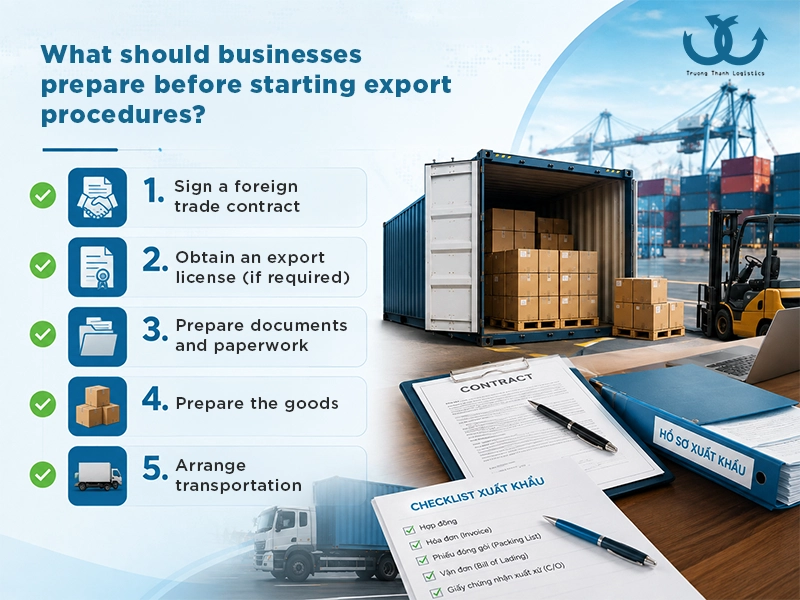
To ensure a smooth export process and minimize issues during customs clearance, businesses should proactively prepare the necessary contracts, licenses, documents, goods, and transportation arrangements. Specifically:
- Sign a foreign trade contract: Clearly agree on delivery schedules, payment methods, delivery terms, transportation methods, and the responsibilities and risks of each party.
- Obtain an export license (if required): Check the applicable goods policies to determine whether the goods require an export license. If so, the business must complete the licensing procedure before exporting the goods.
- Prepare documents and supporting records: Review and complete all documents required under applicable regulations and ensure that the information across documents is consistent to avoid issues during customs declaration.
- Prepare the goods: Check the quality, quantity, packaging specifications, and labeling to ensure that the goods meet the requirements before export.
- Arrange transportation: Contact the shipping line or carrier to make a booking, arrange containers, and agree on the time, location, and conditions for delivery and receipt of the goods.
3. What documents are required for Export Procedures for Goods?
Under the Law on Customs, a customs dossier consists of a customs declaration or a document serving as a substitute for the customs declaration, together with relevant supporting documents. The specific requirements depend on the type of goods and the particular export case.
Businesses can refer to the following groups of documents:
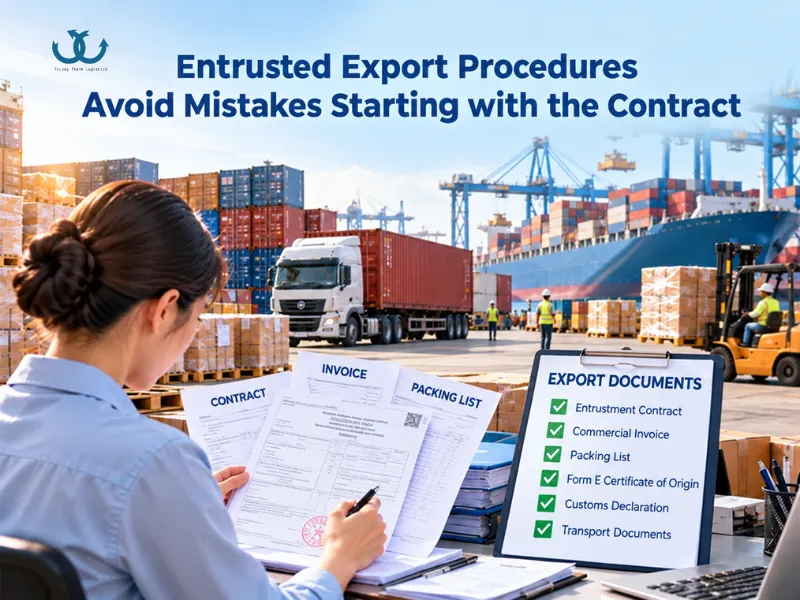
| Document | Applicable case |
| Customs declaration | The main document used to carry out customs procedures for exported goods |
| Commercial invoice or equivalent document | Where the buyer is required to make payment to the seller |
| Export license/authorization document | If the goods are subject to licensing requirements |
| Specialized inspection documents | If the goods are subject to inspection under applicable regulations |
| Documents proving export eligibility | Where the law requires the business to meet specific conditions |
| Entrusted export contract | In cases of entrusted export |
| Other specific documents | Depending on the goods, type of export, and regulatory requirements |
The above list is for general reference. Not every shipment requires all of these documents. Businesses should determine the specific regulations applicable to their goods to prepare the appropriate customs dossier.
4. Process for Export Procedures for Goods
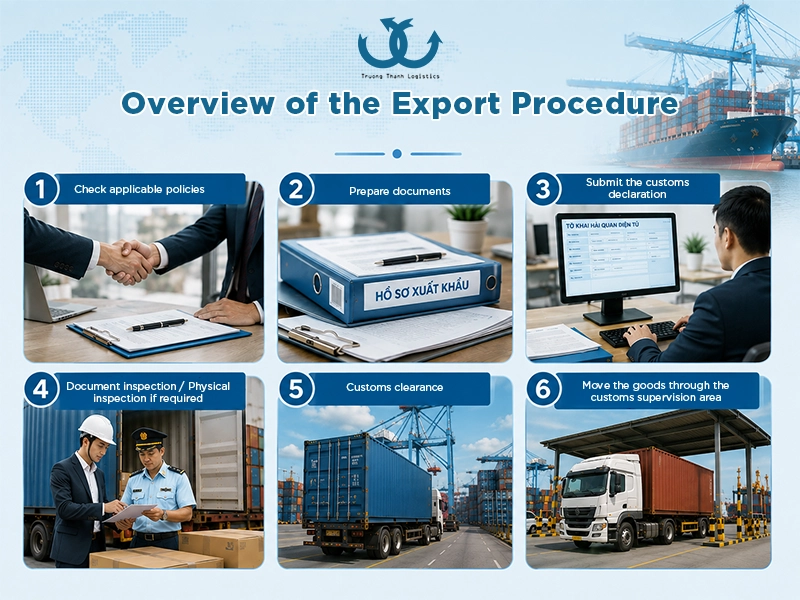
Step 1: Check Applicable Policies and Prepare the Documents
The business determines the HS code, applicable goods policies, export tax, licensing requirements, and specialized inspection requirements. It then prepares the necessary documents for the shipment.
This step should be carried out as early as possible because if the goods are subject to licensing or specialized inspection requirements, the preparation time may directly affect the export schedule.
Step 2: Submit the Customs Declaration
The customs declarant submits information about the goods through the electronic customs system in accordance with applicable regulations. Particular attention should be paid to the product name, HS code, quantity, weight, value, customs procedure type, exporter information, importer information, and transportation details.
For exported goods, the submission time must comply with the applicable declaration deadlines. Businesses should complete cargo consolidation and prepare the customs declaration within the required timeframe to avoid affecting the transportation schedule.
Step 3: Customs Authorities Receive and Inspect the Documents
After the customs declaration is registered, the Customs authority receives and examines it in accordance with applicable regulations. Depending on the results of risk management, the shipment may be subject to document inspection or proceed to physical inspection of the goods.
If the Customs authority requests additional documents or explanations, the business must fully cooperate and resolve the issue before the goods can be cleared.
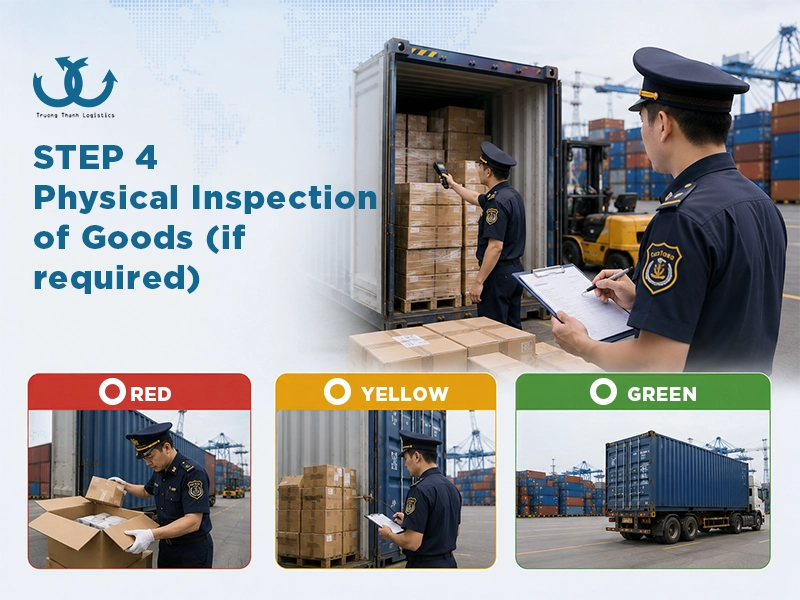
Step 4: Physical Inspection of Goods, If Applicable
If the shipment is subject to physical inspection, the business must present the complete shipment for inspection by the Customs authority.
Under regulations on the time limit for processing customs procedures, document inspection must be completed no later than 02 working hours from the time the Customs authority receives the complete dossier. Physical inspection of goods must be completed no later than 08 working hours from the time the customs declarant presents the complete goods.
For shipments involving large quantities, multiple types of goods, or complex inspection procedures, the processing time may be extended in accordance with applicable regulations.
If the goods are subject to specialized inspection, the time required for physical inspection also depends on when the Customs authority receives the results of the specialized inspection.
Step 5: Customs Clearance and Moving Goods Through the Supervision Area
After completing all requirements relating to documents, inspections, and relevant obligations, the goods are cleared in accordance with applicable regulations.
The business then proceeds with delivery and receipt arrangements, moves the goods into the supervision area, and hands them over to the carrier for export according to the planned schedule.
>>> See also: Import – Export Procedures
5. Important Considerations for Export Procedures for Goods
To facilitate a smooth customs clearance process, businesses should pay attention to the following:
- Check the applicable goods policies before planning the export.
- Determine the correct HS code and export tax, if applicable.
- Check licensing requirements and specialized inspection requirements.
- Cross-check information among the Invoice, Packing List, contract, and customs declaration.
- Check the quantity, weight, and packaging specifications before exporting the goods.
- Proactively arrange the booking, cargo loading, and cargo delivery schedule.
- Avoid declaring goods using overly general product descriptions when there is insufficient basis to determine the HS code.
- Monitor changes to regulations on customs procedures and import-export taxation.
6. Truong Thanh Logistics Supports Export Procedures for Goods
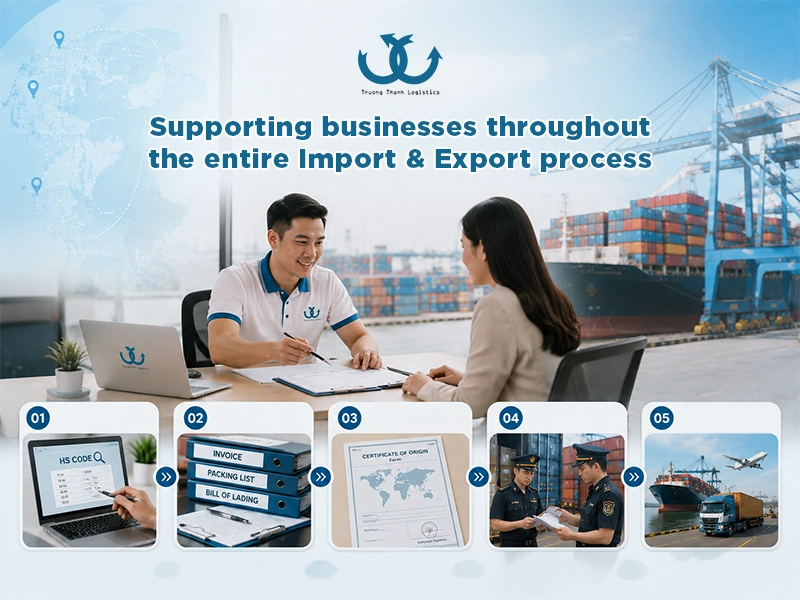
Truong Thanh Logistics accompanies businesses throughout the import-export process, providing flexible solutions ranging from HS code consultation and document preparation to C/O application services, customs declaration services, and international transportation.
Businesses can choose to handle part of the process themselves or entrust the entire process to Truong Thanh Logistics, depending on their needs and resources.
7. Frequently Asked Questions about Export Procedures for Goods
Are Exported Goods Subject to Export Tax?
Not all exported goods are subject to export tax. Businesses need to determine the correct HS code and refer to the current tariff schedule to determine whether the shipment is subject to export tax.
Is a C/O Mandatory for Export Procedures for Goods?
Not every shipment is required to have a C/O. A C/O is generally used to prove the origin of goods and may be required depending on the requirements of the importing country or customer, or to qualify for preferential tariff treatment under the relevant trade agreement.
Can Export Procedures for Goods Be Completed Electronically?
Yes. Customs declarations are primarily submitted through the electronic customs system in accordance with applicable regulations, allowing businesses to take a more proactive approach to registering and processing customs declarations.
The specific process depends on the type of procedure and the particular goods involved.
How Long Do Export Procedures for Goods Take?
Processing time is not fixed and depends on the type of goods, documentation, inspection method, and specialized requirements.
Businesses should allow additional time for obtaining licenses, undergoing specialized inspections, or supplementing and amending documents if issues arise. Therefore, businesses should check the applicable goods policies and prepare the necessary documents early to minimize delays to the export schedule.
Is your business preparing to export but unsure about the required documents, goods policies, HS codes, or customs declaration procedures? Truong Thanh Logistics can assist in reviewing shipment information and recommending an appropriate solution, helping businesses take greater control of Export Procedures for Goods and their export schedule.
Trường Thành Logistics – Professional & Dedicated
Hotline: +84 915 36 38 39
Head Office: 5th Floor, Tower A, Song Da Building, Pham Hung Street, Tu Liem Ward, Hanoi, Vietnam.
Email: sale@truongthanhjsc.com
info@truongthanhlogistics.com
Website: https://truongthanhlogistics.com
HAI PHONG BRANCH
Address: Room C103, TTC Building, 630 Le Thanh Tong Street, Hai An Ward, Hai Phong City, Vietnam.
DA NANG BRANCH
Address: 126 Chau Thi Vinh Te Street, Ngu Hanh Son Ward, Da Nang City, Vietnam.
HO CHI MINH CITY BRANCH
Address: Room 41, 4th Floor, Casanova Building, 85 Nguyen Son Street, Phu Thanh Ward, Ho Chi Minh City, Vietnam
Fanpage: TRƯỜNG THÀNH LOGISTICS