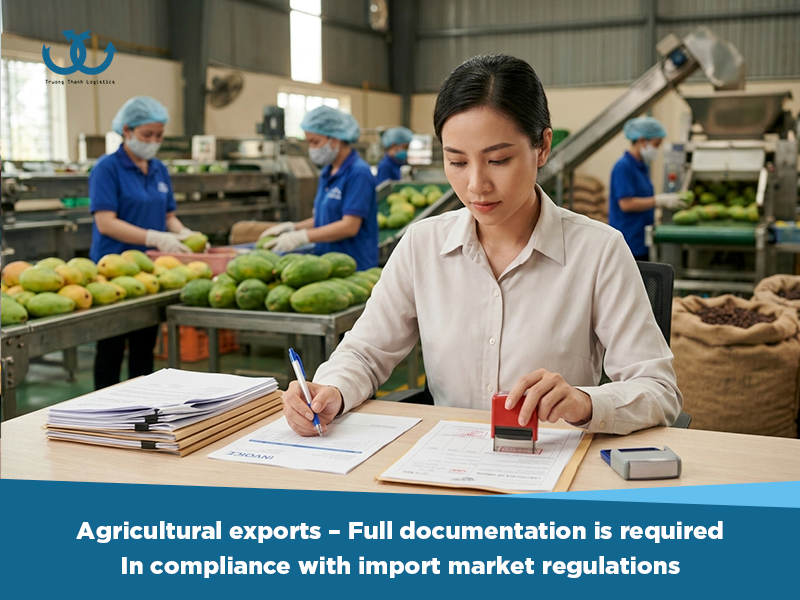
In agricultural exports, documentation is not only a legal requirement but also a critical factor that directly impacts customs clearance, delivery timelines, and a company’s reputation in international markets. In practice, many shipments are delayed or incur significant additional costs not because of product quality, but due to missing or inconsistent documentation.
So, what documents are required for agricultural export, how should they be prepared, and what key considerations should businesses keep in mind to ensure a smooth export process? The following article provides a detailed and comprehensive analysis.
1. What is an agricultural export dossier?
An agricultural export dossier is a set of legal, commercial, and technical documents used throughout the entire export process, from contract signing to customs clearance and final delivery to the importer.
This dossier serves to:
- Prove the legality of the goods
- Meet inspection and supervision requirements of customs authorities
- Support international transportation and logistics
- Provide the basis for payment between parties
A complete and accurate dossier helps businesses shorten clearance time, minimize risks, and enhance professionalism in international trade.
2. Basic commercial document group
The commercial document group forms the foundation of the entire export dossier. These documents directly reflect the international transaction between the seller and the buyer and serve as the basis for subsequent steps such as customs declaration, transportation, and payment.
A complete and accurate set of commercial documents ensures smooth export operations, legal compliance, reduced disputes, and improved business credibility.
2.1. Sales Contract
A sales contract is a legal document that records the agreement between the seller and the buyer in two different countries.
Main contents include:
- Information of both parties
- Description of goods (type of agricultural product, quality standards)
- Quantity, unit price, and total value
- Delivery terms under Incoterms (FOB, CIF, CFR, etc.)
- Payment method (T/T, L/C, etc.)
- Delivery schedule
- Dispute resolution terms
This document serves as the basis for preparing other documents and is a key legal reference in case of disputes.
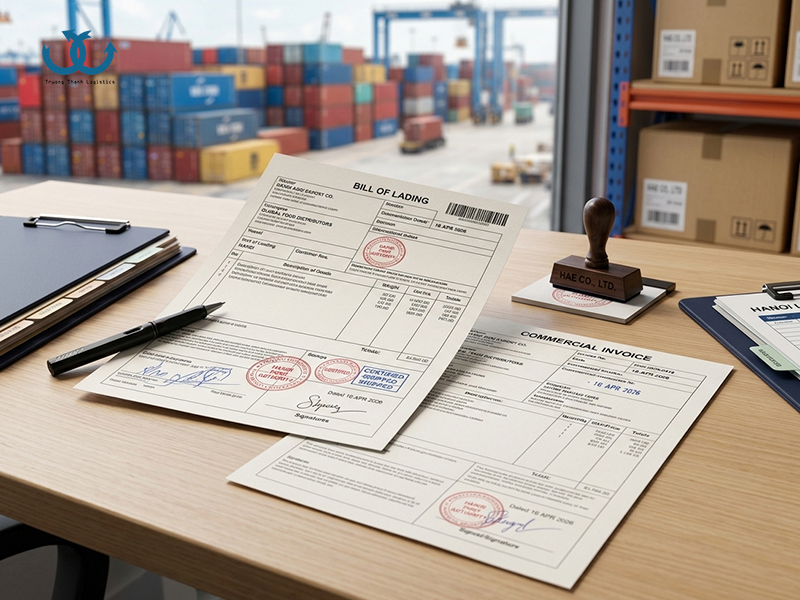
2.2. Commercial Invoice
The Commercial Invoice is issued by the seller and reflects the value of the shipment. It is used for:
- Customs declaration
- Calculation of import-export duties
- International payment processing
Required information includes:
- Product name
- Quantity and unit price
- Total value
- Delivery terms
- Seller and buyer information
2.3. Packing List
The Packing List provides detailed information on how the goods are packed.
Typical contents include:
- Number of packages
- Net weight and gross weight
- Packing specifications
- Dimensions of packages
This document supports inspection at ports and during cargo handling.
2.4. Bill of Lading
The Bill of Lading is issued by the carrier to confirm receipt of goods for transportation.
Its roles include:
- Evidence of the contract of carriage
- Document of title to the goods
- Basis for the importer to receive goods at the destination port
3. Specialized documents for agricultural products
Due to their natural origin, agricultural products must comply with strict quarantine and quality requirements.
3.1. Phytosanitary Certificate
This certificate is issued by the plant quarantine authority, confirming that the shipment is free from pests and diseases.
It is a mandatory document for most agricultural exports.
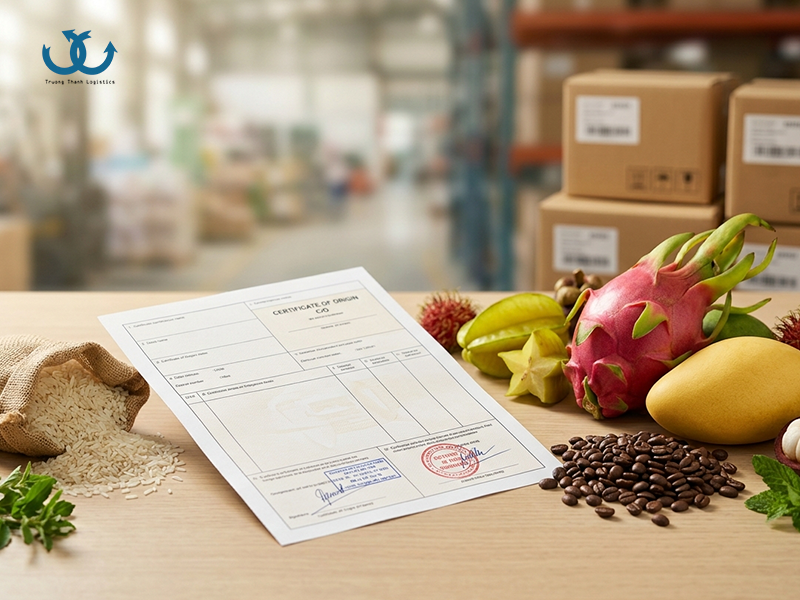
3.2. Certificate of Origin (C/O)
The Certificate of Origin identifies the origin of the goods.
Its roles include:
- Enabling preferential tariff treatment under trade agreements
- Meeting import requirements of the destination country
Businesses must apply for the correct C/O form depending on the market.
3.3. Certificate of Quality
This certificate confirms that the product meets quality standards as required by regulations or the buyer.
It may be issued by:
- Independent inspection organizations
- Specialized authorities
3.4. Fumigation Certificate
This applies to shipments with wooden packaging or those prone to pest infestation.
It certifies that the goods have been treated to eliminate harmful organisms.
4. Documents required by importing markets
Depending on the importing country or region, additional documents may be required, such as:
- Food safety certificate
- Organic certification
- Sustainability certifications (Rainforest Alliance, Fairtrade, etc.)
- Health Certificate
Examples:
- The EU has strict regulations on pesticide residue levels
- The US requires compliance with food safety authority regulations
Failure to meet these requirements may result in shipment rejection or destruction.
5. Customs declaration documents in Vietnam
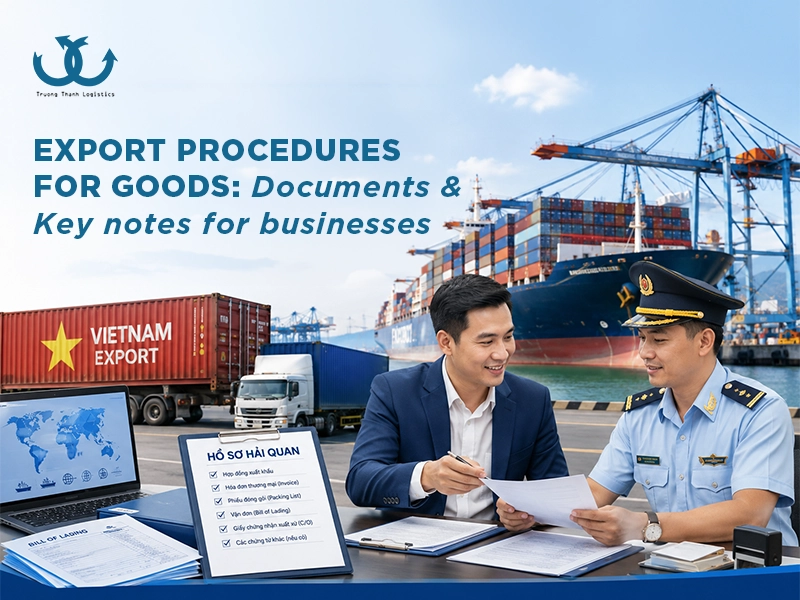
For export procedures, businesses need to prepare the following documents for customs declaration:
- Electronic customs declaration
- Sales contract
- Commercial Invoice
- Packing List
- Bill of Lading
- Phytosanitary Certificate
- Certificate of Origin (if applicable)
In some cases, customs authorities may require physical inspection of the goods.
6. Important considerations when preparing agricultural export documents
In practice, most export risks arise from documentation errors rather than product issues. Preparing documents is not only about completeness but also about accuracy, consistency, market compliance, and timing.
Below are key considerations businesses must pay attention to:
6.1. Ensure consistency across all documents
All information must be fully consistent, including:
- Product name
- Quantity
- Weight
- Dates
Even minor discrepancies can delay customs clearance or result in additional storage costs.
6.2. Understand import market requirements
Each country has different standards and requirements.
Businesses should:
- Study technical regulations in advance
- Prepare all necessary certifications
6.3. Prepare documents early and on schedule
Some documents require processing time, such as:
- Phytosanitary Certificate
- Certificate of Origin
- Certificate of Quality
Early preparation helps avoid disruptions to shipping schedules.
6.4. Maintain proper document storage
All documents should be properly stored for:
- Dispute resolution
- Post-clearance audits
7. Optimized agricultural export documentation solutions from Truong Thanh Logistics
For many businesses, especially SMEs or those new to exporting, building and managing an agricultural export dossier can be challenging due to lack of experience, documentation errors, unfamiliarity with market requirements, or unexpected costs.
In this context, partnering with a professional service provider like Truong Thanh Logistics not only helps handle procedures but also provides a comprehensive solution to optimize the entire export process.
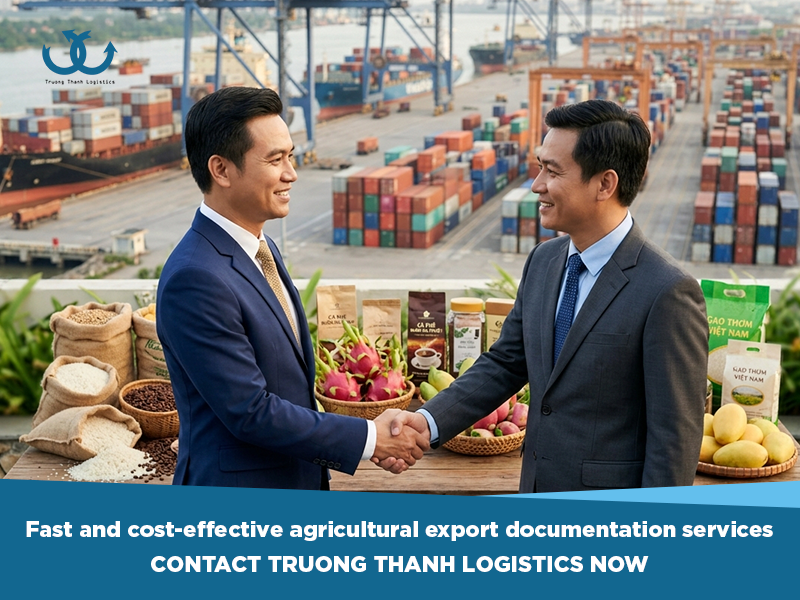
7.1. Standardizing export documentation from the beginning
Truong Thanh Logistics supports businesses in building a complete and compliant export dossier from the outset.
Services include:
- Advising on required documents for each type of agricultural product
- Guiding preparation of legal documentation
- Reviewing and standardizing Commercial Invoice and Packing List
- Ensuring consistency across all documents
This minimizes errors and reduces risks during customs clearance.
7.2. Market-specific consulting
Each market has its own documentation and technical requirements. Truong Thanh Logistics helps businesses:
- Identify required certifications (quarantine, origin, quality, etc.)
- Understand import standards of each country
- Anticipate risks related to regulations and inspections
This allows businesses to proactively prepare and avoid delays or shipment rejection.
7.3. Synchronizing documentation with logistics planning
One of Truong Thanh’s key strengths is aligning documentation with logistics operations.
This includes:
- Planning document preparation according to vessel schedules
- Monitoring certification progress
- Coordinating packing and customs clearance timelines
As a result, businesses can avoid:
- Shipping delays
- Additional storage costs
- Supply chain disruptions
7.4. Transparent cost management
Truong Thanh Logistics provides clear and structured pricing:
- Detailed quotation for each service component
- No hidden costs
- Cost optimization strategies tailored to each shipment
This enables businesses to effectively control budgets and evaluate profitability.
7.5. Long-term partnership approach
Truong Thanh Logistics goes beyond per-shipment services and focuses on long-term collaboration:
- Advising on export process improvements
- Supporting market expansion
- Continuously updating regulatory changes
This helps businesses gradually build strong and sustainable export capabilities.
Conclusion
Agricultural export documentation is a core element of the entire export process. A complete, accurate, and compliant dossier not only ensures smooth customs clearance but also enhances a company’s credibility in international trade.
In an increasingly competitive global market, investing in a well-structured documentation process is the foundation for sustainable growth and successful market expansion.