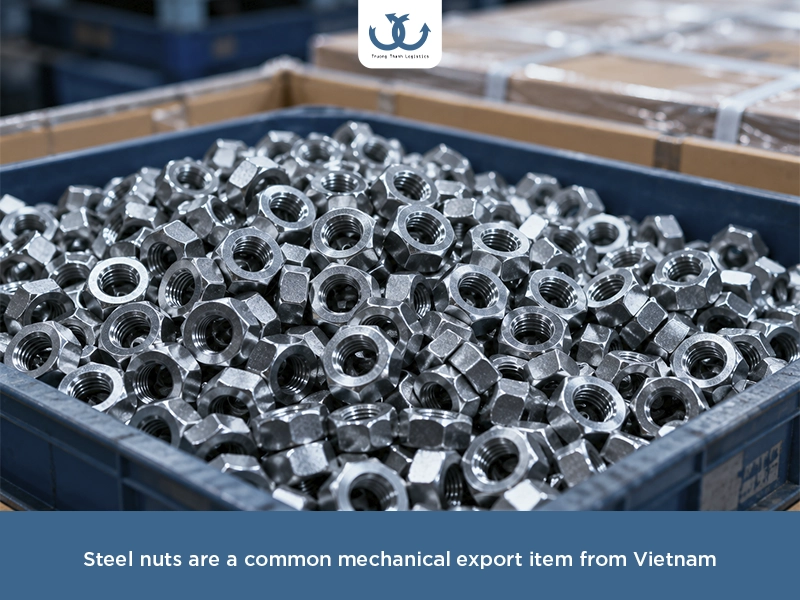
Nuts are a familiar mechanical export item from Vietnam, tied to the growth of the supporting industries, automotive, motorcycle and construction sectors. Nut export procedures are straightforward in general.
But there’s a very recent development that many exporters to the EU haven’t caught up on yet: the EU’s Carbon Border Adjustment Mechanism (CBAM) entered full operation on 1 January 2026, and nuts, bolts, and screws – as downstream steel products – fall within its scope. This article from Truong Thanh Logistics covers both the standard export procedure and this new requirement you need to prepare for.
1. HS code for nuts
Iron or steel nuts fall under heading 73.18 in Chapter 73 (articles of iron or steel), specifically under subheading 7318.16 – in the same heading group as related items like bolts (7318.15), screws (7318.14), and washers (7318.21/7318.22).
If the nut is made of a different material, the HS code changes entirely:
- Copper/copper-alloy nuts: heading 74.15.
- Aluminum nuts: heading 76.16.
- Plastic nuts: Chapter 39, depending on the specific plastic type.
Businesses should confirm the exact material and look up the correct 8-digit HS code before declaring, since the duty rate and related obligations (such as CBAM, covered in Section 3) can differ between codes.
2. Export duty and VAT
- Export duty: nuts are a processed mechanical product (unlike raw steel material, which is subject to export controls), so most codes under heading 73.18 enjoy a 0% export duty to encourage export of processed, value-added goods.
- VAT on export: 0%, provided the business has complete non-cash payment documentation as required.
- C/O at the destination market: if the partner wants to claim a preferential import duty under an FTA, the business needs to apply for the appropriate C/O (Form E under ACFTA, Form D under ATIGA, EUR.1 under the EVFTA…) depending on the export market.
3. The most important note: CBAM for nut exports to the EU
This is a point many businesses exporting nuts, bolts, and screws to the EU haven’t caught up on yet, since it’s a very recent regulation.
The EU’s CBAM (Carbon Border Adjustment Mechanism) went through a transitional phase (reporting only, no charges) from 1 October 2023 through 31 December 2025, and entered full operation on 1 January 2026. From that point, EU importers must purchase CBAM certificates to offset the embedded carbon emissions in imported goods.
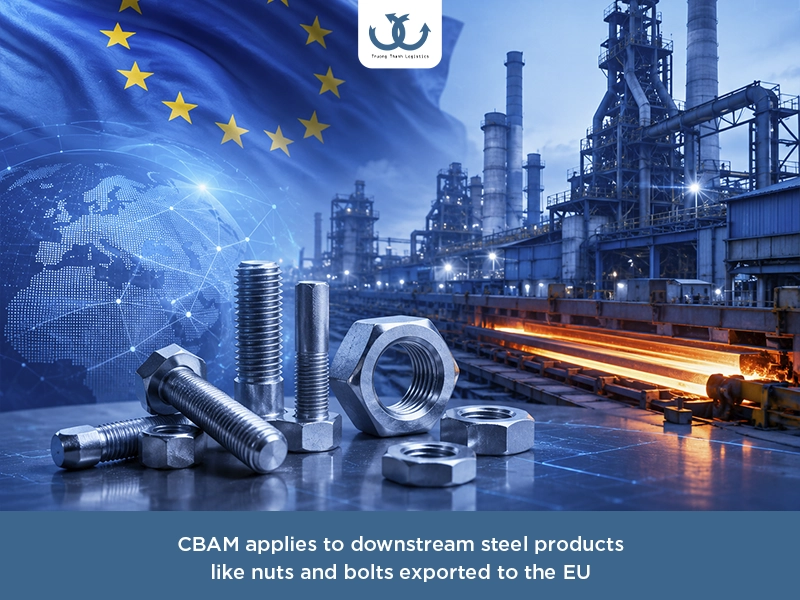
Initially, CBAM applied only to raw materials (iron and steel, aluminum, cement, fertilizers, electricity, hydrogen). But importantly, CBAM has now expanded to cover downstream (further-processed) products of iron, steel, and aluminum – including nuts, bolts, and screws – not just raw material. The first official emissions declaration deadline under the new mechanism is 30 September 2027.
What does this mean for businesses exporting nuts to the EU?
- EU importers will ask Vietnamese businesses to provide primary greenhouse gas emissions data (from the manufacturer) for the nut production process, rather than relying solely on the EU’s default values (which carry a higher certification cost).
- Businesses should proactively build an internationally standardized greenhouse gas emissions inventory system as early as possible, rather than waiting until close to the reporting deadline.
- This isn’t a requirement from Vietnam Customs at export – it’s an obligation that falls on the EU importer – but it directly affects whether the EU partner continues the contract.
4. Trade defense and origin-fraud risks to watch
According to Ministry of Industry and Trade data, as of the end of May 2026, Vietnamese exports had faced a total of 321 trade defense investigations from 27 markets, with the EU emerging as a key focus area alongside the US, Canada, and Mexico.
Steel products and downstream steel products (including nuts and bolts) are a category frequently scrutinized by major markets over country-of-origin concerns, due to worries about raw steel from a third country being lightly processed in Vietnam and re-exported to avoid duties.
Businesses exporting nuts should:
- Keep complete documentation proving the origin of the steel raw material and the manufacturing steps carried out in Vietnam.
- Ensure the value added in Vietnam meets the rules of origin for the C/O being applied for, to avoid being suspected of merely simple processing (assembly, packaging) without meeting the tariff classification change or local content criteria required.
5. Customs documents required for metal nut export procedures
- Export customs declaration
- Commercial contract (Sales Contract)
- Commercial invoice
- Packing list
- Bill of lading
- Certificate of origin (C/O) – as required by the importing partner
- Catalogue and technical specifications (material, dimensions, strength grade) – to support accurate HS classification and any origin-verification requests
6. Frequently asked questions – Nut export procedures
Is CBAM a tax collected by Vietnam Customs when exporting nuts?
No. CBAM is an EU mechanism that applies to EU importers when they bring goods into the EU market. Vietnamese businesses don’t pay CBAM directly, but they need to provide emissions data to their importing partner so the partner can fulfill their declaration obligation.
Do exported nuts require any special license?
No, nuts aren’t on the list of prohibited or restricted export goods and are processed like ordinary goods – aside from the CBAM requirement noted above if exporting to the EU.
Can I still export nuts to the EU if I don’t have a carbon emissions inventory system yet?
Yes, in the short term, but the EU importer may need to use default emission values (usually at a higher cost) if the business can’t provide actual data – over time, this could affect price competitiveness compared to competitors who already have their data ready.
Are nut exports at risk of trade defense investigations?
Steel and downstream steel products in general are under tighter origin scrutiny from many markets, so businesses should prepare thorough documentation proving the origin of raw materials and the extent of processing carried out in Vietnam.
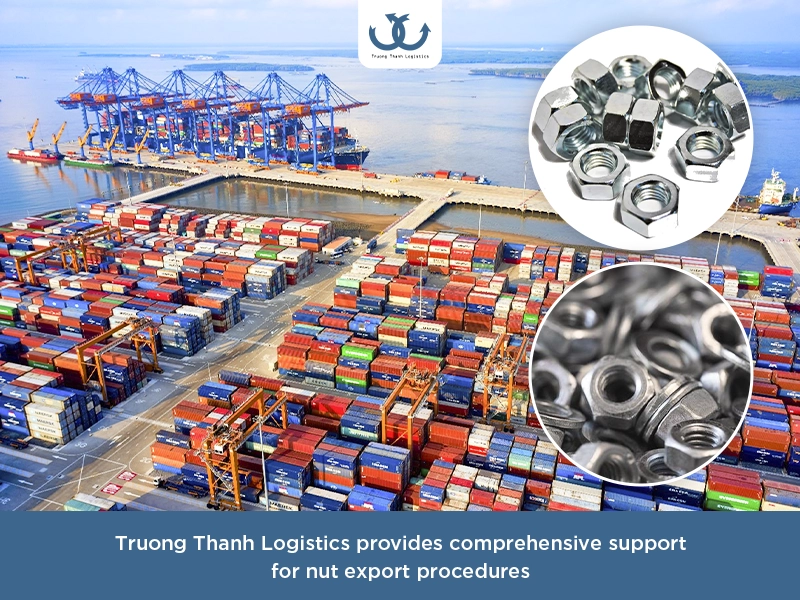
7. Truong Thanh Logistics – Comprehensive fastener nut export procedures support
Truong Thanh Logistics helps businesses export nuts and other mechanical products with:
- Advice on determining the correct HS code based on material and construction
- Assistance applying for the right C/O for each market and trade agreement
- Updates on new requirements from importing markets (such as CBAM in the EU) so businesses can prepare proactively
- International sea and road transport at competitive rates
If your business needs specific advice on nut export procedures for an upcoming shipment, especially the new requirements for exporting to the EU, contact Truong Thanh Logistics directly:
Trường Thành Logistics – Professional & Dedicated
Hotline: +84 915 36 38 39
Head Office: 5th Floor, Tower A, Song Da Building, Pham Hung Street, Tu Liem Ward, Hanoi, Vietnam.
Email: sale@truongthanhjsc.com
info@truongthanhlogistics.com
Website: https://truongthanhlogistics.com
HAI PHONG BRANCH
Address: Room C103, TTC Building, 630 Le Thanh Tong Street, Hai An Ward, Hai Phong City, Vietnam.
DA NANG BRANCH
Address: 126 Chau Thi Vinh Te Street, Ngu Hanh Son Ward, Da Nang City, Vietnam.
HO CHI MINH CITY BRANCH
Address: Room 41, 4th Floor, Casanova Building, 85 Nguyen Son Street, Phu Thanh Ward, Ho Chi Minh City, Vietnam
Fanpage: TRƯỜNG THÀNH LOGISTICS
You can also read 6 Rules of Goods Classification (HS Code Application) to better understand how to determine accurate HS codes for mechanical products.
References:
- Vietnam’s Import-Export Tariff Schedule – Chapters 39, 73, 74, 76
- Regulation (EU) 2023/956 on the Carbon Border Adjustment Mechanism (CBAM)
- Vietnam Ministry of Industry and Trade trade-defense statistics (as of May 2026)
Note: This article is for general reference, compiled based on legal regulations and international practice at the time of publication. CBAM requirements, HS codes, export duty, and trade defense measures may change over time; businesses should contact Truong Thanh Logistics or the relevant authority directly for the most accurate, up-to-date information for their specific shipment.