Official export has become an inevitable choice for Vietnamese enterprises amid deep international integration, where requirements for transparency in product origin, quality, and legal compliance are increasingly stringent. However, for businesses conducting official exports for the first time, a lack of experience and insufficient understanding of procedures and regulations can lead to significant risks in terms of costs, timelines, and legal compliance.
So what exactly is official export? What should businesses prepare, and what are the key considerations to avoid mistakes from the very beginning? The following article provides a comprehensive and practical overview to help you get started correctly.
1. Properly Understanding Official Export Before Getting Started
Before carrying out any export activities—especially for businesses entering the international market for the first time—having a correct and comprehensive understanding of official export is the most important foundation. Many risks arise not from complex procedures, but from incorrect perceptions at the outset.
Official export refers to the shipment of goods abroad through lawful commercial channels that are recognized by both Vietnamese law and the importing country’s regulations. The entire export process must be conducted under a clear foreign trade contract, accompanied by complete invoices, supporting documents, customs declarations, and the fulfillment of all relevant tax and fee obligations.
Unlike informal or border trade methods, official export places businesses within a standardized legal framework. This means:
- Goods are legally protected during international circulation
- Businesses have a clear legal basis in the event of commercial disputes
- Long-term and sustainable cooperation with foreign partners is easier to establish
A common misconception among first-time exporters is that official export simply involves “additional paperwork.” In reality, it is a complete international business activity that requires compliance with multiple regulatory systems simultaneously, including Vietnamese law, customs regulations, tax policies, and the standards of the importing market.
Beyond legal compliance, official export also reflects a company’s capability and level of professionalism. For major and demanding markets such as the EU, the United States, Japan, or South Korea, official export is almost a mandatory requirement. International partners typically do not engage in long-term cooperation with businesses that lack transparency in product origin, documentation, and legal responsibility.
Moreover, choosing official export from the outset helps businesses:
- Proactively build product brands in international markets
- Take advantage of free trade agreements through preferential Certificates of Origin (C/O)
- Establish a solid foundation for long-term export expansion
However, these benefits come with the need for thorough preparation. Businesses must recognize that official export is not suitable for a “quick and short-term” mindset. Instead, it requires a structured, well-planned approach and strict compliance with procedures.
A proper understanding of official export from the beginning helps businesses avoid complacency and choose the right strategy—whether to handle the process internally or cooperate with professional logistics and export outsourcing providers. This is a crucial “foundation-laying” step to ensure subsequent stages proceed smoothly and effectively.
2. Clearly Determining Whether the Exported Goods Are Eligible
Before considering contracts, transportation, or target markets, businesses must answer a decisive question: are the intended goods eligible for official export? This foundational step is often underestimated, leading to serious risks during implementation.
In official export, not all goods are freely exportable. Depending on their nature, use, and origin, each product category is subject to different regulatory policies under both Vietnamese law and the importing country’s regulations.
First, businesses must check whether the goods fall under prohibited or restricted export categories under Vietnamese regulations. For goods subject to special management, export is only permitted once all required conditions are met and licenses are issued by competent authorities. Skipping this step may result in cargo being denied customs clearance at the declaration stage.
Next, businesses must determine whether the goods are subject to specialized inspection. Many product categories exported through official channels require additional documentation, such as:
- Phytosanitary or veterinary certificates
- Food safety certificates
- Quality inspection, conformity, or standard compliance results
- Licenses issued by relevant ministries or authorities
For agricultural products, processed foods, natural-origin products, and consumer goods, specialized inspection requirements are often particularly stringent. First-time exporters who are unfamiliar with these requirements may easily encounter “missing documentation” issues, causing cargo to be held at ports, incurring storage costs, and delaying delivery schedules.
Beyond Vietnamese regulations, businesses must carefully study the import requirements of the destination market. Each country or region has its own standards regarding:
- Product quality
- Food safety, residue limits, and ingredient composition
- Packaging, labeling, and language requirements
- Traceability and accompanying certifications
There are many cases where goods are legally exportable from Vietnam but fail to meet the importing country’s standards, resulting in rejection or forced re-export, causing substantial losses for businesses.
A frequently overlooked issue among new exporters is consistency between the actual nature of the goods and the declared documentation. Product names, descriptions, and compositions must accurately reflect reality. Vague declarations, misrepresentation, or intentional simplification to bypass procedures can lead to serious legal consequences.
Additionally, businesses should assess the stability of their supply sources. Official export is not suitable for goods with unstable supply or inconsistent quality control. Foreign partners typically require consistent quality and long-term supply capability, not just one-off shipments.
3. Preparing Complete Export Documentation
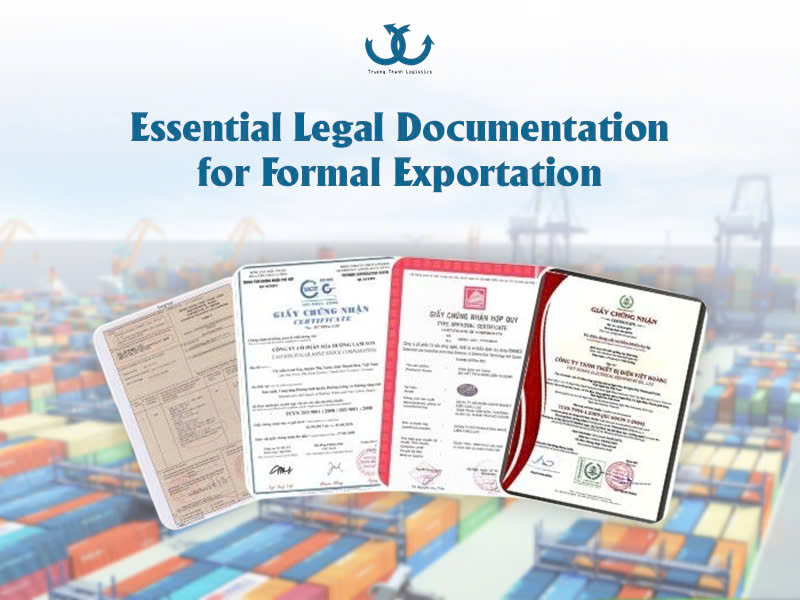
One of the biggest challenges for first-time exporters is documentation. Official export dossiers typically include:
- Foreign trade contract
- Commercial Invoice
- Packing List
- Export customs declaration
- Bill of Lading / Airway Bill
- Certificate of Origin (C/O), if required by the market
- Specialized inspection documents (if applicable)
Businesses must ensure absolute consistency across all documents, avoiding discrepancies in product names, quantities, values, or HS codes, as these are common causes of customs clearance delays.
4. Special Attention to HS Codes and Tax Policies
HS codes are the “backbone” of official export operations. Incorrect HS classification can result in:
- Incorrect export tax application
- Back tax assessments and administrative penalties
- Delayed clearance or forced re-declaration
First-time exporters should:
- Determine HS codes based on the actual nature of the goods
- Cross-check with the current export tariff schedule
- Consult experienced logistics providers or customs experts to mitigate risks
This is not a step that should be handled based on assumptions or unverified references.
5. Choosing Appropriate Transportation Methods and Delivery Terms
Official export is closely linked to the selection of suitable Incoterms and transportation modes (sea transport, air freight, road transport, etc.).
First-time exporters should:
- Clearly define responsibilities, costs, and risks under each delivery term
- Avoid selecting Incoterms beyond their control capabilities
- Carefully calculate logistics costs to prevent unexpected expenses
Incorrect Incoterm selection can expose businesses to unnecessary costs and risks.
6. Ensuring Compliance with Importing Country Regulations
A common mistake among new exporters is focusing solely on Vietnamese procedures while overlooking the regulations of the importing country.
Each market has specific requirements regarding:
- Labeling and language presentation
- Quality and safety certifications
- Packaging and traceability regulations
Failure to comply may result in goods being rejected upon arrival, even if they have already cleared export customs in Vietnam.
7. Should You Handle Official Export Yourself the First Time?
For many new exporters, a common question is whether to handle the entire official export process internally to save costs. In reality, this is a strategic decision that directly affects efficiency, risk exposure, and long-term growth.
Official export is not merely about filing a customs declaration or booking transportation. It is an interconnected process involving product policy assessment, HS classification, document preparation, customs procedures, specialized inspections, Incoterm selection, international transport coordination, and issue resolution. For first-time exporters, a lack of experience at any stage can cause delays or unexpected costs.
Self-Handling: Cost Savings or Hidden Risks?
Handling the process internally may be suitable for businesses that already have:
- A dedicated import–export department
- Staff knowledgeable in customs law and product policies
- Practical experience in documentation and issue handling
However, first-time official exporters often face risks such as:
- Incorrect HS classification and tax application
- Missing or incorrect documents causing cargo to be held at ports
- Insufficient understanding of importing country regulations
- Storage, demurrage, and document amendment costs
- Loss of credibility with partners due to delivery delays
These risks can far outweigh the cost of engaging professional service providers, especially for initial shipments that serve as a gateway to new markets.
A Safe Solution for First-Time Exporters
For businesses with limited experience, partnering with a reputable logistics and export outsourcing provider is the optimal solution to ensure smooth, lawful, and time-efficient export operations.
At Truong Thanh Logistics, first-time exporters receive comprehensive, end-to-end support that goes beyond basic customs procedures. Truong Thanh provides:
- Consultation on suitable export policies for each product
- Verification of legal eligibility and specialized inspection requirements
- HS code, export tax, and documentation advisory
- Execution of official export customs clearance
- International transport coordination and issue handling
Truong Thanh Logistics’ export outsourcing service is implemented under a representative model, whereby the company acts on behalf of the exporter to carry out the entire official export process. Truong Thanh directly undertakes all necessary procedures, from legal eligibility checks and policy consultation to document preparation, customs declaration, international transport coordination, and clearance issue resolution.
Entrusting Truong Thanh Logistics helps first-time exporters minimize legal risks and avoid common errors related to HS codes, documentation, or specialized inspections—factors that frequently cause delays and significant additional costs. At the same time, businesses can operate without immediately investing in a dedicated import–export department while still ensuring transparent, compliant, and professional export operations.
This export outsourcing model is particularly suitable for small and medium-sized enterprises, businesses newly expanding into international markets, or those handling exploratory shipments. With Truong Thanh Logistics as a partner, businesses can focus on production, sales, and market development, while the entire official export process is tightly managed by an experienced logistics provider.
Contact Truong Thanh Logistics today for detailed consultation tailored to each product and target market.