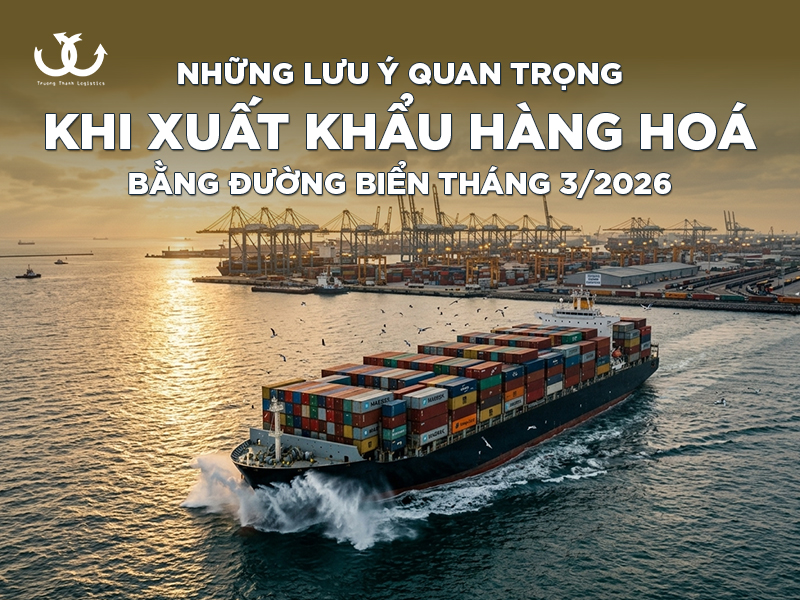
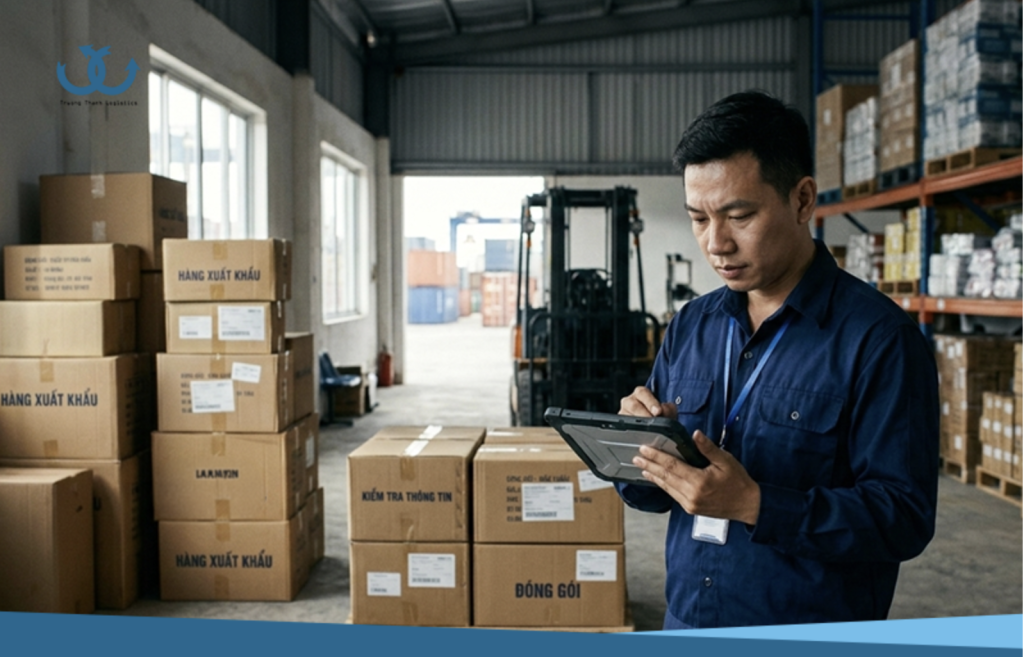
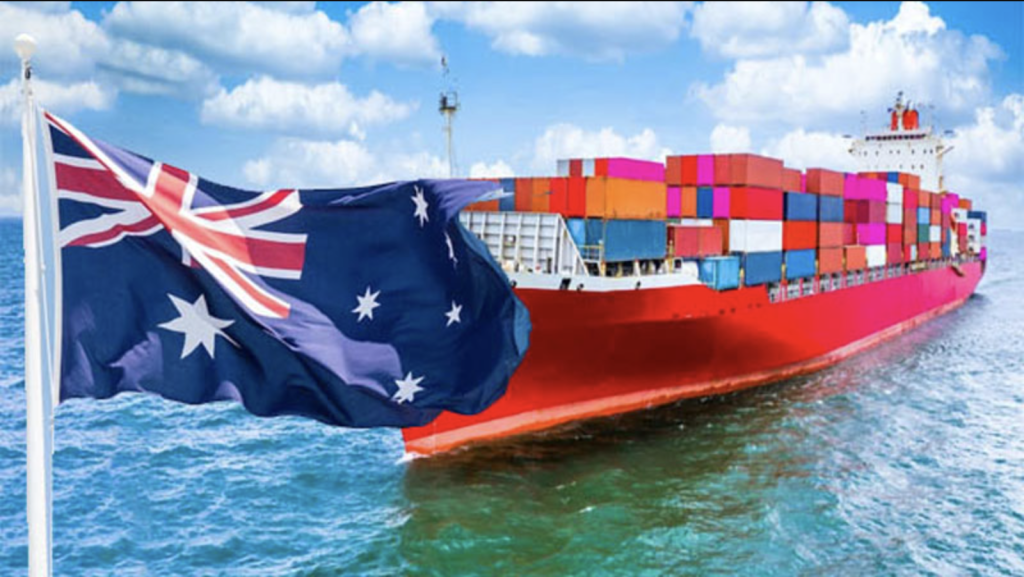
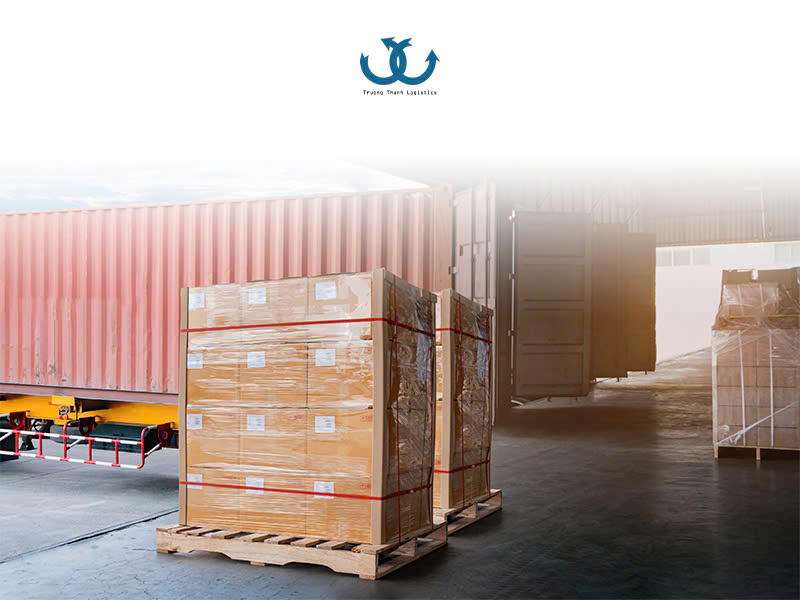
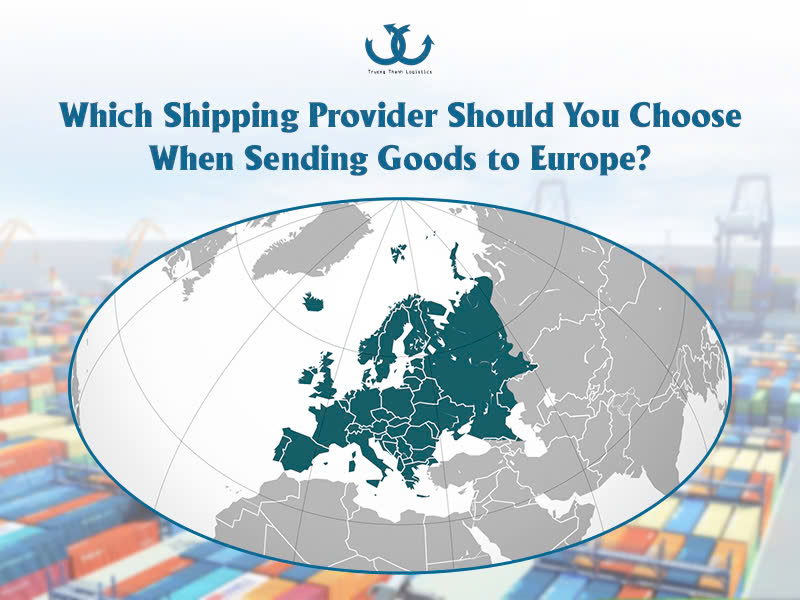
Agricultural exports are becoming one of the key sectors, generating significant revenue for many Vietnamese enterprises. With advantages in climate, soil conditions, and abundant raw materials, Vietnamese agricultural products are increasingly present in demanding markets such as the United States, the EU, and Japan.
However, bringing agricultural products to international markets is not simply about production and sales. Businesses must clearly understand legal procedures, choose appropriate transportation methods, and pay attention to critical considerations to ensure smooth customs clearance, cost optimization, and risk minimization.
1. Overview of Agricultural Exports
Agricultural exports refer to the activity of bringing agricultural products to international markets through various trade methods such as direct export, entrusted export, or via intermediaries.
This is not merely a trading activity but a closed-loop process that includes:
production – harvesting – preprocessing – quality inspection – packaging – transportation – customs clearance – distribution in foreign markets.
In the context of global economic integration, agricultural exports play an important role in:
- Businesses: expanding markets, increasing revenue, enhancing brand value
- The agricultural sector: promoting production aligned with international standards
- The economy: significantly contributing to national export turnover
However, this sector also requires strict compliance in terms of:
- Food quality and safety
- Traceability
- Market-specific technical standards
- Preservation and cross-border logistics capabilities
Common Exported Agricultural Products
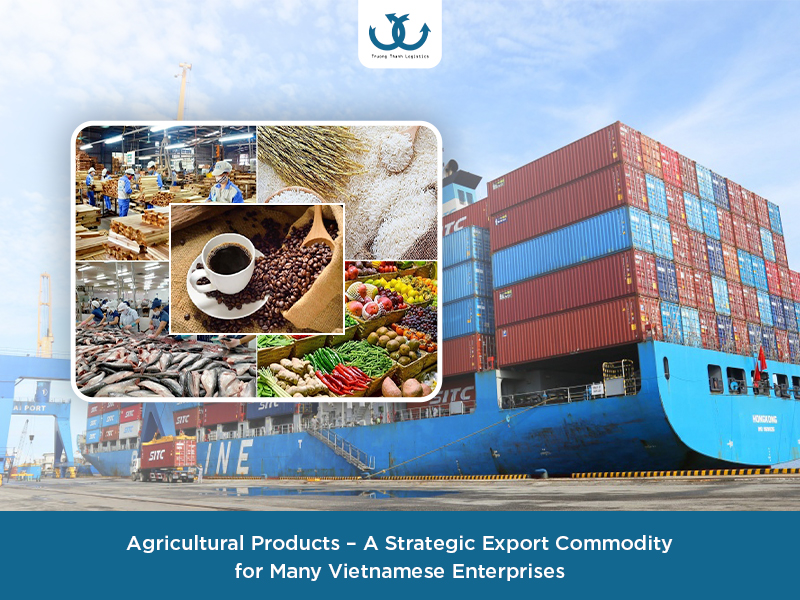
- Fresh fruits: mango, dragon fruit, banana, durian
- Dry agricultural products: coffee, pepper, cashew nuts, rice
- Processed products: juice, canned fruits, dried products
Each type of agricultural product has specific requirements for preservation, transportation, and import standards depending on the destination country.
2. Detailed Procedures for Agricultural Exports
Exporting agricultural products involves a multi-step process, including legal compliance, quality inspection, customs declaration, and international transportation arrangements. Proper and complete execution of these steps helps ensure fast customs clearance while minimizing risks such as delays, additional costs, or rejection at destination.
Below is the detailed process businesses need to follow:
2.1. Verify Export Eligibility and Market Requirements
Before exporting, businesses must determine whether the product is eligible for export and carefully study the regulations of the importing market.
Key aspects to review include:
- Phytosanitary regulations of the importing country
- Maximum residue limits (MRLs) for pesticides
- Requirements for growing area codes and packing facilities
- Labeling, packaging, and traceability requirements
- Mandatory technical standards or certifications
This is a critical step to avoid the risk of goods being rejected at the importing country’s border.
2.2. Prepare Export Documentation
Documentation plays a crucial role in determining the speed of customs clearance. A complete export document set typically includes:
Commercial documents
- Sales Contract
- Commercial Invoice
- Packing List
Transport documents
- Bill of Lading or Airway Bill
Legal and inspection documents
- Certificate of Origin (C/O)
- Phytosanitary Certificate
Additional documents (depending on market requirements)
- Quality Certificate
- Food Safety Certificate
- International certifications such as HACCP, GlobalGAP, FDA
All documents must be accurate and consistent. Even minor discrepancies can lead to delays or additional inspections.
2.3. Phytosanitary Inspection and Quality Control
For agricultural products, inspection is mandatory before export.
Businesses are required to:
- Register for phytosanitary inspection with relevant authorities
- Check for pests, diseases, and contamination
- Assess food safety compliance
Additional checks may include:
- Chemical residue levels
- Food hygiene and safety standards
- Packaging specifications
Once compliant, the competent authority will issue a Phytosanitary Certificate, which is a mandatory document for export.
2.4. Electronic Customs Declaration
After completing the documentation, businesses proceed with customs declaration via the electronic system.
The process includes:
- Entering customs declaration information
- Submitting supporting documents
- Waiting for cargo classification results
Customs classification typically falls into three categories:
- Green channel: immediate clearance
- Yellow channel: document inspection
- Red channel: physical inspection of goods
Processing time depends on the accuracy of the documentation and the company’s compliance history.
2.5. Customs Clearance
After completing the required inspections, customs authorities will approve clearance if all requirements are met.
Businesses need to:
- Fulfill tax and fee obligations (if applicable)
- Obtain customs clearance confirmation
- Prepare goods for shipment to port or airport
This step confirms that the goods are eligible for export.
2.6. International Transportation Arrangement
After clearance, goods are transported to the port or airport for export.
Key tasks include:
- Booking space with shipping lines or airlines
- Arranging appropriate container loading
- Monitoring domestic and international transportation
For fresh agricultural products, special attention must be paid to:
- Temperature control throughout transit
- Timely delivery according to schedule
- Minimizing physical damage
2.7. Post-Shipment Documentation and Payment
After shipment, businesses must:
- Send the document set to the importer
- Execute payment according to contract terms
- Retain documents for verification and auditing
Depending on the payment method (T/T, L/C), document handling requirements may vary.
3. Common Transportation Methods for Agricultural Products
Selecting the appropriate transportation method is crucial, as it directly affects product quality, delivery time, and logistics costs.
Businesses should consider factors such as product characteristics, shelf life, distance, and budget.
Common transportation methods include:
3.1. Sea transport
- Suitable for large-volume shipments
- Cost-effective
- Longer transit time
- Often uses reefer containers for fresh products
3.2. Air Freight
- Fastest transportation method
- Suitable for perishable goods
- High cost
3.3. Road / Rail Transport
- Suitable for nearby markets such as China and ASEAN
- Flexible with moderate transit time
4. Key Considerations for Agricultural Exports
Although agricultural exports offer great potential, they also involve significant risks if not properly managed.
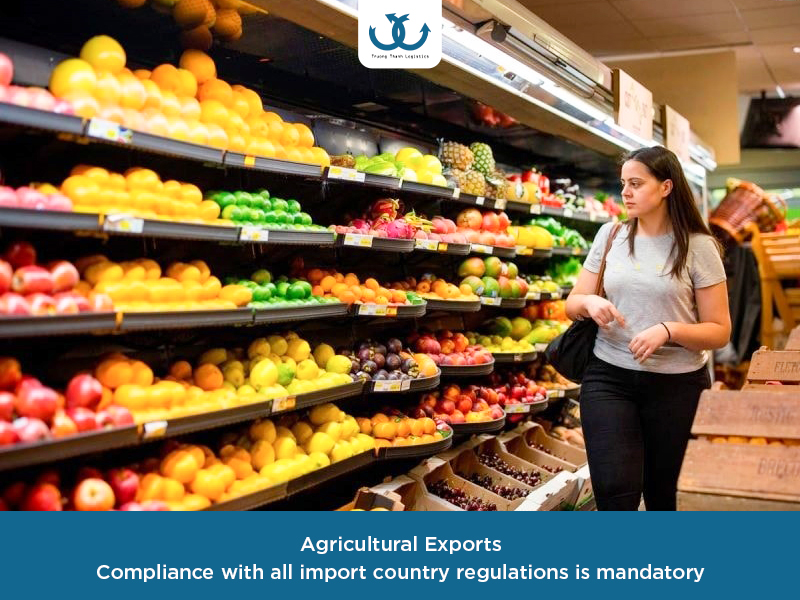
4.1. Understand Import Market Standards
Each country has its own regulations. Non-compliance may result in rejection, destruction, or return of goods.
Businesses must comply with:
- Pesticide residue regulations
- Phytosanitary requirements
- Food safety standards
- Traceability requirements
- Labeling and packaging standards
Markets such as the US, EU, and Japan have particularly strict and frequently updated regulations.
4.2. Ensure Product Quality from the Source
Quality control must begin from production and harvesting stages.
Key factors include:
- Cultivation processes and agrochemical usage
- Harvesting and preprocessing conditions
- Control of ripeness, moisture, size, and uniformity
4.3. Comply with Growing Area Codes and Packing Facility Requirements
Many markets require:
- Approved growing area codes
- Certified packing facilities
Failure to comply may result in rejection at the borde
4.4. Choose Appropriate Packaging and Preservation Methods
Proper packaging and preservation directly impact product quality.
Key considerations:
- Use export-standard packaging materials
- Design packaging suitable for each product type
- Control temperature and humidity
- Minimize physical damage
For fresh products, maintaining a continuous cold chain is essential.
5. Effective Agricultural Export Solutions for Businesses
In an increasingly competitive global market, exporting agricultural products requires more than just having quality goods. Businesses need a comprehensive solution that integrates market knowledge, standardized procedures, and professional logistics systems.
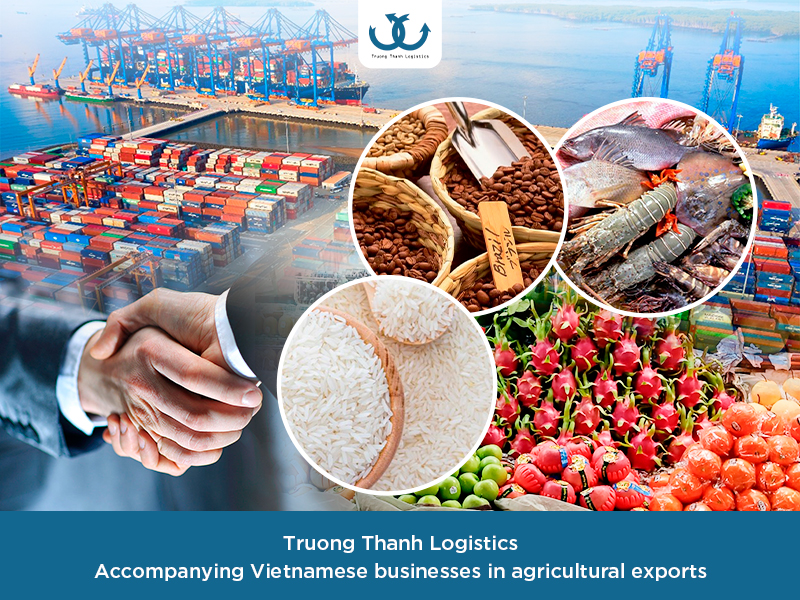
This is why many companies choose to partner with Truong Thanh Logistics as a trusted export partner.
5.1. End-to-End Export Solutions
Truong Thanh Logistics provides comprehensive services to optimize the entire export process:
- Consulting on export requirements by product and market
- Assisting in preparing complete documentation
- Supporting inspection and quality control
- Handling customs declaration efficiently and accurately
- Organizing suitable international transportation
Businesses benefit from a single point of contact instead of coordinating with multiple service providers.
5.2. Optimized Transportation Solutions
Each agricultural product requires a tailored transportation approach.
Truong Thanh Logistics supports:
- Selecting appropriate transport modes (sea, air, road, multimodal)
- Advising on the use of reefer or dry containers
- Planning optimal shipping schedules
Especially for fresh products:
- Maintaining a continuous cold chain
- Monitoring temperature and storage conditions
- Minimizing damage risks during transit
5.3. Faster Customs Clearance and Risk Reduction
Delays in procedures can significantly impact product quality.
With practical experience, Truong Thanh Logistics helps:
- Standardize documentation from the beginning
- Increase the likelihood of green channel clearance
- Handle issues promptly at border checkpoints
5.4. Market Advisory and Export Capacity Building
Beyond logistics, the company also supports:
- Updating the latest import regulations
- Advising on technical standards and certifications
- Building structured and sustainable export processes
5.5. Cost Optimization
Logistics costs significantly impact profitability.
Truong Thanh Logistics helps:
- Optimize transportation routes
- Reduce storage and container detention costs
- Minimize additional costs due to procedural errors
5.6. Long-Term Partnership
Agricultural exports require a long-term strategy. Truong Thanh Logistics acts as a strategic partner, not just a service provider.
Businesses receive:
- End-to-end support
- Continuous advisory on market changes
- Flexible solutions for each growth stage
To export agricultural products effectively, businesses need more than just a logistics provider. They need a partner that understands the market, masters procedures, and optimizes the entire logistics chain.
With experience and comprehensive solutions, Truong Thanh Logistics helps businesses:
- Shorten export timelines
- Ensure product quality
- Optimize costs and reduce risks
This creates a solid foundation for expanding into global markets and enhancing the value of Vietnamese agricultural products worldwide.
Trường Thành Logistics – Professional & Dedicated
Hotline: +84 915 36 38 39
Head Office: 5th Floor, Tower A, Song Da Building, Pham Hung Street, Tu Liem Ward, Hanoi, Vietnam.
Email: sale@truongthanhjsc.com
info@truongthanhlogistics.com
Website: https://truongthanhlogistics.com
HAI PHONG BRANCH
Address: Room C103, TTC Building, 630 Le Thanh Tong Street, Hai An Ward, Hai Phong City, Vietnam.
DA NANG BRANCH
Address: 126 Chau Thi Vinh Te Street, Ngu Hanh Son Ward, Da Nang City, Vietnam.
HO CHI MINH CITY BRANCH
Address: Room 41, 4th Floor, Casanova Building, 85 Nguyen Son Street, Phu Thanh Ward, Ho Chi Minh City, Vietnam